A Complete Guide to VMC for BIMI

Quick Answer
A Verified Mark Certificate (VMC) for BIMI helps organizations display their verified brand logo in supported email inboxes, improving trust, brand visibility, and email engagement. This guide explains how VMC works with BIMI, DMARC, and trademark requirements to strengthen email authentication and brand credibility.
Try Our Free BIMI Checker
Verify your BIMI record and check VMC certificate status.
Check BIMI Record →
Email security and brand trust have become more important than ever. Customers are constantly exposed to phishing attacks, spoofed emails, and fake sender identities. Because of this, businesses are looking for ways to make their emails instantly recognizable and trustworthy. One of the most effective ways to achieve this is through BIMI and Verified Mark Certificates (VMCs).
A VMC helps organizations display their verified brand logo directly inside supported email inboxes. When recipients see a familiar and authenticated logo next to your email, confidence increases and the chances of engagement improve significantly.
This guide explains everything you need to know about VMC for BIMI, including how it works, why it matters, setup requirements, benefits, limitations, and implementation best practices.
Understanding BIMI
BIMI, short for Brand Indicators for Message Identification, is an email specification that allows organizations to display their official logo beside outgoing emails in supported mailbox providers.
Instead of showing a generic avatar or empty sender icon, BIMI-enabled emails can display a company’s authenticated brand image. This gives recipients immediate visual confirmation that the message is legitimate.
BIMI works together with email authentication standards such as:
Without proper email authentication, BIMI cannot function correctly. If SPF, DKIM, and DMARC are unfamiliar, our glossary of SPF terms is a helpful starting point.
What Is a Verified Mark Certificate (VMC)?
A Verified Mark Certificate is a digital certificate that verifies ownership of a brand logo and confirms that the sender has permission to use it in email communications.
The certificate is issued by an approved certification authority after the organization completes a verification process. Once issued, the VMC is linked to the sender’s BIMI record.
A VMC proves two important things:
- The organization owns the sending domain.
- The organization owns the trademarked logo being displayed.
This additional layer of validation helps mailbox providers trust the displayed logo.
Why VMCs Matter for BIMI
Although some mailbox providers may support BIMI without a certificate, major providers like Gmail often require a VMC before displaying logos consistently.
A VMC strengthens trust because it prevents attackers from impersonating legitimate brands using fake logos.
Without verification, anyone could potentially publish a misleading image in their BIMI record. The VMC process reduces this risk through legal and technical validation.
How BIMI and VMC Work Together
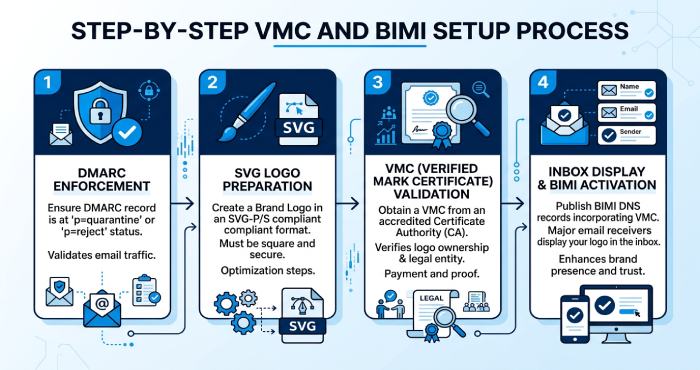
The process involves several connected technologies working together.
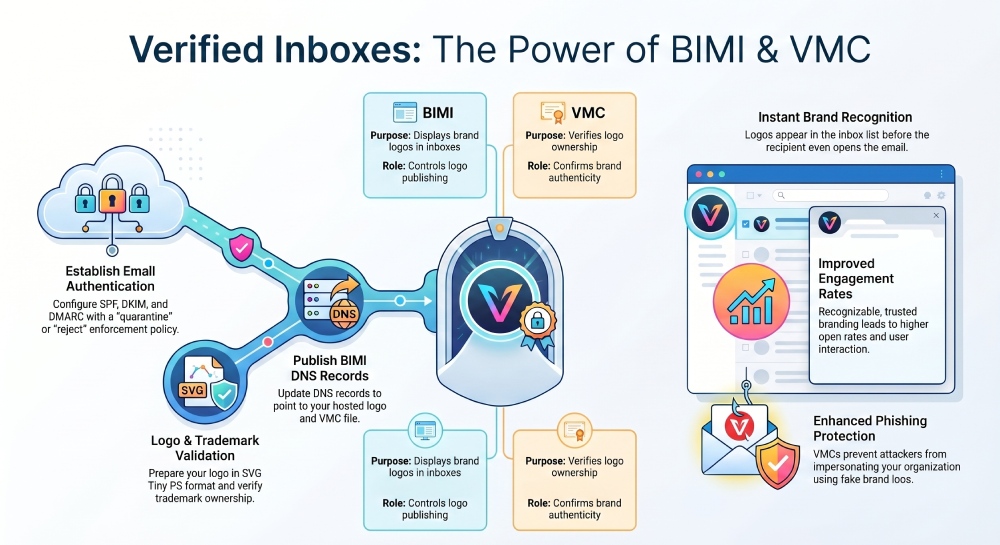
Step 1: Email Authentication
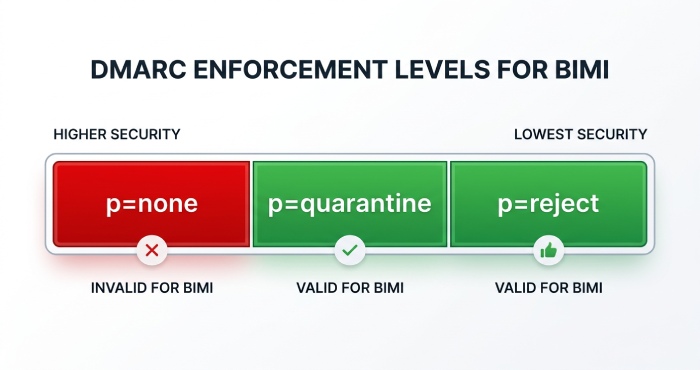
The sender must properly configure SPF, DKIM, and DMARC. Build a valid record with our free SPF record generator before publishing, then run it through an SPF validator to confirm the syntax is correct. The domain also needs a DMARC enforcement policy, typically:
- p=quarantine
- p=reject
Step 2: Logo Preparation
The organization prepares its logo in the required SVG Tiny PS format.
Step 3: Certificate Validation
A certification authority verifies:
- Trademark ownership
- Domain ownership
- Organization legitimacy
Step 4: BIMI DNS Record
The sender publishes a BIMI TXT record containing:
- The logo location
- The VMC certificate location
Step 5: Mailbox Verification
When a message arrives, the receiving provider checks:
- DMARC alignment
- BIMI record validity
- Certificate authenticity
If everything passes, the logo appears beside the email.
Main Requirements for Getting a VMC
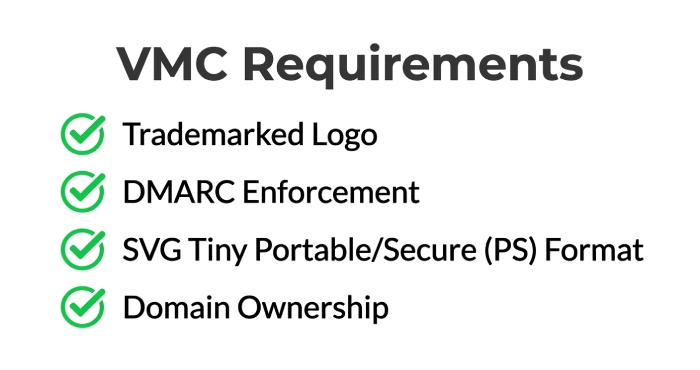
Organizations must meet several conditions before applying for a Verified Mark Certificate.
Trademarked Logo
Most VMC providers require the logo to be officially trademarked. The trademark must usually be registered with a recognized intellectual property authority.
DMARC Enforcement
Your domain must have DMARC configured with enforcement enabled. Monitoring mode alone is generally not enough.
Proper SVG Format
The logo must follow strict SVG Tiny Portable/Secure formatting requirements.
Valid Domain Ownership
The organization must demonstrate ownership and operational control of the sending domain.
Organizational Verification
The certificate authority may request legal documentation and company verification records.
Benefits of Using a VMC for BIMI
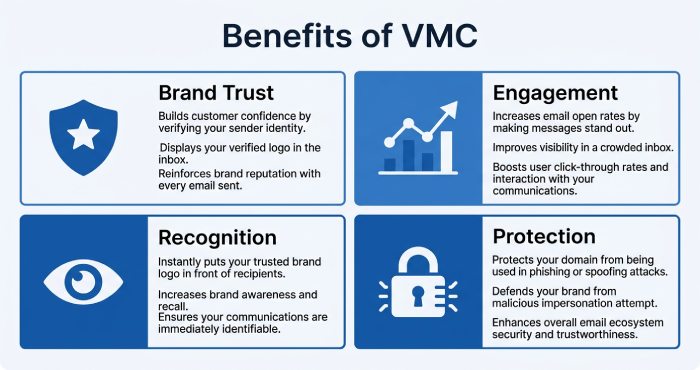
Stronger Brand Recognition
Displaying your logo inside inboxes makes emails easier to identify.
Recipients immediately recognize your brand before opening the message.
Improved Email Trust
Visual verification helps users distinguish legitimate emails from spoofed messages.
This can reduce phishing-related concerns and improve confidence.
Better Engagement Rates
Recognizable branding may increase:
- Email opens
- User interaction
- Click-through rates
People are more likely to engage with trusted senders.
Enhanced Brand Protection
VMCs make it harder for cybercriminals to impersonate your organization using fake logos.
Professional Appearance
A verified logo gives your emails a polished and enterprise-grade appearance.
Common Challenges During VMC Setup
Organizations often face several obstacles while deploying BIMI and VMCs.
Trademark Delays
Trademark registration can take months depending on the country and legal process.
Incorrect SVG Formatting
Many logos fail validation because standard SVG files do not meet BIMI specifications.
DMARC Misconfiguration
BIMI depends heavily on proper email authentication alignment. Even minor errors can prevent logo display.
Inconsistent Mailbox Support
Not all email providers support BIMI in the same way.
Some providers require VMCs while others may display logos without them.
BIMI Without a VMC
Certain mailbox providers allow BIMI logos without requiring a VMC. However, support may be limited and inconsistent.
In many cases:
- Gmail requires verified certification
- Other providers may allow basic BIMI implementation
- Display behavior can vary
Organizations seeking broad compatibility typically choose to implement a VMC.
Difference Between BIMI and VMC
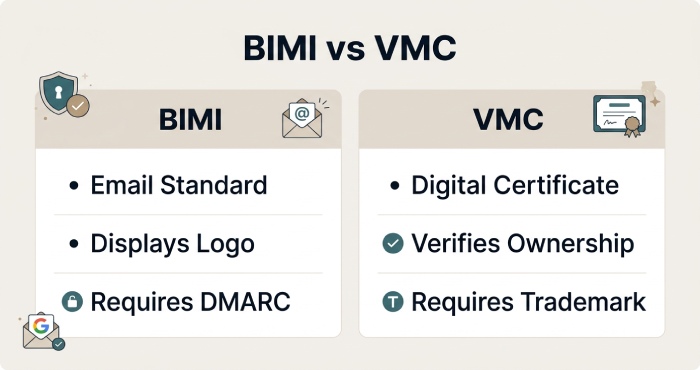
Many people confuse BIMI and VMC, but they serve different purposes.
BIMI (Brand Indicators for Message Identification) is designed to display verified brand logos directly in email inboxes, helping recipients easily recognize legitimate senders. It works as an email standard that relies on proper DMARC configuration to function correctly. BIMI primarily controls how and when a brand’s logo is published across supporting email platforms.
VMC (Verified Mark Certificate), on the other hand, is a digital certificate used to prove ownership of the brand logo. It requires trademark validation to ensure the logo legally belongs to the organization using it. Instead of functioning independently, VMC is referenced within the BIMI record and serves as a trust layer that confirms the authenticity of the displayed logo.
In short, BIMI handles logo display in emails, while VMC verifies that the logo is genuine and belongs to the rightful brand owner.
Components of a BIMI Record
A BIMI TXT record typically contains:
- Version tag
- Logo URL
- Certificate URL
Example structure:
v=BIMI1; l=https://example.com/logo.svg; a=https://example.com/vmc.pem
The l= tag references the SVG logo.
The a= tag points to the certificate file.
Best Practices for VMC Deployment
Enforce DMARC Gradually
Move from monitoring to quarantine and finally reject mode carefully to avoid email delivery issues.
Use High-Quality Logos
Ensure the logo remains clear and readable even at small sizes.
Validate SVG Files
Always verify that the SVG follows BIMI formatting standards before deployment.
Monitor Authentication Reports
Use DMARC reporting tools to identify alignment or delivery problems.
Maintain Certificate Renewals
VMCs require renewal and ongoing compliance monitoring.
Mailbox Providers Supporting BIMI
BIMI adoption continues growing across the email ecosystem.
Support currently exists among several providers, including:
- Gmail
- Yahoo Mail
- Apple Mail
- Fastmail
However, feature support and certificate requirements differ by provider.
How Long Does VMC Setup Take?
The implementation timeline depends on several factors.
Fast Deployments
Organizations with:
- Existing trademarks
- Proper DMARC enforcement
- Ready SVG files
may complete deployment relatively quickly.
Longer Timelines
Businesses still needing trademark approval may wait several months before qualifying for a VMC.
Is a VMC Worth It?
For organizations focused on email branding and trust, the answer is usually yes.
A VMC provides:
- Verified visual identity
- Better email credibility
- Stronger phishing protection
- Higher brand visibility
While setup requires effort, the long-term advantages can outweigh the initial investment.
Final Thoughts
BIMI and Verified Mark Certificates are transforming how brands establish trust in email communications. As inbox providers continue prioritizing security and sender authenticity, visual identity verification is becoming increasingly valuable.
A VMC helps organizations prove ownership of both their sending domain and their logo while giving recipients a safer and more recognizable email experience.
Businesses that invest in proper authentication, DMARC enforcement, and verified branding position themselves for stronger email performance, improved customer trust, and better protection against impersonation attacks.
General Manager
Founder and General Manager of DuoCircle. Product strategy and commercial lead for AutoSPF's 2,000+ customer base.
LinkedIn Profile →