Best SPF Management Tools for MSPs in 2026 A Buyer’s Guide

Quick Answer
SPF (Sender Policy Framework) is an email authentication protocol that allows domain owners to specify which IP addresses and mail servers are authorized to send email on behalf of their domain. It is published as a DNS TXT record and evaluated by receiving mail servers during every inbound SMTP transaction.
What Is SPF Management and Why Do MSPs Need Dedicated Tooling?
SPF (Sender Policy Framework) is an email authentication protocol that allows domain owners to specify which IP addresses and mail servers are authorized to send email on behalf of their domain. It is published as a DNS TXT record and evaluated by receiving mail servers during every inbound SMTP transaction. Grasping the purpose of SPF records is the starting point for managing them at scale. When SPF passes, the receiving server has confidence that the message came from an authorized source. When SPF fails, the message may be quarantined, rejected, or flagged as suspicious.
For managed service providers, SPF is not a single-domain concern. It is a multi-tenant operational challenge that scales in complexity with every client you onboard. Each client domain has its own SPF record, its own set of sending services, its own DNS provider, and its own tolerance for email disruption. When one client adds HubSpot to their marketing stack, or switches from Mailchimp to ActiveCampaign, or starts using a new ticketing system that sends email, their SPF record needs updating. Multiply that across 50, 100, or 200 client domains, and manual SPF management becomes an unscalable liability.
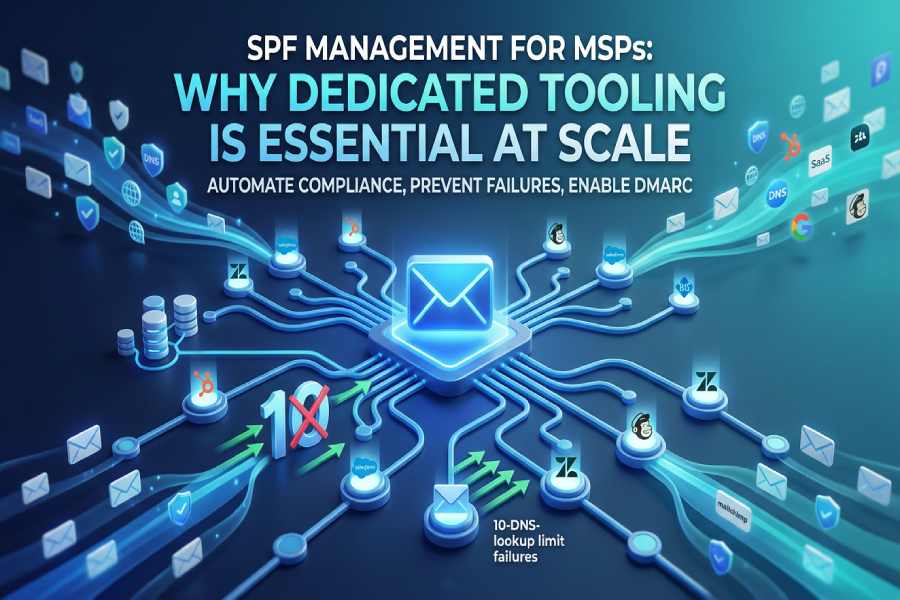
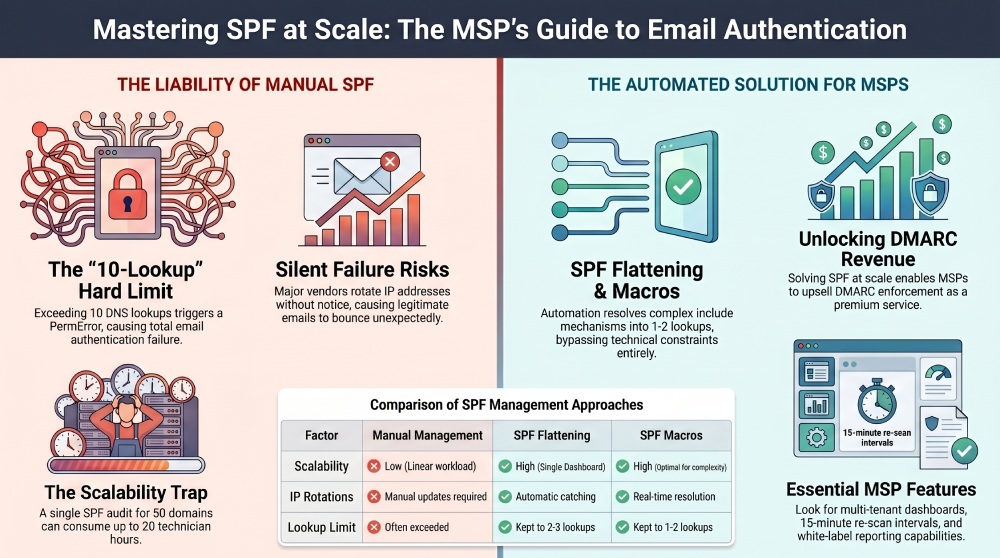
The specific technical constraint that creates this problem is the 10-DNS-lookup limit defined by RFC 7208. Every include, a, mx, and redirect mechanism in an SPF record counts as one DNS lookup. When the total exceeds 10, SPF returns a PermError from too many lookups and authentication fails for every message sent from that domain. Modern businesses routinely use five or more email-sending services, which means most MSP clients are either already exceeding the limit or one vendor addition away from breaking their email.
SPF management tools solve this by automating the process of keeping SPF records within the 10-lookup limit while authorizing all legitimate sending sources. For MSPs, the right tool transforms SPF from a recurring manual burden into a set-and-monitor service that scales with your client base.
Why SPF Is the Hardest Protocol for MSPs to Manage at Scale
DKIM is a one-time configuration per sending service. DMARC is a single DNS record per domain. But SPF is a living, breathing record that changes every time a client adds, removes, or modifies an email-sending service, and that breaks silently when vendor IP ranges rotate.
Here is why SPF creates disproportionate operational overhead for MSPs compared to DKIM and DMARC:
Vendor IP ranges change without notice. Google, Microsoft, SendGrid, and other major email platforms periodically rotate their sending IP addresses. When this happens, a manually maintained or statically flattened SPF record goes stale, silently de-authorizing legitimate email. The MSP has no warning until a client reports bounced messages or failed deliveries.
Every client has a different sending stack. Client A uses Google Workspace, Salesforce, and Mailchimp. Client B uses Microsoft 365, HubSpot, SendGrid, and Zendesk. Client C uses all of the above plus a custom SMTP relay. There is no single SPF configuration that works across your client base. Each domain requires individual management.
The 10-lookup limit creates cascading failures. When a client exceeds 10 DNS lookups, SPF does not partially fail. It completely fails with a PermError for every message. There is no graceful degradation. An MSP managing 100 domains must monitor every one of them to ensure none has drifted past the limit.
Shadow IT introduces unknown senders. Clients frequently sign up for SaaS tools that send email on their behalf, such as project management tools, invoicing platforms, CRM systems, and customer support software, without informing their MSP. Each of these adds include mechanisms to the SPF record that the MSP may not know about until authentication starts failing.
DNS access is fragmented. MSP clients use a dozen different DNS providers: GoDaddy, Cloudflare, AWS Route 53, Namecheap, Network Solutions, and more. Updating SPF records manually means logging into different portals with different interfaces for every client. Some clients manage their own DNS and require handholding through every change.
The MSP SPF Challenge: How 10 Clients Becomes 100 Problems
To illustrate the scale of the challenge, consider a typical MSP managing 50 client domains. Each client uses an average of 6 email-sending services. That is 300 SPF include mechanisms across 50 domains, each of which must stay within the 10-lookup limit, and each of which can break independently when any one of 300 vendor IP ranges changes.
Without automation, an MSP must regularly audit every client domain for SPF compliance, check whether any vendor has rotated IPs, verify that no client has added a new sending service without notification, update DNS records across multiple providers, and test that the changes propagate correctly. A single SPF audit across 50 domains can consume 10-20 hours of technician time. Quarterly audits across a growing client base quickly become the largest hidden cost in an MSP’s email security practice.
According to EasyDMARC’s 2026 DMARC Adoption Report, DMARC adoption among the top 1.8 million domains globally reached 52.1%, but only about 9% combine enforcement with reporting. For MSPs, this means the majority of your clients likely have DMARC published but are not yet enforcing it, and broken SPF records are one of the primary blockers preventing the move from p=none to p=reject.
The business case for MSPs is clear: automated SPF management reduces operational overhead, prevents client-facing email outages, and unblocks the path to DMARC enforcement, which is an upsell opportunity for every client in your portfolio.
Benefits of Automated SPF Management for MSPs
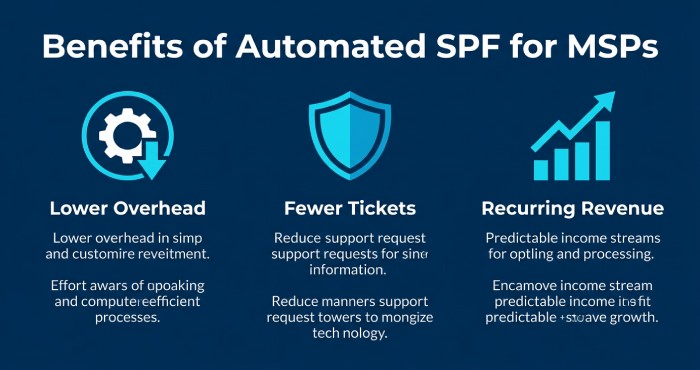
Reduced operational overhead. Automated flattening and re-scanning eliminate the need for manual SPF audits. Tools that re-scan upstream vendor IPs every 15 minutes catch IP rotations before they cause delivery failures, removing the most time-consuming aspect of SPF management. An automated SPF flattening service handles this continuously across every client domain.
Fewer client-facing incidents. SPF failures cause bounced emails, missed invoices, and failed marketing campaigns. For MSPs, every SPF-related incident generates a support ticket, damages client trust, and risks churn. Automated SPF management prevents these incidents before they reach the client.
Scalable service delivery. A tool that manages SPF across all client domains from a single dashboard turns a per-domain manual process into a per-account automated one. MSPs can onboard new clients without proportionally increasing technician workload.
DMARC enforcement enablement. SPF alignment is one of the two pillars of DMARC (alongside DKIM). Broken SPF records are a primary blocker for moving clients from p=none to p=reject. Solving SPF at scale directly enables DMARC enforcement as a premium service offering.
Recurring revenue opportunity. SPF management is inherently ongoing. Vendor IPs change, clients add services, and records drift. This creates a natural recurring revenue stream for MSPs who offer SPF management as a managed service rather than a one-time configuration.
Competitive differentiation. Most MSPs still manage SPF manually or not at all. Offering automated, continuously monitored SPF management with guaranteed uptime SLAs differentiates your practice from competitors who treat email authentication as a checkbox.
The Compliance Landscape: Why MSP Clients Need SPF Solved Now
The regulatory pressure on email authentication has intensified dramatically between 2024 and 2026, and MSPs are increasingly the ones responsible for keeping their clients compliant.
Gmail, Yahoo, and Microsoft sender requirements. Since February 2024, Gmail and Yahoo have required SPF, DKIM, and DMARC for any domain sending 5,000+ messages per day. Microsoft followed in May 2025 with similar enforcement for Outlook.com and Microsoft 365. Messages that fail authentication are now actively rejected, not just filtered to spam. For MSP clients sending transactional email, invoices, or marketing campaigns, a broken SPF record means their messages are being blocked by the three largest mailbox providers on the planet.
PCI DSS v4.0. As of March 2025, organizations processing payment card data must implement DMARC. Since DMARC depends on SPF and DKIM alignment, MSP clients in retail, e-commerce, and financial services cannot achieve PCI DSS compliance without functioning SPF records.
CISA BOD 18-01. All U.S. federal domains must implement DMARC at p=reject. MSPs serving government contractors, agencies, or organizations doing business with federal entities face compliance requirements that flow downstream.
Cyber insurance requirements. An increasing number of cyber insurance providers are requiring email authentication (including SPF and DMARC) as a condition for coverage or favorable premiums. MSPs that proactively implement email authentication for their clients reduce cyber insurance costs and strengthen renewal conversations.
The MSP opportunity. Every one of these compliance requirements represents a revenue opportunity for MSPs. Clients need SPF solved, they need DMARC enforced, and they need someone to manage it on an ongoing basis. The MSP that positions email authentication as a managed service, rather than a one-time project, captures recurring revenue from every client in their portfolio.
Key Features MSPs Should Look for in an SPF Management Tool
When evaluating SPF management tools as an MSP, the requirements are fundamentally different from those of a single-domain buyer. These are the capabilities that separate MSP-ready tools from tools designed for individual organizations.
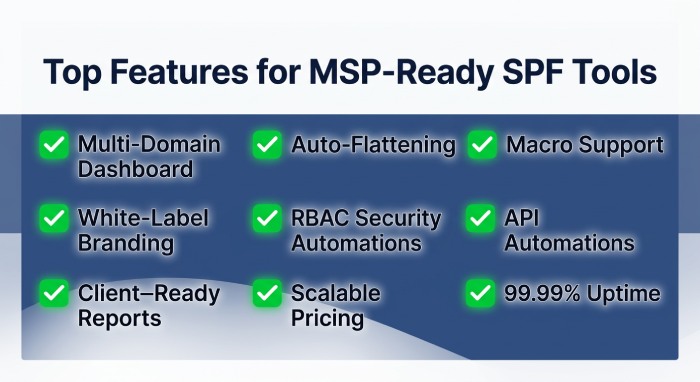
Multi-domain dashboard. The tool must provide a single view across all client domains, showing SPF status, lookup count, last scan time, and any alerts. Switching between individual client portals for each domain is not scalable past 20 clients.
Automatic flattening with frequent re-scanning. Flattening resolves include mechanisms into IP addresses to reduce DNS lookups. The re-scan frequency determines how quickly the tool catches vendor IP rotations. For MSPs, 15-minute re-scan intervals or faster are the baseline. Daily re-scanning is not frequent enough to prevent delivery gaps.
SPF macro support. Macros (RFC 7208 section 7) bypass the 10-lookup limit entirely by delegating per-query resolution to a managed DNS service. For MSP clients with complex sending stacks that exceed what flattening alone can handle, macro support is essential. Not all tools offer true macros.
White-label or partner branding. MSPs that want to present SPF management as their own service need white-label capabilities: custom branding on dashboards, reports, and client-facing communications.
Role-based access control (RBAC). MSP technicians, account managers, and clients each need different levels of access. The tool should support role-based permissions so that junior techs can monitor without modifying, account managers can view status without touching DNS, and clients can see their own domain without accessing others.
API access for automation. MSPs running PSA (Professional Services Automation) or RMM (Remote Monitoring and Management) platforms need API access to integrate SPF monitoring into existing workflows, trigger alerts in ticketing systems, and automate client onboarding.
Client-ready reporting. Non-technical stakeholders at client organizations need reports they can understand. The tool should generate PDF or dashboard-based reports showing SPF status, authentication pass rates, and any incidents, suitable for inclusion in monthly or quarterly business reviews.
Scalable pricing. Per-domain pricing that decreases at volume, or flat-rate MSP pricing, is essential. Tools that charge $37/mo per domain become expensive at 100+ domains. Look for MSP-specific pricing tiers, partner programs, or volume discounts.
DNS infrastructure reliability. SPF records served through the tool’s infrastructure must resolve in milliseconds for every inbound email. If the tool goes down, SPF fails for every client domain it manages. Look for 99.99%+ uptime SLAs backed by infrastructure like Cloudflare or AWS.
SPF Flattening vs. SPF Macros vs. Manual Management: A Comparison for MSPs
Understanding the three approaches to SPF management is essential for evaluating tools. Each has different trade-offs for MSPs managing client domains at scale.
| Factor | Manual Management | SPF Flattening | SPF Macros |
|---|---|---|---|
| How it works | Manually edit DNS TXT records for each domain | Tool resolves includes into IP addresses automatically | Tool delegates per-query DNS resolution to managed service |
| DNS lookups consumed | All original lookups (often exceeds 10) | Typically 2-3 lookups | 1-2 lookups |
| Handles IP rotation | No, must manually check and update | Yes, automatic re-scanning catches changes | Yes, resolution happens at query time, always current |
| Scales across clients | No, linear increase in workload per domain | Yes, tool manages all domains from one dashboard | Yes, same architecture regardless of domain count |
| Unlimited includes | No, hard limit of 10 lookups | Possible with aggressive flattening but may hit TXT record size limits | Yes, truly unlimited includes with 1-2 lookups |
| IP obfuscation | No, all authorized IPs visible in DNS | No, flattened IPs are public | Yes, competitors cannot see authorized senders |
| MSP operational cost | High, 15-30 min per domain per audit | Low, set-and-monitor | Low, set-and-monitor |
| Tools that offer this | Any DNS provider | AutoSPF, PowerSPF, EasySPF, MxToolbox, DMARCLY Safe SPF | AutoSPF (Premium/Enterprise), PowerSPF, Valimail Instant SPF |
For MSPs, the key takeaway: Manual management does not scale. Flattening is the minimum viable approach. Macros are the optimal approach for clients with complex sending stacks. The best MSP tools offer both flattening and macros to match each client’s needs.
How to Evaluate an SPF Tool as an MSP
Before comparing specific products, establish your evaluation criteria based on your MSP’s specific situation:
1. How many client domains do you manage today, and how many in 12 months? This determines whether you need basic multi-domain support or a fully multi-tenant architecture with bulk onboarding.
2. Do your clients need DMARC and DKIM management alongside SPF? If yes, an all-in-one platform saves integration complexity. If you already handle DMARC reporting through a separate tool, a dedicated SPF solution avoids paying for duplicate capabilities.
3. What is your clients’ average sending stack complexity? Clients using 3-5 services may be fine with flattening. Clients using 10+ services with complex routing need macros.
4. Do you need to white-label the tool as your own service? Not all tools offer white-label capabilities. If your MSP brand depends on presenting services under your own name, this is a non-negotiable filter.
5. What compliance requirements do your clients have? MSPs serving healthcare, finance, or government clients need tools with SOC-2 certification, SLAs, DPAs, and audit logs. These are not optional features for regulated industries.
6. What is your target per-domain cost? MSP margins depend on keeping per-domain costs predictable. Map each tool’s pricing to your domain count and compare the all-in cost, not just the headline price.
Summary Comparison Table
| Tool | SPF Approach | Macros | Multi-Tenant | White-Label | MSP Program | API | Re-scan | Starting Price | Not Ideal For |
|---|---|---|---|---|---|---|---|---|---|
| AutoSPF | Dedicated flattening + macros | Yes (Premium+) | Yes | Partner program | Yes | Yes | 15 min | $37/mo (1 domain) | Solopreneurs, all-in-one seekers, budget startups |
| PowerDMARC | PowerSPF (hosted macros) | Yes | Yes | Full white-label | Yes (MSP/MSSP) | Yes | Dynamic | From $8/mo | MSPs wanting SPF-only with dedicated SLA |
| EasyDMARC | EasySPF (dynamic flattening) | No | Yes | Custom branding | Yes (MSP program) | Limited | Dynamic | $35.99/mo | MSPs needing macros or deep SPF specialization |
| Redsift OnDMARC | Dynamic SPF | No | Yes (purpose-built) | Limited | Yes (MSP-focused) | Full REST API | Dynamic | Contact sales | Solo domain owners; MSPs not needing multi-tenant |
| Valimail | Instant SPF (patented macros) | Yes | Yes | No | Limited | Yes | Real-time | ~$5,000/yr | Budget-conscious MSPs serving SMB clients |
| DMARCLY | Safe SPF (flattening) | No | Yes | Limited | No dedicated program | Enterprise only | Varies | $17.99/mo | MSPs needing advanced multi-tenant or white-label |
| dmarcian | SPF Surveyor (analysis only) | No | Yes | No | Partner program | Yes | N/A (no management) | Contact sales | MSPs needing active SPF management (analysis only) |
Pricing sourced from published vendor pages, G2, Capterra, and TrustRadius as of April 2026. MSP and partner pricing is typically negotiated. Contact vendors for current rates.
Tool Reviews
AutoSPF
AutoSPF is a dedicated, enterprise-grade SPF management platform built exclusively for solving the SPF 10-DNS-lookup limit through automatic flattening and macro-based optimization, with a partner program designed for MSPs and digital agencies.
Unlike all-in-one DMARC platforms where SPF is one feature among many, AutoSPF focuses entirely on SPF record management. This dedicated architecture means the product’s 99.99% DNS uptime SLA covers SPF specifically, not a broader platform where SPF competes for infrastructure resources with DMARC reporting and analytics workloads. DNS availability is served through Cloudflare infrastructure.
For MSPs, the multi-domain dashboard provides a centralized view across all client domains, showing SPF status, lookup count, and alerts without switching between accounts. Role-based access control allows MSP technicians to manage records while account managers monitor status and clients view their own domain in isolation. AutoSPF’s flattening is transparent, so you can review exactly how it works under the hood.
The standard flattening approach re-scans upstream vendor IPs every 15 minutes, catching IP rotations from Google, Microsoft, SendGrid, and other providers before they cause delivery failures. For clients with complex sending stacks, SPF macros on Premium and Enterprise plans bypass the 10-lookup limit entirely, allowing truly unlimited include mechanisms with just 1-2 DNS lookups while adding IP obfuscation as a security benefit.
AutoSPF’s partner program is built for MSPs who want to offer SPF management as a recurring managed service. The program includes volume-based pricing that scales as domain count grows, along with the multi-domain management, team access, and reporting capabilities MSPs need for client-facing delivery. According to one verified MSP partner review on AutoSPF’s compare page, the tool “eliminated 90% of manual SPF management workload across 40+ client domains.”
AutoSPF has been in operation since 2018 and serves over 2,000 businesses. The company holds SOC-2 Type II certification and offers enterprise compliance documentation including signed SLAs, DPAs, NDAs, SSO/SAML, RBAC, audit logs, and DNS rollback. According to G2, AutoSPF holds High Performer, Easiest to Use, Best Support, and Easiest Setup badges. Reviewers on G2 consistently highlight two things: the simplicity of the 60-second setup process and the exceptional quality of support, including personalized support videos for complex configurations.
Top Features:
- Automatic SPF flattening with 15-minute re-scan cycles across all included domains
- True SPF macro support (RFC 7208) for unlimited includes with 1-2 DNS lookups
- Multi-domain dashboard with centralized management across all client domains
- MSP partner program with volume-based pricing
- Role-based access control for MSP teams, account managers, and clients
- IP obfuscation via macros so competitors cannot enumerate authorized senders
- 99.99% DNS uptime SLA served through Cloudflare infrastructure
- SOC-2 Type II with enterprise compliance documentation (SLAs, DPAs, SSO/SAML, audit logs)
Pricing: Plus: $37/mo (1 domain, unlimited emails). Premium: $97/mo (5 domains, macros). Enterprise: $387/mo (10 domains, macros, SSO/SAML, audit logs). Additional domains: $10/mo (Plus/Premium), $20/mo (Enterprise). MSP partner pricing available on request. 30-day free trial, no credit card required.
Best For: MSPs and digital agencies that need dedicated SPF management with its own uptime SLA, macro support for complex client stacks, and a partner program with volume pricing, without being forced to migrate their existing DMARC reporting stack.
How Does It Compare: AutoSPF is the most focused SPF management tool on this list. It does not include DMARC reporting, DKIM management, or BIMI support. Those are handled by its sister product DMARC Report or by whatever DMARC platform the MSP already uses. For MSPs that already have DMARC handled and need SPF solved as a dedicated, high-reliability service, AutoSPF is the specialist choice.
PowerDMARC (PowerSPF)
PowerDMARC is a full-stack email authentication platform that manages DMARC, SPF, DKIM, BIMI, MTA-STS, and TLS-RPT from a single dashboard, with one of the most mature MSP/MSSP partner programs in the market featuring full white-label support in 11 languages.
PowerSPF, the platform’s SPF management component, uses hosted macros to optimize SPF records. The platform positions itself as a single-vendor solution for MSPs: manage every client’s entire authentication stack from one dashboard with one contract. The MSP/MSSP multi-tenancy feature includes a white-labeled control panel that MSPs can present as their own branded service, with custom domains, logos, and login portals.
PowerDMARC supports 11 global language translations, making it suitable for MSPs operating across multiple geographies. The platform is used by over 10,000 organizations across 100+ countries, with 700+ channel partners. On G2, PowerDMARC holds a 4.9/5 rating across 238 reviews. According to a G2 reviewer operating as an MSP, PowerDMARC’s reporting capability helps “show visibility in the value I’m providing to my customers as an MSP instead of just saying it.” According to G2 feedback, some users note that pricing can become a concern when managing many domains.
Top Features:
- PowerSPF hosted macros for unlimited SPF includes
- Full white-label MSP/MSSP platform with custom branding, domain, and login portal
- AI-powered DMARC reporting with 8 dashboard views
- 11-language support for global MSP operations
- Full protocol coverage: DMARC, SPF, DKIM, BIMI, MTA-STS, TLS-RPT
Pricing: Pay-as-you-go from $8/mo. MSP/MSSP partner pricing is negotiated. 15-day free trial.
Best For: MSPs that want a single-vendor, fully white-labeled platform covering DMARC + SPF + DKIM + BIMI for all clients, with established MSP partner economics and multi-language support.
How Does It Compare: PowerDMARC offers the most complete all-in-one MSP package, with the deepest white-label capabilities and broadest protocol coverage. The trade-off is that SPF management is one feature within a larger platform. MSPs that need a dedicated SPF uptime SLA separate from the platform SLA, or that already have DMARC reporting handled, may find they are paying for capabilities they do not need.
EasyDMARC (EasySPF)
EasyDMARC is a user-friendly DMARC platform with a dedicated MSP program, featuring EasySPF for dynamic SPF flattening, guided enforcement workflows, and marketplace procurement through Pax8 and Microsoft Azure for streamlined MSP billing.
EasyDMARC’s MSP program is designed around multi-tenant self-service: MSPs can group domains by client, bulk-verify and deploy DMARC records, and customize reports with their own branding. The one-click DMARC deployment feature allows MSPs to push DMARC records to any domain managed by a connected DNS provider directly from the platform. Procurement through Pax8 Marketplace or Microsoft Azure Marketplace allows MSPs to consolidate EasyDMARC billing into their existing master invoices.
EasySPF uses dynamic flattening to manage the 10-lookup limit but does not offer true SPF macros. The platform does not publish the specific re-scan interval for EasySPF. On G2, one MSP reviewer noted that EasyDMARC “takes the guesswork out of configuring SPF, DKIM, and DMARC records” and that the initial setup was “extremely easy and straightforward.” According to independent review analysis, pricing can escalate as domain count and email volume increase, and the free tier is limited to 14-day data retention.
Top Features:
- MSP program with bulk domain verification and one-click DMARC deployment
- EasySPF dynamic flattening for the 10-lookup limit
- Domain grouping by client for organized multi-tenant management
- Pax8 and Azure Marketplace procurement for consolidated MSP billing
- Custom branding on reports and downloadable materials
Pricing: Free plan (1 domain, 14-day retention). Plus: $35.99/mo. Premium: $71.99/mo. MSP pricing through Pax8/Azure Marketplace. 14-day free trial.
Best For: MSPs new to offering DMARC as a service who want guided onboarding, marketplace procurement for simplified billing, and a user-friendly interface that does not require deep DNS expertise.
How Does It Compare: EasyDMARC offers the smoothest MSP onboarding experience and the most integrated procurement workflow through Pax8 and Azure. The trade-off is that EasySPF lacks macro support, meaning MSP clients with very complex sending stacks (10+ services) may still face limitations. According to G2 feedback, some users note the platform can feel basic for advanced use cases.
Redsift OnDMARC (Dynamic SPF)
Redsift OnDMARC is a purpose-built, MSP-focused email security platform with the most sophisticated multi-tenant architecture on this list, featuring Dynamic SPF technology, a full REST API for programmatic client management, and flat-rate MSP pricing.
OnDMARC was architected for service providers from the ground up. The multi-tenant platform provides complete data isolation between clients, delegated admin capabilities, and API-first automation that integrates with existing MSP tooling. The free Investigate assessment tool allows MSPs to instantly check a prospective client’s email security posture without any signup, providing a sales enablement tool for prospecting new DMARC/SPF business.
Dynamic SPF addresses the 10-lookup limit, and the platform covers the full authentication stack including DMARC, BIMI, and MTA-STS. According to Redsift’s published data, organizations using OnDMARC reach DMARC enforcement (p=reject) in an average of 6-8 weeks. Redsift’s MSP pricing uses a flat-rate model rather than per-domain billing, which becomes cost-effective at scale.
Top Features:
- Purpose-built MSP multi-tenant platform with complete data isolation
- Dynamic SPF for the 10-lookup limit
- Full REST API for programmatic domain onboarding and automation
- Free Investigate assessment tool for MSP prospecting
- Flat-rate MSP pricing (not per-domain)
- Full protocol support: DMARC, BIMI, MTA-STS
Pricing: Flat-rate MSP pricing negotiated directly with Redsift. SMB plans available.
Best For: MSPs and MSSPs managing 50+ client domains who need the most mature multi-tenant architecture, API-driven automation for PSA/RMM integration, and flat-rate pricing that scales predictably.
How Does It Compare: Redsift has the strongest multi-tenant architecture and API depth of any tool on this list, making it the top choice for MSPs that prioritize programmatic automation. The trade-off is that Dynamic SPF does not offer true macros, and the platform is more complex to evaluate and deploy than simpler alternatives. Solo domain owners or small MSPs with fewer than 20 client domains may find the platform heavier than necessary.
Valimail (Instant SPF)
Valimail is an enterprise-grade DMARC automation platform with patented macro-based SPF management, designed for large organizations wanting automated enforcement with minimal manual DNS work, suitable for MSPs serving enterprise and Fortune 500 clients.
Valimail’s Instant SPF uses a patented macro approach that bypasses the 10-lookup limit entirely. The platform’s intelligent sender identification automatically labels IPs by service name, reducing the time required to map complex client sending ecosystems. Valimail was acquired by DigiCert in 2025, integrating it into a broader digital trust platform.
On G2, Valimail holds a 4.6/5 rating across 441 reviews and has been ranked the number one DMARC solution for 15 consecutive quarters. However, Valimail’s pricing is positioned squarely at the enterprise market, with Enforce starting at approximately $5,000 per year. According to G2 reviewer feedback, pricing is a recurring concern, particularly for smaller organizations. According to Gartner Peer Insights, some reviewers note that certain email service providers have compatibility issues with Valimail’s macro approach.
Top Features:
- Patented Instant SPF with macro-based approach
- Automated DMARC enforcement with zero DNS maintenance after initial setup
- Intelligent sender identification by service name
- Free tier for Microsoft 365 customers (Valimail Monitor)
Pricing: Monitor: free. Align: from $19/mo. Enforce: approximately $5,000/year. Enterprise: quote-based.
Best For: MSPs serving large enterprise or Fortune 500 clients where the per-domain cost is justified by the client’s budget, and where automated, zero-maintenance enforcement is the priority.
How Does It Compare: Valimail offers the deepest automation and the strongest macro-based SPF technology, backed by the largest G2 review base. The trade-off for MSPs is clear: the pricing model does not scale for MSPs serving SMB clients. An MSP managing 50 SMB domains at Valimail’s enterprise pricing would face costs that exceed what SMB clients are willing to pay. The DigiCert acquisition has prompted some customers to re-evaluate. According to G2 feedback, the platform’s push toward automation is not ideal for MSPs wanting granular, hands-on control over client configurations.
DMARCLY (Safe SPF)
DMARCLY is a budget-friendly DMARC and SPF platform with Safe SPF flattening, offering an accessible entry point for MSPs starting to build an email authentication practice without large upfront costs.
Safe SPF uses traditional flattening to resolve include mechanisms into IP addresses. The platform covers DMARC, SPF, DKIM, BIMI, MTA-STS, and TLS-RPT. DMARCLY’s pricing starts at $17.99/mo, making it one of the most affordable options on this list. The platform supports multi-domain management and user access control on higher tiers.
DMARCLY does not have a dedicated MSP partner program, and API access is reserved for the Enterprise plan. According to independent review analysis, the platform is well-suited for beginners and smaller organizations. However, advanced features like SSO and API access are gated behind the most expensive tier. DMARCLY has a limited review presence on G2 compared to competitors, which independent analysts note as a signal of lower adoption.
Top Features:
- Safe SPF flattening for the 10-lookup limit
- Budget-friendly starting price at $17.99/mo
- Full protocol coverage: DMARC, SPF, DKIM, BIMI, MTA-STS, TLS-RPT
- Automatic subdomain detection and IP reputation monitoring
Pricing: Professional: $17.99/mo (2 domains, 100K emails). Growth: $39.99/mo (8 domains). Business: $69/mo (15 domains). Enterprise: custom pricing with API and SSO.
Best For: MSPs that are just starting to offer email authentication services and need the lowest-cost entry point for basic SPF flattening and DMARC monitoring across a small client base.
How Does It Compare: DMARCLY offers the most affordable entry point on this list, making it attractive for MSPs testing the market. The trade-off is that Safe SPF lacks macro support, API access requires Enterprise pricing, there is no dedicated MSP program, and white-label capabilities are limited. MSPs planning to scale past 20-30 client domains will likely outgrow the platform’s multi-tenant capabilities.
dmarcian (Fortra)
dmarcian is a DMARC visibility and reporting pioneer, founded by one of DMARC’s original creators, offering the SPF Surveyor tool for analyzing SPF records alongside strong educational content and documentation, but without active SPF management capabilities.
dmarcian was acquired by Fortra (formerly HelpSystems), integrating it into a broader cybersecurity portfolio. The platform’s SPF Surveyor is a widely used diagnostic tool that visualizes SPF record structure and identifies lookup count issues. However, dmarcian does not offer SPF flattening, macros, or automated SPF record management. It is an analysis and monitoring tool, not a management tool.
For MSPs, dmarcian provides a partner program and clear, educational reporting that can help demonstrate DMARC value to non-technical client stakeholders. According to Fortra’s analysis of the top 10 million internet domains, domains using Fortra’s managed services achieve reject policies at significantly higher rates than self-managed domains. The free plan is limited to personal and non-commercial use.
Top Features:
- SPF Surveyor for visual SPF record analysis and diagnostics
- Extensive educational content and documentation
- Clear, visual DMARC reporting for non-technical stakeholders
- Fortra cybersecurity ecosystem integration
Pricing: Free for personal/non-commercial use. Business plans are quote-based.
Best For: MSPs early in their DMARC journey who want educational, clear reporting to demonstrate value to clients, and who will pair dmarcian with a separate SPF management tool for active record optimization.
How Does It Compare: dmarcian is the strongest educational and diagnostic platform on this list, but it does not manage SPF records. MSPs that choose dmarcian for DMARC reporting will need a separate tool (such as AutoSPF or PowerSPF) for active SPF flattening and management. This two-tool approach adds integration complexity but allows MSPs to use best-of-breed for each function.
How to Choose: Decision Framework for MSPs
| If This Describes Your MSP | Consider This Tool |
|---|---|
| Need dedicated SPF management with its own SLA; DMARC already handled | AutoSPF |
| Want one fully white-labeled platform for DMARC + SPF + everything | PowerDMARC |
| New to DMARC services; want guided onboarding and Pax8/Azure billing | EasyDMARC |
| Managing 50+ domains; need API-first automation and flat-rate pricing | Redsift OnDMARC |
| Serving enterprise/Fortune 500 clients with premium budgets | Valimail |
| Starting out; need lowest-cost entry into SPF/DMARC | DMARCLY |
| Want DMARC education and diagnostics; will pair with a separate SPF tool | dmarcian + AutoSPF or PowerSPF |
| Need SOC-2, SLAs, DPAs, and SSO for regulated-industry clients | AutoSPF Enterprise or Redsift |
| Need macros for clients with 10+ sending services | AutoSPF (Premium/Enterprise) or PowerDMARC or Valimail |
Role-Based Guidance for MSP Teams
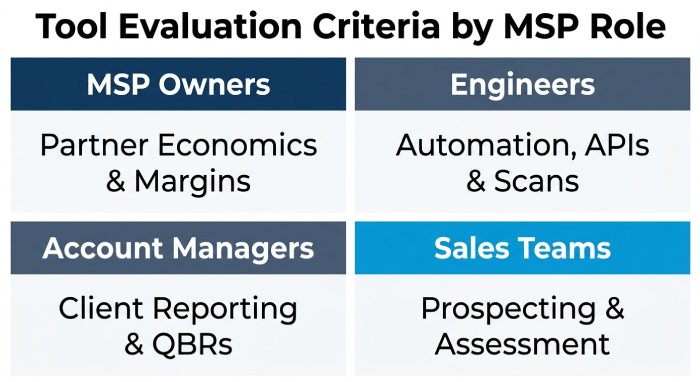
For MSP Owners and Practice Leaders: Evaluate tools based on partner economics, not just per-domain feature lists. The right tool should generate positive margin at your target client price point, reduce technician time spent on SPF issues, and create a defensible recurring revenue stream. PowerDMARC and EasyDMARC offer the most structured MSP partner programs. AutoSPF’s partner program offers volume-based pricing for SPF-specific practices.
For MSP Technical Leads and Engineers: Prioritize re-scan frequency, macro support, and API depth. Your team’s time is the most expensive input in service delivery. A tool that re-scans every 15 minutes and offers macros for complex client stacks eliminates the highest-cost manual tasks. Redsift’s API-first architecture and AutoSPF’s 15-minute re-scanning are the benchmarks.
For MSP Account Managers: Focus on client-facing reporting and ease of demonstrating value. Your QBR presentations need data that non-technical clients understand: emails authenticated, threats blocked, compliance status. PowerDMARC and EasyDMARC generate the most client-ready reports. AutoSPF’s change logs and SPF status dashboards support MSP-to-client communication.
For MSP Sales Teams: Look for prospecting and assessment tools. Redsift’s free Investigate tool provides instant email security assessments for prospective clients without any signup. AutoSPF’s free SPF Checker tool provides a similar entry point for SPF-focused conversations. These tools convert prospects by demonstrating problems before pitching solutions.
Implementation Considerations for MSPs
Start with your riskiest clients. Do not attempt to migrate all client domains simultaneously. Begin with clients experiencing active SPF issues (bounced emails, PermErrors) where the value is immediately demonstrable, then expand to the rest of your portfolio.
Pair SPF management with DMARC enforcement as an upsell. Once SPF is solved for a client domain, the path to DMARC enforcement (p=reject) is significantly shorter. This creates a natural upsell from SPF management ($X/mo) to full email authentication management ($X+Y/mo).
Standardize your DNS workflow. If you manage DNS for your clients, standardize on one or two DNS providers (such as Cloudflare) to simplify SPF record updates. If clients manage their own DNS, document the one-time setup process (typically replacing one TXT record) and provide client-facing instructions.
Monitor continuously, not quarterly. SPF issues surface between audits. A client adds a new SaaS tool on a Tuesday, exceeds 10 lookups by Wednesday, and emails start bouncing by Thursday. Automated monitoring with real-time alerts prevents these incidents from becoming support tickets.
Build a runbook. Document your SPF management process: onboarding steps, escalation procedures for SPF failures, and QBR reporting templates. This allows junior technicians to manage day-to-day operations while senior engineers handle complex edge cases.
Frequently Asked Questions
Can I use a dedicated SPF tool alongside a separate DMARC platform?
Yes. Many MSPs use AutoSPF for SPF management alongside DMARC Report, dmarcian, or another DMARC platform for reporting and enforcement. The two tools operate independently: the SPF tool manages the DNS TXT record, while the DMARC platform processes authentication reports. This best-of-breed approach is common among MSPs that want specialized tooling for each function.
How do I price SPF management as a service for my clients?
Most MSPs bundle SPF management into a broader email security or managed IT package rather than selling it standalone. Common pricing models include per-domain monthly fees ($5-25/mo per client domain on top of your tool cost), inclusion in a per-seat managed security package, or inclusion in a DMARC enforcement project with ongoing management. Your margin depends on the gap between your tool cost and your client-facing price.
What happens if the SPF management tool goes down?
If the tool serving your clients’ flattened or macro-based SPF records experiences downtime, receiving servers cannot resolve SPF for any client domain managed through the tool. SPF authentication fails for every outbound email during the outage. This is why the DNS uptime SLA is the single most important reliability metric for MSPs evaluating SPF tools.
Should I choose a dedicated SPF tool or an all-in-one DMARC platform with SPF included?
If you already have DMARC reporting and enforcement handled, a dedicated SPF tool avoids paying for duplicate capabilities and provides a separate uptime SLA for SPF. If you are building an email authentication practice from scratch, an all-in-one platform provides faster time-to-value with a single vendor relationship. Neither approach is inherently better; it depends on what you already have in your stack.
How long does it take to onboard a new client domain?
With most tools, the initial onboarding takes 5-15 minutes: add the domain, review the existing SPF record, generate the optimized or flattened record, and replace the DNS TXT entry. AutoSPF guarantees 60 seconds or less for the core setup. The longer-tail work is identifying all legitimate sending sources for the client, which may take 1-2 hours of discovery for clients with complex stacks.
We hope this guide has been useful in evaluating SPF management options for your MSP practice. If you would like to see how AutoSPF handles multi-domain SPF management for MSPs, you can try it free for 30 days at autospf.com/pricing or learn about the partner program at autospf.com/partners. No credit card required.
This guide is maintained and updated regularly. Last updated: April 2026. If you believe any characterization in this guide is inaccurate, please contact us at autospf.com/contact-us and we will investigate and correct it promptly.
General Manager
General Manager of DuoCircle. Product strategy and commercial lead for AutoSPF's 2,000+ customer base.
LinkedIn Profile →