DMARC RFC 7489 Explained: The Standard Behind Email Authentication

Quick Answer
DMARC RFC 7489 defines how domains use SPF, DKIM, alignment, policies, and reporting to protect email from spoofing and phishing. It helps domain owners monitor authentication results and gradually enforce quarantine or reject policies.
Try Our Free DMARC Checker
Validate your DMARC policy, check alignment settings, and verify reporting configuration.
Check DMARC Record →
What DMARC RFC 7489 Is and Why It Matters
DMARC, defined in RFC 7489, is an email authentication framework that helps domain owners protect their domains from abuse, including phishing, spoofing, and other forms of fraudulent messaging. DMARC stands for Domain-based Message Authentication, Reporting, Conformance, and it builds on two foundational mechanisms: SPF and DKIM.
At its core, DMARC RFC 7489 gives a Domain Owner a way to publish authentication policies in DNS and tell a mail-receiving organization how to handle mail that does not authenticate properly. That instruction is expressed through a DMARC policy, published as a DNS TXT record known as a DMARC Policy Record.
DMARC is important because email was not originally designed with strong sender identity verification. The visible address that users see in a message can be easy to imitate unless receiving systems have a reliable way to compare that visible identity with authenticated technical identifiers. RFC7489 provides the framework for that comparison and gives domain owners a practical method to reduce direct domain spoofing.
For organizations, this is not only a security concern but also a brand, trust, and deliverability concern. A domain that is frequently spoofed can damage customer confidence, increase fraud risk, and make legitimate email harder to distinguish from malicious email. DMARC helps solve that problem by linking authentication, policy, and reporting into one operational model.
The Standards Context Behind RFC 7489
RFC 7489 is the original specification that defined DMARC, establishing how domain owners can publish authentication policies and use SPF, DKIM, alignment, and reporting to protect their domains from email spoofing and abuse. It provides the foundation for understanding how DMARC operates across modern email systems.
How DMARC Works with SPF and DKIM Alignment
DMARC does not replace SPF or DKIM. Instead, DMARC validation evaluates whether either SPF or DKIM produces an authenticated result that aligns with the visible sender identity in the message.
SPF and Sender Policy Framework Alignment
SPF, defined in RFC7208 as Sender Policy Framework, allows a domain to specify which mail servers are authorized to send mail on its behalf. During DMARC validation, SPF can contribute to a DMARC pass only if the authenticated SPF domain aligns with the domain in the message’s visible From header.
That visible From header is defined by RFC5322, specifically the RFC5322.From field. DMARC focuses on this field because it is the identity most visible to users and the identity most often abused in spoofed email.
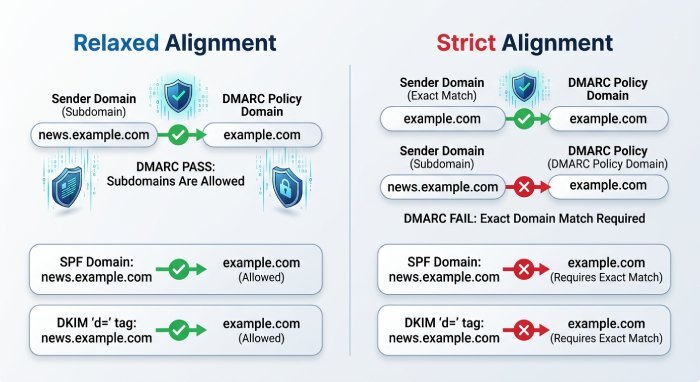
Relaxed Alignment
With relaxed alignment, the SPF-authenticated domain may be a subdomain of the Organizational Domain found in the RFC5322.From address. For example, mail from news.example.com may align with example.com under relaxed alignment.
Relaxed alignment is the default because it supports common business sending patterns. Many organizations use subdomains for marketing, billing, notifications, password resets, newsletters, or regional mail streams. Allowing aligned subdomains gives administrators flexibility while still tying the authenticated identity to the same organizational domain.
Strict Alignment
With strict alignment, the domains must match exactly. A strict setting is more restrictive and may improve control, but it can increase implementation complexity, especially for organizations using third-party senders.
Strict alignment is often preferred by organizations with highly controlled mail flows, such as financial institutions, government agencies, or brands frequently targeted by phishing. However, strict alignment requires careful coordination with every sending service. If a third-party provider signs with its own domain or uses a different envelope sender domain, strict alignment may cause otherwise legitimate messages to fail DMARC.
DKIM and DomainKeys Identified Mail Alignment
DKIM, defined in RFC6376 as DomainKeys Identified Mail, allows a sender to cryptographically sign selected parts of an email message. During DMARC validation, DKIM can produce a DMARC pass when the DKIM signing domain aligns with the Author Domain in the RFC5322.From field.
DKIM alignment is especially valuable because a valid signature can remain intact even when a message is forwarded, provided the signed portions of the message are not modified in a way that breaks the signature. This makes DKIM a critical component of resilient DMARC deployment, particularly for organizations whose messages pass through forwarding services, mailing lists, or security appliances.
Why Alignment Matters
A message can technically pass SPF or DKIM but still fail DMARC if the authenticated domain does not align with the visible sender domain. This is why DMARC is stronger than standalone SPF or DKIM. It connects authentication results to the domain users actually see, improving anti-phishing protection and supporting better reputation assessment.
Alignment is the core concept that turns technical authentication into user-facing trust. A user does not normally inspect envelope sender domains, return-path values, or cryptographic signature headers. The user sees the From address. DMARC asks whether authenticated evidence supports that visible identity. If it does, the message can pass DMARC. If it does not, the domain owner’s published policy can guide receivers on what to do next.
DMARC DNS Records, Policy Tags, and Enforcement Levels
A DMARC Policy Record is published in DNS as a DNS TXT record at a special hostname, typically _dmarc.example.com. This record tells receivers what DMARC policy applies and where reports should be sent.
Anatomy of a DMARC Policy Record
A basic DMARC Policy Record might look like this:
_dmarc.example.com TXT "v=DMARC1; p=none; rua=mailto:dmarc-reports@example.com"The v=DMARC1 tag identifies the record as DMARC. The p= tag defines the mail handling preference for messages that experience validation failure during DMARC validation.
A more advanced record may include reporting destinations, alignment preferences, forensic reporting options, subdomain policy, and rollout percentage:
_dmarc.example.com TXT "v=DMARC1; p=quarantine; rua=mailto:dmarc-agg@example.com; adkim=s; aspf=r; sp=reject; pct=50"This example asks receivers to quarantine failing mail for the organizational domain, apply strict DKIM alignment, relaxed SPF alignment, reject failing subdomain mail, and enforce the policy against only 50 percent of applicable failing messages. Not every organization needs every tag, but understanding these options helps administrators design policies that match their operational reality.
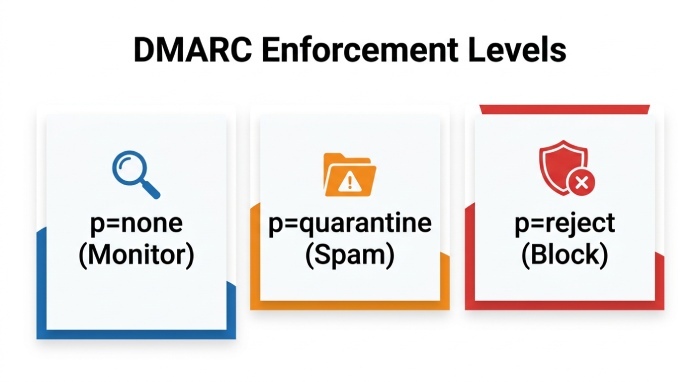
Policy: none
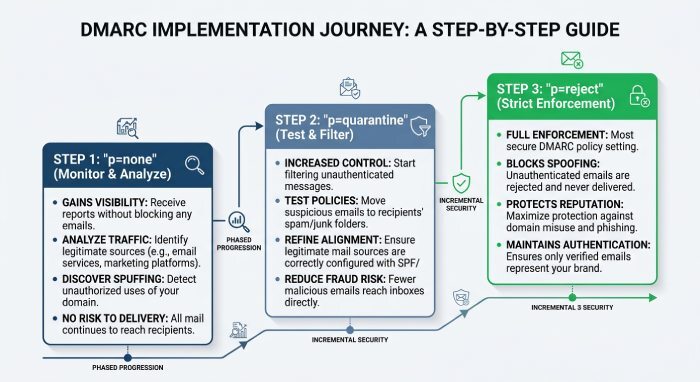
A DMARC policy of p=none tells receivers to take no enforcement action based solely on DMARC. This mode is commonly used for monitoring and discovery. It allows the Domain Owner to collect aggregate reports before moving toward enforcement.
p=none is not a final security posture for domains at high risk of impersonation, but it is an essential starting point. It helps reveal all the systems sending mail that claims to be from a domain. Those systems may include approved business services, forgotten legacy applications, employee tools, cloud platforms, or unauthorized senders. The visibility gained from monitoring is often the difference between a smooth enforcement rollout and a disruptive one.
Policy: quarantine
A p=quarantine policy asks receivers to treat failing messages as suspicious. Depending on the receiver’s systems, such messages may be routed to spam or subjected to additional filtering.
Quarantine is a useful intermediate step because it begins reducing user exposure to unauthenticated mail while still giving administrators a chance to detect mistakes. If legitimate messages unexpectedly land in spam, aggregate reports and user feedback can help identify the affected sending source. Organizations often use quarantine for a defined observation period before moving to reject.
Policy: reject
A p=reject policy requests that receivers reject messages that fail DMARC. This is the strongest DMARC policy and is commonly used after legitimate sending sources have been identified and properly authenticated.
Reject is the most effective policy for preventing unauthenticated direct spoofing of a domain. When a receiver honors the policy, the failing message should not be delivered to the user’s inbox. For high-value domains, reaching p=reject is often the primary objective of a DMARC program.
Subdomain Policy and Alignment Tags
DMARC also supports tags such as sp= for subdomain policy, adkim= for DKIM alignment mode, and aspf= for SPF alignment mode. These options let administrators tune authentication policies for different organizational structures.
The sp= tag is especially important for organizations with many delegated subdomains. A parent domain might use one policy for its own mail and a different policy for subdomains. For example, a company may send production email from example.com but reserve certain subdomains for vendors or internal applications. A carefully designed subdomain policy helps prevent attackers from abusing overlooked or inactive subdomains.
Percentage-Based Rollout
The pct= tag allows gradual enforcement. For example, a domain can apply a reject policy to only a portion of failing traffic, improving scalability during phased deployment.
A staged rollout is helpful when an organization has many business units or high mail volume. Administrators can move from p=none to p=quarantine; pct=25, then increase to pct=50, pct=75, and finally pct=100. The same approach can be used when moving from quarantine to reject. The purpose is to reduce risk while continuing to improve protection.
Reporting, Monitoring, and Common Implementation Challenges
DMARC’s reporting capability is one of the reasons RFC 7489 became so important to modern email authentication. The reporting framework allows domain owners to receive feedback from receivers about authentication outcomes.
Aggregate Reports and Operational Visibility
Aggregate reports provide XML-based summaries of email sources, SPF results, DKIM results, and DMARC outcomes. These reports help administrators identify legitimate senders, unauthorized systems, forwarding behavior, and possible phishing campaigns.
A mature DMARC program typically starts with p=none, analyzes aggregate reports, corrects SPF and DKIM configuration issues, and then advances the DMARC policy toward quarantine or reject.
Aggregate reports are usually sent to the address listed in the rua= tag. Because the reports can be numerous and complex, many organizations use a dedicated DMARC reporting platform or internal data pipeline to parse, normalize, and visualize them. The raw XML may include source IP addresses, authentication results, policy dispositions, and counts of messages observed by the reporting receiver.
Common Causes of DMARC Failure
A fail result can occur when SPF fails, DKIM fails, or neither aligned identifier satisfies DMARC. Common causes include missing DKIM signatures, unauthorized sending IPs, misconfigured SPF records, third-party platforms sending without proper authentication, and forwarding paths that break SPF.
Other common causes include expired DKIM keys, incorrect selector configuration, messages modified after signing, DNS lookup limits in SPF, and vendors that authenticate using their own domain rather than the customer’s domain. In some cases, a message may pass DKIM cryptographically but fail alignment because the d= signing domain is not aligned with the RFC5322.From domain.
Message Handling Differences Across Receivers
Although RFC 7489 defines the protocol, final message handling decisions belong to the receiving system. A mail-receiving organization may consider DMARC results alongside local filtering, user reputation signals, malware checks, and business rules. This flexibility improves operational practicality but can create differences between providers.
For example, one receiver may reject a failing message during SMTP time, while another may accept it and place it in spam. Another provider may apply additional analysis if the sender has strong historical reputation or if the message appears to be part of a known forwarding pattern. DMARC policy is a strong signal, but it is not the only signal in modern mail filtering.
Implementation Complexity and Interoperability
DMARC deployment can expose weaknesses in existing email infrastructure. Large organizations often have many sending services, including marketing platforms, CRMs, help desks, billing systems, and regional gateways. Maintaining SPF, DKIM, and DMARC Policy Record accuracy across those systems requires governance.
The DMARC RFC emphasizes interoperability, but real-world deployment still depends on careful inventory, vendor coordination, and monitoring. Documents such as RFC7960 and RFC7841 are also relevant to broader email operations and authenticated messaging discussions, while RFC 9091 further clarifies how public suffixes affect domain evaluation. In standards roadmaps, teams may also track RFC 9989, RFC9990, and RFC9991 alongside RFC 7489 and RFC9091 when reviewing DMARC evolution.
Interoperability also depends on receivers parsing records consistently and senders publishing clean, unambiguous DNS data. A domain should publish only one DMARC Policy Record at the expected _dmarc location. Multiple records can cause permanent errors, and syntax mistakes may cause receivers to ignore the policy entirely. Because DMARC sits at the intersection of mail systems, DNS, security operations, and vendor management, a successful implementation often requires coordination across several teams.
Receiver-Side DMARC Evaluation and Authentication Results
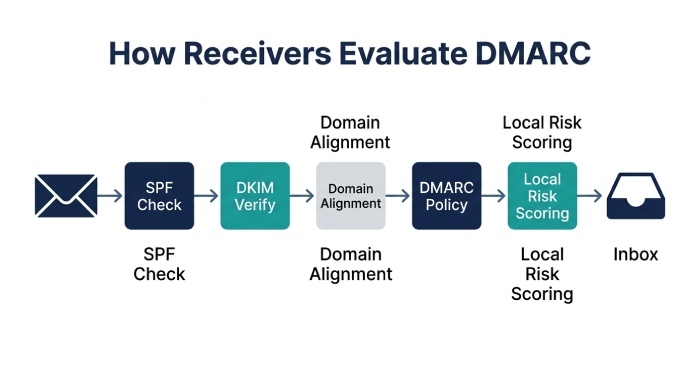
From the receiver’s perspective, DMARC evaluation is part of a larger message assessment process. The receiving system accepts or examines the message, performs SPF checks, verifies DKIM signatures, determines whether either result aligns with the visible From domain, retrieves the applicable DMARC Policy Record, and applies local handling logic.
This receiver-side process is why consistent implementation matters. RFC 7489 describes how receivers should determine the relevant domain, evaluate alignment, and report outcomes. However, receivers still retain discretion over final disposition. Local policy, abuse intelligence, content scanning, and user protection systems may influence the ultimate handling of a message.
The Role of Authentication-Results Headers
Many receiving systems record authentication outcomes in an Authentication-Results header. This header can show whether SPF, DKIM, and DMARC passed or failed, along with associated domains and reasons. Security teams often inspect these headers when troubleshooting deliverability or investigating suspicious messages.
For example, an Authentication-Results header might indicate that SPF passed for one domain, DKIM passed for another, but DMARC failed because neither authenticated identifier aligned with the From domain. This distinction is critical. Without alignment context, a casual review might mistakenly assume that a message passing SPF or DKIM automatically passes DMARC.
Local Policy and Risk Scoring
DMARC does not eliminate the need for broader email security controls. A message can pass DMARC and still be malicious if it comes from a compromised legitimate account or an authenticated attacker-controlled domain. Conversely, a message can fail DMARC because of forwarding or configuration problems while not being intentionally malicious.
Receivers therefore use DMARC as one signal among many. They may combine DMARC outcomes with URL reputation, attachment scanning, sender history, user reports, malware detection, machine-learning classifiers, and organizational policy. The strength of DMARC is that it provides domain-owner intent and aligned identity verification, which are highly valuable signals in that broader scoring model.
Forwarding, Mailing Lists, and Indirect Mail Flows
Indirect mail flows are among the most common DMARC challenges. When a message is forwarded, SPF may fail because the forwarding server is not authorized in the original sender’s SPF record. DKIM may survive if the message is not modified, but mailing lists often add footers, change subject lines, or alter headers in ways that can break signatures.
Because of this, organizations should not rely exclusively on SPF for DMARC success. Strong DKIM signing practices, stable canonicalization choices, and careful vendor configuration improve resilience. Receivers may also use mechanisms and local heuristics to understand common forwarding patterns, but senders should design their authentication posture to withstand normal mail routing as much as possible.
Practical DMARC Rollout Checklist and Troubleshooting Workflow
A successful DMARC rollout follows a structured sequence. The details vary by organization, but the general workflow is consistent: discover, authenticate, monitor, enforce gradually, and maintain. This approach aligns well with the operational spirit of RFC 7489 and the broader Internet Standards Track emphasis on interoperable implementation.
The most common mistake is moving too quickly to enforcement without understanding all legitimate mail sources. The second most common mistake is staying at p=none indefinitely. Monitoring without enforcement provides visibility, but it does not fully protect the domain from spoofing. The goal should be controlled progress toward quarantine or reject.
Step 1: Inventory All Sending Sources
Begin by listing every system that sends mail using the domain. Include corporate email, bulk marketing platforms, transactional services, ticketing systems, payroll tools, cloud infrastructure, monitoring alerts, survey platforms, and regional providers. Ask business units directly because not all sending services are visible from central IT records.
Once the list is complete, map each source to its authentication method. Determine whether it uses aligned SPF, aligned DKIM, both, or neither. Identify owners for each source so configuration issues can be resolved quickly.
Step 2: Publish Monitoring Policy
Publish a DMARC Policy Record with p=none and a valid rua= destination. Confirm that receivers can retrieve the record and that reports are arriving. During this phase, do not assume every source in reports is malicious. Some may be legitimate systems that were previously unknown.
Review the reports over a meaningful period. High-volume senders will appear quickly, but low-volume systems may only send monthly invoices, quarterly notifications, annual reminders, or event-based alerts. The monitoring period should be long enough to capture normal business cycles.
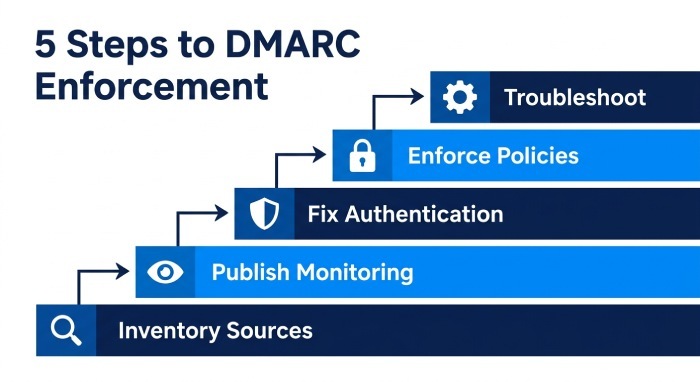
Step 3: Fix Authentication and Alignment
For each legitimate source, configure DKIM and/or SPF so that DMARC can pass. Prefer aligned DKIM where available. Ensure SPF records stay within DNS lookup limits and avoid unnecessary includes. Remove obsolete sending services from records when they are no longer used.
If a source cannot support alignment, consider whether it should use a different subdomain, a vendor-managed From domain, or an updated sending configuration. In some cases, replacing a non-compliant vendor may be the best long-term security decision.
Step 4: Move to Quarantine and Then Reject
After legitimate sources are passing DMARC, move to p=quarantine, optionally with pct= for gradual rollout. Continue monitoring reports and user feedback. If failures are expected and unauthorized, increase enforcement. If legitimate failures appear, fix them before proceeding.
When confidence is high, move to p=reject. This policy provides the strongest protection against unauthenticated direct spoofing. Continue monitoring after the transition because new sending sources and configuration drift can still create failures.
Step 5: Troubleshoot Failures Systematically
When a message fails DMARC, examine the authentication results in order. First, determine the visible From domain. Second, check whether SPF passed and which domain was authenticated. Third, check whether DKIM passed and which d= domain signed the message. Fourth, determine whether either authenticated domain aligns with the From domain. Finally, confirm that the correct DMARC Policy Record was discovered.
This systematic process prevents misdiagnosis. A message may fail DMARC even if SPF passes, because the SPF domain is not aligned. It may fail even if DKIM is present, because the signature is invalid or the signing domain is unrelated. DMARC troubleshooting requires looking beyond pass/fail labels and understanding identity alignment.
RFC 7489’s Role in Modern Email Security and Best Practices
RFC 7489 remains the foundational DMARC RFC for protecting domains from impersonation. It gives domain owners a standardized way to publish a DMARC Policy Record, define a DMARC policy, receive reports, and guide receivers when messages fail DMARC validation.
The importance of RFC7489 has grown as email-based attacks have become more sophisticated. Attackers frequently exploit user trust in known brands, suppliers, executives, and service providers. By giving domain owners a way to publish explicit policy, DMARC reduces the opportunity for attackers to send unauthenticated mail that appears to come directly from a trusted domain.
Best Practices for Deploying DMARC
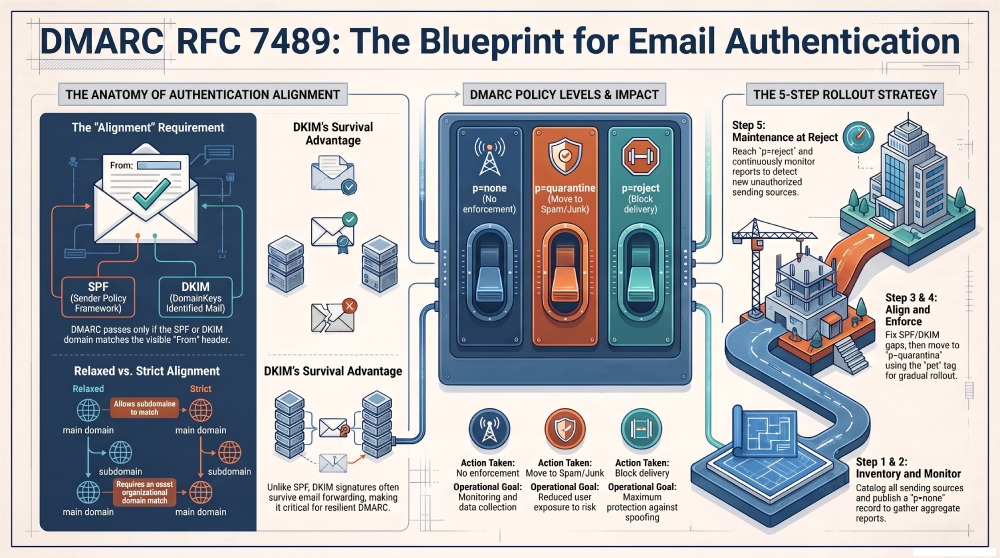
Organizations should begin with a complete inventory of legitimate mail sources. Every approved sender should be configured for SPF and/or DKIM, with alignment to the RFC5322.From domain. DKIM is especially valuable because signatures often survive forwarding better than SPF.
A best-practice deployment should also define internal ownership. Someone must be responsible for reading reports, maintaining DNS records, coordinating with vendors, and approving enforcement changes. Without ownership, DMARC records can become stale, and organizations may remain stuck at monitoring mode.
Start with Monitoring
Publish a DMARC Policy Record using p=none and collect aggregate reports. This provides visibility without disrupting legitimate mail.
Monitoring should be treated as an active discovery phase, not a passive waiting period. Administrators should categorize sources, contact service owners, and fix authentication gaps. The sooner legitimate mail is aligned, the sooner the domain can move toward meaningful enforcement.
Move Gradually to Enforcement
After authentication gaps are corrected, move the DMARC policy to quarantine, then eventually to reject. Use pct= if a staged rollout is needed.
Gradual enforcement is especially useful for organizations with high-volume customer communications. A sudden disruption to invoices, password resets, order confirmations, or support messages can affect business operations. Phasing enforcement allows security teams to improve protection while minimizing the risk of blocking legitimate mail.
Review Public Suffix and Organizational Domain Behavior
Because RFC 9091 affects how DMARC interacts with public suffix boundaries, organizations operating registries, platforms, or delegated domains should understand the role of the Public Suffix Operator and the Organizational Domain. This is especially important for service providers and large-scale platforms.
Public suffix behavior matters because DMARC needs to determine the correct organizational boundary for alignment and policy discovery. Domains under a public suffix may not share a common organizational owner. Proper handling prevents one entity from unintentionally or maliciously asserting policy over another entity’s domain space.
DMARC in the Broader Email Authentication Ecosystem
Modern email authentication depends on multiple layers: SPF for sending authorization, DKIM for cryptographic identity, and DMARC for aligned policy enforcement. The DMARC RFC family, including RFC 7489, RFC 9091, and references such as RFC 9989, continues to influence how providers secure mail at scale.
As phishing, business email compromise, and spoofed email attacks evolve, DMARC remains a practical, standards-based control. When implemented correctly, it improves domain protection, strengthens receiver-side reputation assessment, and gives the Author Domain and Domain Owner greater control over how unauthenticated mail is treated across the global email ecosystem.
DMARC is most effective when combined with user education, secure account practices, inbound filtering, brand monitoring, and incident response. It is not a complete solution to all email fraud, but it is one of the most important controls for preventing direct domain impersonation. Its value comes from being widely understood, broadly implemented, and grounded in the shared language of RFC 7489, RFC7489 references, and continuing Internet Standards Track work.
General Manager
General Manager of DuoCircle. Product strategy and commercial lead for AutoSPF's 2,000+ customer base.
LinkedIn Profile →