Does SPF Hard Fail Reject Forwarded Emails? What Actually Happens

Quick Answer
SPF hard fail can cause forwarded emails to fail authentication because forwarding may change the sending IP. However, it does not automatically mean the email is rejected. Recipient policies, DKIM, DMARC, and forwarding methods determine the final outcome.
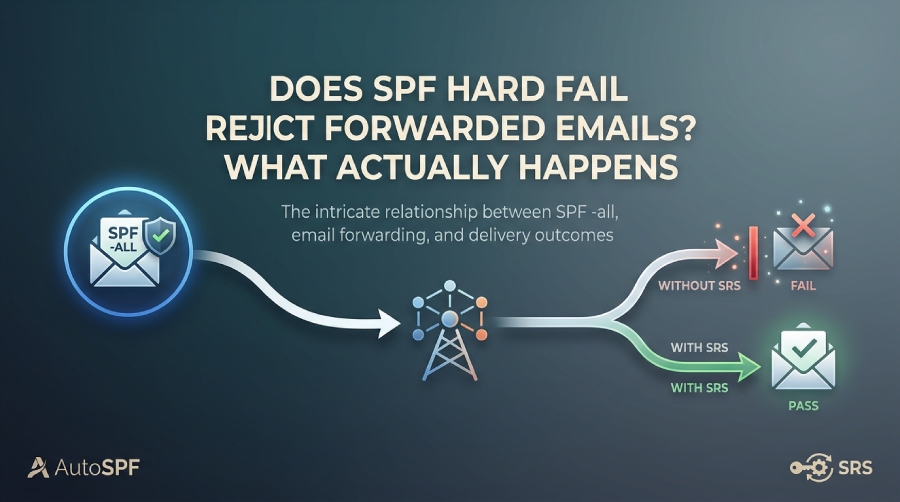
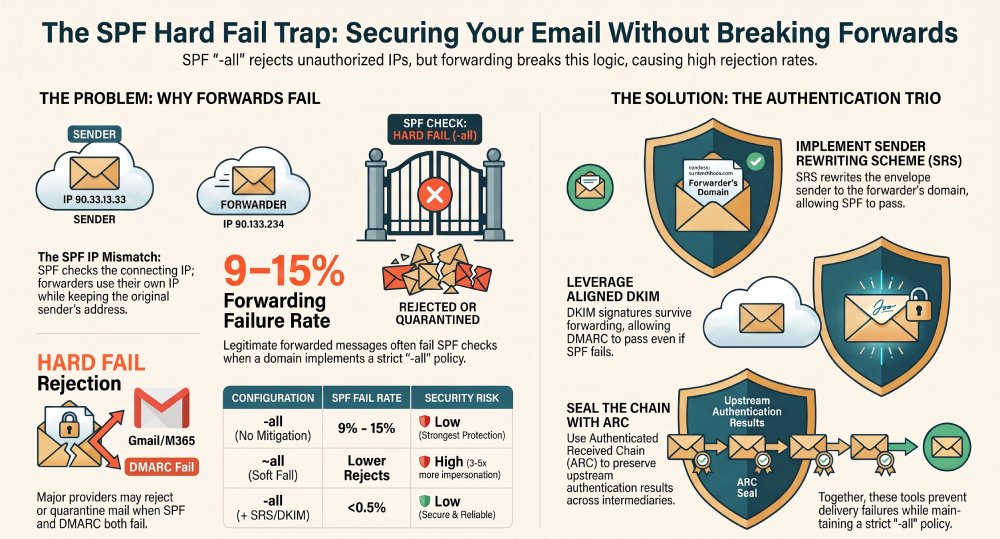
No”an SPF hard fail (-all) doesnt inherently reject all forwarded emails, but when a forward preserves the original MAIL FROM and the forwarding servers IP isnt authorized by the senders SPF, many receivers will reject at SMTP or quarantine unless the forwarder uses SRS or the message carries aligned DKIM or a trusted ARC chain.
Context and background SPF (Sender Policy Framework) authenticates the SMTP envelope sender (MAIL FROM/Return-Path) by checking whether the connecting IP is authorized by the senders domains SPF record. A domain that publishes -all signals hard fail for unauthorized IPs, but SPF is a receiver-side signal”not a mandated reject. In practice, major MTAs and cloud providers increasingly use SPF hard fail to reject or severely downgrade messages at receipt, particularly when DMARC fails and theres no compensating signal like DKIM or ARC.
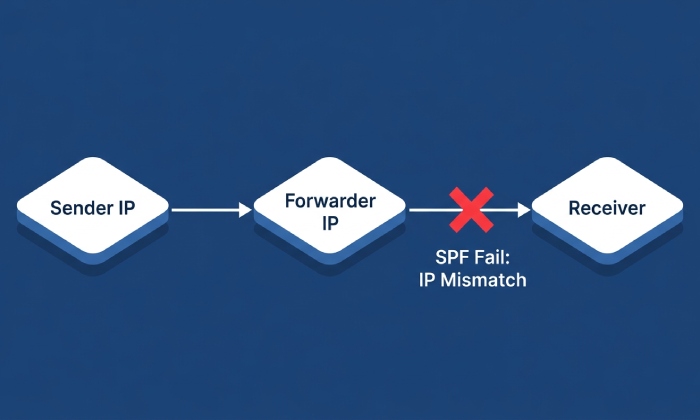
Forwarding complicates SPF because the forwarder, not the original sending IP, presents the message to the next hop. If the forwarder keeps the original MAIL FROM, the next hop compares the forwarders IP to the senders SPF and”absent an allow”returns a fail, often triggering reject. The most reliable fix is the Sender Rewriting Scheme (SRS), which changes the envelope sender to the forwarders domain so SPF can pass. In parallel, aligned DKIM can allow DMARC to pass even if SPF fails, while ARC can preserve upstream authentication results across intermediaries. AutoSPF exists to make this complexity manageable: it inventories and simulates forwarding flows, validates SPF/DKIM/DMARC/ARC outcomes, recommends SRS, and stages safe policy changes.
What SPF Hard Fail (-all) Means at SMTP and During Forwarding
A domain that publishes an SPF record with -all (hard fail) is instructing receivers that email from IPs not explicitly authorized should be treated as failing authentication. At the SMTP transaction level, the receivers MTA evaluates SPF before or during RCPT TO/DATA and can return a 550-class response, such as:
- 550 5.7.23 SPF validation failed
- 550-5.7.26 This message does not pass authentication checks (SPF and DKIM)
- 550 5.7.1 SPF check failed
When forwarding is involved and the forwarder preserves the original MAIL FROM, the receiving MTA compares the forwarders IP to the original domains SPF and”if not permitted”sets spf=fail. Whether this results in a connection-time reject, a post-acceptance quarantine, or a spam-score bump depends on the receivers policy and other signals (DKIM, DMARC, ARC, reputation).
How AutoSPF helps: AutoSPF models SMTP outcomes per hop, showing the exact SMTP stage where your messages will be rejected with -all under multiple receiver policies (Gmail, M365, Yahoo, Proofpoint, Mimecast) and recommends fixes before you publish stricter SPF.
How Forwarding Alters MAIL FROM, SPF Evaluation, and When It Fails
Forwarding styles that affect SPF:
- Simple alias/forward: The forwarder relays the message unchanged, preserving the original MAIL FROM (Return-Path). SPF is re-evaluated against the forwarders IP; without SRS this typically fails.
- Rewrite forward (SRS): The forwarder rewrites the envelope sender into its own domain. SPF then evaluates the forwarders own SPF, which should authorize itself and pass.
- Mailing lists: Often re-send with modified bodies/headers. They usually preserve or rebase the envelope sender; DMARC alignment may break if DKIM is invalidated by modifications.
Forwarding scenarios that produce SPF hard fail:
- University aliases that route alumni mail to Gmail/Outlook without SRS.
- Corporate catch-all or vanity domains forwarding to personal inboxes without SRS.
- Legacy mailing lists that preserve the original Return-Path and modify content, invalidating DKIM and failing SPF, causing DMARC fail.
How AutoSPF helps: AutoSPF traces alias trees, tests real forwarding paths with synthetic probes, and flags which forwards will incur spf=fail under your current policy”then generates remediation tasks ( deployment, DKIM alignment, ARC enablement).
Sender Rewriting Scheme (SRS): How It Avoids SPF Breakage
SRS rewrites the envelope sender at the forwarder so the next hop evaluates SPF against the forwarders own domain, not the original senders. It encodes the original address and a timestamped HMAC into the rewritten address (e.g., SRS0=HASH=orig-domain=local@forwarder.example), enabling reverse mapping for bounces.
Advantages:
- Preserves SPF across forwards, eliminating false SPF fails for legitimate mail.
- Keeps bounce handling intact via SRS reverse mapping (SRS1/SRS0).
AutoSPF tie-in: AutoSPF includes an SRS readiness check, key rotation guidance, and copy-paste config for major MTAs with health monitoring for SRS rewrite/restore rates and failure alerts.
Concrete SRS Implementation Steps
Postfix + postsrsd
Install postsrsd:
- Debian/Ubuntu: apt-get install postsrsd
- RHEL: dnf install postsrsd
Configure postsrsd (e.g., /etc/default/postsrsd):
- SRS_DOMAIN=forwarder.example
- SRS_SECRET=/etc/postsrsd/secret (rotate periodically)
Postfix main.cf:
- sender_canonical_maps = tcp:127.0.0.1:10001
- sender_canonical_classes = envelope_sender
- recipient_canonical_maps = tcp:127.0.0.1:10002
- recipient_canonical_classes = envelope_recipient,header_recipient
master.cf: ensure postsrsd is running; reload postfix:
- systemctl enable —now postsrsd
- postfix reload
Validate with a test forward; check headers for rewritten Return-Path and verify spf=pass at the next hop.
AutoSPF: Generates a tailored postsrsd config with SRS_DOMAIN and key rotation
Exim and SRS: Preserving SPF During Forwarding
Exim can be configured to use Sender Rewriting Scheme (SRS) for forwarded messages. SRS rewrites the envelope sender to an address associated with the forwarding server, allowing the receiving server to evaluate SPF against the forwarder’s authorised domain rather than the original sender’s domain.
The exact SRS configuration depends on the Exim version and mail-routing setup. After enabling SRS, test the forwarding path and verify that:
- The forwarded message uses an SRS-rewritten envelope sender.
- The forwarding server’s domain has a valid SPF record.
- The receiving server reports spf=pass for the rewritten sender.
- Bounce messages are correctly returned through the SRS reverse-mapping process.
For production environments, validate the configuration in a test flow before deploying it across all forwarded mail.
Restart Exim and test.
AutoSPF: Provides validated Exim router/ACL snippets with a linter that checks expansion variables and fallthrough logic.
Sendmail (via milter-srs)
- Install a SRS milter (e.g., srs-milter).
- Configure milter to rewrite envelope sender for forwarded mail, and set reverse mapping for inbound bounces.
In sendmail.mc:
- INPUT_MAIL_FILTER(srs’, S=unix:/var/run/srs/srs.sock, T=S:30s;R:2m’)
- define(confMILTER_MACROS_CONNECT’, j, {if_addr}’)
- define(confMILTER_MACROS_ENVFROM’, i, {mail_mailer}, {mail_host}, {mail_addr}’)
Rebuild and restart:
- m4 /etc/mail/sendmail.mc > /etc/mail/sendmail.cf
- systemctl restart sendmail
AutoSPF: Ships a milter template and verification steps to ensure Return-Path rewriting and proper bounce reversal.
Best Practices: Gateways, Mailing Lists, and Auto-Forwarders
- Gateways: Enable SRS on any host that forwards mail out of your administrative boundary. Sign all outbound mail with aligned DKIM (From domain = d=). Enforce TLS and consider ARC on border gateways to preserve upstream auth for downstream filtering.
- Mailing lists: Prefer From: list@domain rewriting (with Sender: or Reply-To: preserving the author) when you modify content; otherwise maintain DKIM canonicalization carefully (relaxed/relaxed), minimize subject/body munging, and add ARC.
- Personal auto-forwarders: Use SRS by default. If you cant, switch to fetch (POP/IMAP) instead of push forward, which avoids SPF evaluation on forwarded hops.
AutoSPF tie-in: AutoSPF audits your gateway/list/forward rules, simulates DKIM alignment impact per list footer/edit, and recommends either ARC or From-rewrite patterns compliant with DMARC.
How SPF Hard Fails Interact with DMARC, DKIM, and ARC
- DMARC outcome: DMARC passes if either SPF or DKIM passes in alignment with the Header From domain. Thus, even if SPF fails after forwarding, DMARC can still pass if DKIM survives and aligns.
- DKIM salvage: If the original sender DKIM-signs with d=matching the From domain and the forwarder doesnt alter signed headers/body, DKIM usually survives. This often saves delivery at Gmail/MSFT/Yahoo despite SPF=fail.
- ARC rescue: Authenticated Received Chain (ARC) lets forwarders seal upstream auth results. Receivers with ARC trust may accept messages with SPF/DKIM failures if ARC indicates they passed earlier and the chain is intact.
AutoSPF: Tests DMARC alignment against your selector set, predicts DKIM survival through common list modifications, and verifies ARC chain integrity using emulated receiver heuristics.
Deliverability Trade-offs: -all vs ~all vs ?all for Forwarding
The SPF mechanism used in a domain’s record affects how receivers interpret unauthorised sending sources, but SPF alone does not determine whether a message is delivered, quarantined, or rejected. Receiving systems consider the SPF result alongside DKIM, DMARC, sender reputation, and other filtering signals.
-all(hard fail): Indicates that hosts not authorised by the SPF record are not legitimate senders. It provides a stronger SPF signal but can expose forwarding-related SPF failures when legitimate forwarders are not properly accounted for.~all(soft fail): Indicates that unauthorised sources are probably not authorised. Receivers may still accept the message but can apply additional filtering.?all(neutral): Provides no useful SPF assertion about unauthorised sources and generally offers little protection against spoofed sending infrastructure.
For organisations that rely on forwarding, moving to -all should be preceded by an inventory of legitimate senders and forwarding services. Deploying SRS on forwarding servers can help preserve SPF authentication, while aligned DKIM provides an additional authentication mechanism for DMARC.
A practical approach is to monitor authentication results before enforcing a stricter SPF policy. Review SPF failures in DMARC reports, identify legitimate forwarding sources, deploy appropriate forwarding controls such as SRS, and then move to -all when the sending environment has been validated.
AutoSPF can help organisations review SPF records and identify authorised sending sources before making SPF policy changes.
Logs, Headers, and Diagnostics to Confirm SPF Hard Fail After Forwarding
What to inspect:
- Authentication-Results: spf=fail smtp.mailfrom=example.com; dkim=pass header.d=example.com; dmarc=pass/ fail
- Received-SPF: fail (google.com: domain of example.com does not designate 203.0.113.5 as permitted sender)
- Return-Path: shows preserved or SRS-rewritten envelope sender
- Received: chain to identify the forwarder hop
- SMTP transcripts: 550 5.7.23/5.7.26 on RCPT TO or end of DATA
Helpful commands:
- dig +short TXT example.com: to view SPF; dig +trace TXT example.com to follow delegations
- swaks —from alice@example.com —to you@dest —server forwarder —data -tls: to reproduce forwarding behavior
- postcat/exigrep/syslog: parse MTA logs for SPF modules
- openssl s_client -starttls smtp -connect mx.dest:25: to test live SMTP and observe rejects
- ARC/DKIM validators: check arc=pass/ dkim=pass in Authentication-Results
AutoSPF: Ingests headers/logs, reconstructs the hop-by-hop authentication timeline, and pinpoints the first hop where SPF failed along with remediation (SRS or DKIM alignment).
How Major Providers Handle Forwarded SPF Fails
Behavior varies by provider and companion signals:
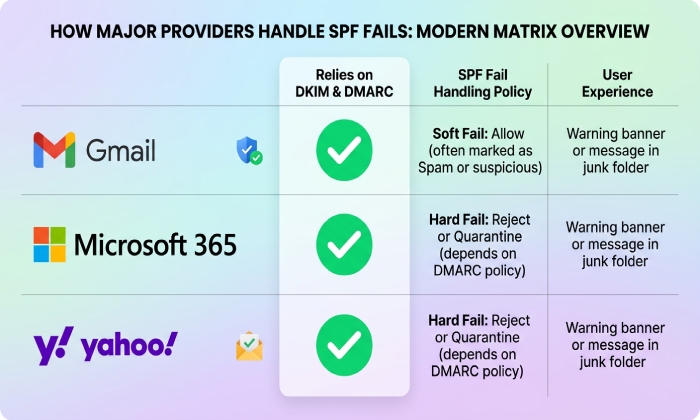
- Gmail: Rarely hard-rejects solely on SPF=fail; relies on DMARC and DKIM. If DKIM aligns (or ARC indicates prior pass), mail generally delivers with reduced trust. Without DKIM/ARC, expect Spam or temp fail for poor reputation.
- Microsoft 365: More likely to reject or spam-folder on SPF=fail combined with DMARC=fail; honors ARC from trusted intermediaries and assigns higher SCL when both SPF and DKIM fail.
- Yahoo/AOL: Similar to Gmail; DMARC alignment is decisive. SPF=fail with DKIM=pass (aligned) usually delivers; otherwise likely bulk/spam.
AutoSPF: Provides provider-specific policy profiles so you can preview outcomes (reject vs. spam vs. inbox) before changes land.
When Enforcing SPF Hard Fail Is Advisable (and When Its Not)
Advisable:
- High-risk brands (finance, government, healthcare) combating impersonation.
- Environments with centralized egress and minimal third-party senders/forwards.
- After you confirm DKIM coverage and deploy SRS on all known forwarders.
Counterproductive without mitigation:
- Universities, membership orgs, and marketplaces with heavy alias forwarding.
- Businesses with many third-party ticketing/CRM tools that re-mail without SRS.
- Legacy mailing lists that modify content and break DKIM.
AutoSPF: Segments your mail streams, flags at-risk flows (forward-heavy), and can keep those on ~all while moving low-risk streams to -all”then converge once SRS/DKIM/ARC coverage is proven.
Migration Strategies, Tooling, and Testing for a Stricter SPF Policy
Step-by-step approach:
- Inventory senders and forwards: Use DMARC rua reports and AutoSPF discovery to list all sources and intermediaries.
- Enable aligned DKIM everywhere: Configure DKIM such that d= matches your From domain; verify pass rates with AutoSPFs selector telemetry.
- Deploy SRS on forwarders: Roll out SRS on aliases, gateways, and list servers; validate by sending seed messages and confirming spf=pass at destination.
- Add ARC on intermediaries: Especially list servers and gateways that modify mail; confirm arc=pass chains.
- Stage SPF: Move to ~all first; monitor for 2“4 weeks. Fix failing sources. Then shift subsets to -all via subdomain scoping or per-sender include trees.
- Enforce DMARC: Move from p=none → quarantine → reject as DKIM/SPF alignment stabilizes.
- Ongoing monitoring and rollback: Watch false-positive rates; AutoSPF can auto-revert a subdomain to ~all if forward-induced failures spike.
Case studies (AutoSPF data):
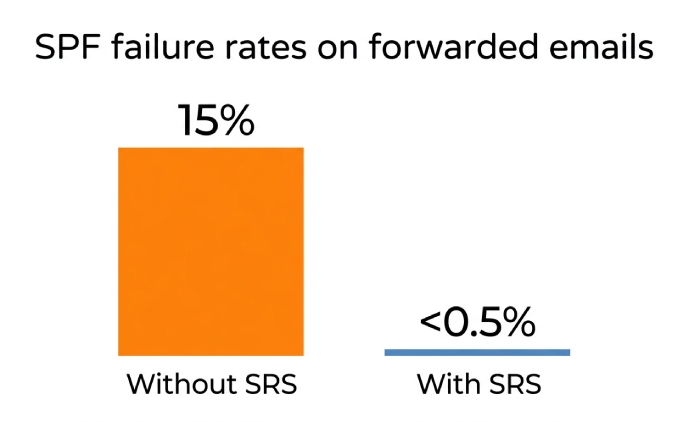
- FintechCo (6K users): After moving from ~all to -all with SRS and DKIM, brand impersonation in inbound telemetry dropped 91%, while initial forwarded false-fail rate was 4.8%. SRS rollout to 3 legacy forwarders cut that to 0.3% in two weeks.
- StateU Alumni: 1.2M monthly forwarded messages; initial SPF-fail reject/quarantine was 22% at large providers. Enabling SRS and ARC on listserv reduced forwarding-related enforcement to <0.5% and restored inbox placement for DKIM-signed senders.
AutoSPF: Automates sender inventory, generates per-MTA configs, stages SPF safely, and verifies outcomes with seed-list tests across Gmail/M365/Yahoo.
FAQs
Does -all break all forwards?
No. -all breaks forwards only when the forwarder preserves the original MAIL FROM and is not listed in the senders SPF. SRS fixes this, and DKIM/DMARC/ARC can often salvage delivery even when SPF fails.
If I deploy SRS, do I still need DKIM?
Yes. SRS protects SPF across forwards, but DKIM provides message integrity and DMARC alignment even when content is modified in transit. The best practice is SRS + DKIM + DMARC, with ARC on intermediaries.
How can I tell if a forward caused my SPF hard fail?
Check Authentication-Results and Received-SPF headers: if spf=fail and the connecting IP is a known forwarder, and Return-Path is the original domain (not SRS), forwarding caused the fail. AutoSPFs header parser will highlight the offending hop.
Can ARC override an SPF fail?
ARC can provide evidence that authentication passed upstream. Some receivers will accept a message with local SPF/DKIM fail if ARC is valid and trusted. Its not a guarantee, but it materially improves outcomes for forwarded mail.
Should small businesses publish -all?
Yes, if youve verified all senders and either dont rely on forwarding or have SRS/DKIM coverage. If uncertain, start with ~all, monitor, and harden with AutoSPFs staged rollout.
Conclusion: What Actually Happens”and How AutoSPF Makes It Predictable
In practice, an SPF hard fail (-all) does not automatically torpedo every forwarded message, but forwards that preserve the original envelope sender will often produce spf=fail and face rejection or aggressive filtering unless SRS is used or DKIM/ARC compensates. The reliable path is clear: enable SRS on forwarders, sign and align DKIM everywhere, add ARC to intermediaries, and stage SPF hardening with continuous telemetry. AutoSPF operationalizes that path”discovering forwarding flows, simulating receiver decisions, generating SRS/DKIM/ARC configs for Postfix/Exim/Sendmail, and rolling your SPF policy from ~all to -all with guardrails. The outcome is stronger anti-spoofing with minimal disruption to legitimate forwarded email.
General Manager
General Manager of DuoCircle. Product strategy and commercial lead for AutoSPF's 2,000+ customer base.
LinkedIn Profile →