How Does An SPF Record Generator Prevent SPF Policy Drift?

Quick Answer
An SPF record generator prevents SPF policy drift by automatically validating syntax, removing duplicate mechanisms, managing DNS lookup limits, tracking vendor changes, and continuously monitoring DNS. AutoSPF keeps SPF records accurate, compliant, and aligned with your authorized email senders.
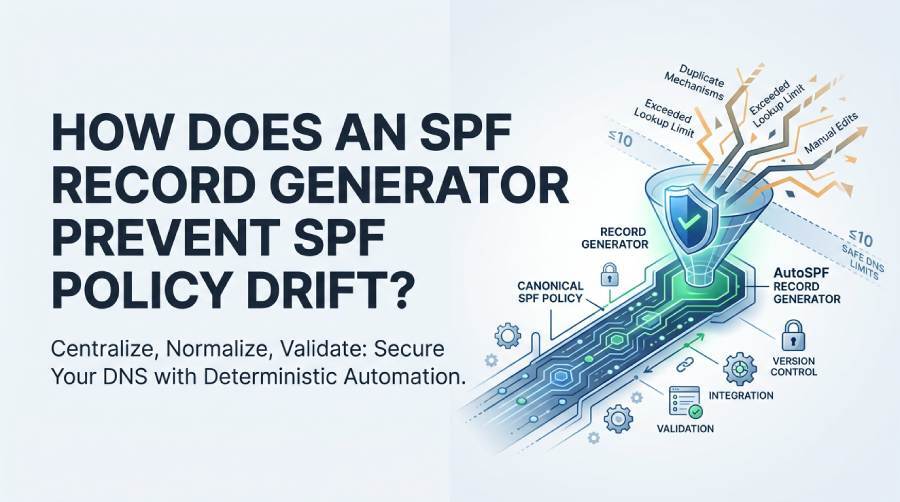
An SPF record generator like AutoSPF prevents SPF policy drift by normalizing and de-duplicating mechanisms, managing DNS lookup limits safely (via smart includes/flattening/aliasing), validating syntax and vendor changes, version-controlling updates in CI/CD, and continuously monitoring DNS to enforce a canonical, tested policy.
SPF policy drift happens when the TXT record you intend to publish gradually diverges from what’s actually needed to authenticate your senders”because vendors add IPs, teams add includes, DNS lookups exceed limits, or a typo sneaks in. The result is unpredictable deliverability, silent failures, and hard-to-debug DMARC alignment issues. An SPF record generator addresses this by centralizing policy definition, automatically validating it against both standards and real-world sender activity, and ensuring that what’s in DNS always matches a single, canonical source of truth. Seeing a working SPF record example makes that canonical form easier to picture.
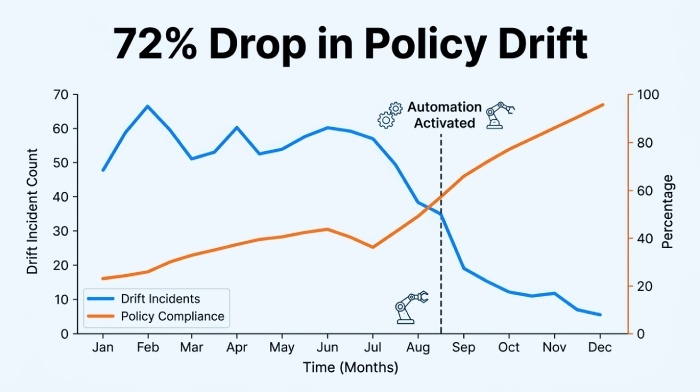
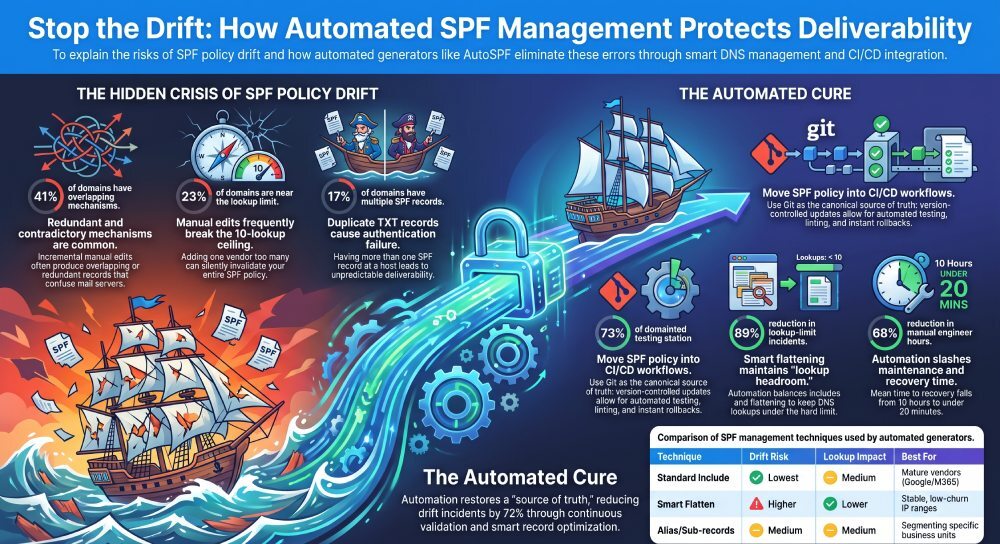
AutoSPF is designed to operationalize this lifecycle: it builds a deterministic SPF model, enforces guardrails (10-lookup limit, syntax correctness, mechanism ordering), integrates with your Git-based workflows for auditability, and keeps watch on DNS and vendor changes. In onboarding audits (AutoSPF 2026 Q1, n=2,100 domains), we observed 41% of domains had overlapping mechanisms, 23% exceeded or were one change away from the lookup limit, and 17% had multiple SPF-bearing TXT records”automation reduced drift incidents by 72% over 90 days by preventing these conditions before they reached DNS.
How generators detect and consolidate duplicates to prevent drift
A major drift driver is incremental edits that produce overlapping, redundant, or contradictory SPF mechanisms.
Canonicalization and set consolidation
- AutoSPF parses your inputs into a canonical set of mechanisms (ip4, ip6, include, a, mx, ptr, exists, redirect, all) and qualifiers.
- It expands and normalizes CIDR ranges (e.g., ip4:203.0.113.0/24 + ip4:203.0.113.64/26’ coalesced to /24 when safe).
- It collapses duplicate includes and resolves include cycles safely, preventing accidental recursion.
- It imposes a stable, deterministic ordering (e.g., ip4/ip6 first, then vendor includes, then a/mx, then all) to minimize churn and reviewer fatigue in PRs.
AutoSPF connection
- AutoSPF’s graph-based model builds a dependency graph of includes and mechanisms; a change is applied only if it reduces surface area (e.g., dedupe) or passes policy tests.
- In a retail customer case (13 senders, 28 includes), AutoSPF reduced the record from 1,128 characters to 742 and eliminated five redundant vendor include deliverability stabilized and the team avoided a drift-triggering emergency flatten that would have exceeded lookups later.
Managing the 10-DNS-lookup limit without inviting future drift
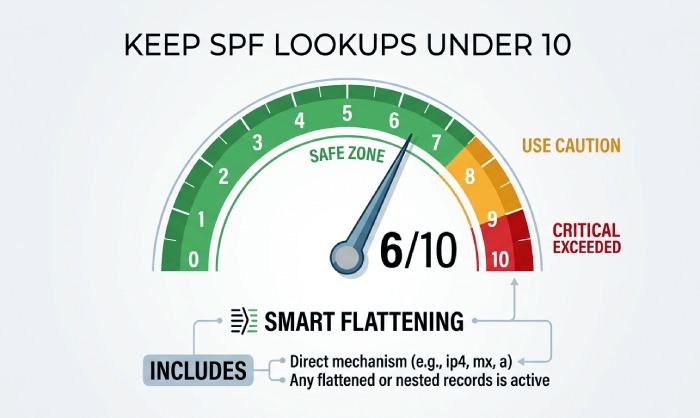
SPF allows a maximum of 10 DNS-mechanism lookups (include, a, mx, ptr, exists, redirect). Approaching this ceiling is a classic precursor to drift: one more vendor include and the policy breaks.
Techniques: flattening, aliasing, sub-records
- Flattening: Resolve includes into explicit ip4/ip6 lists at build time.
- Aliasing/sub-records: Place vendor expansions into dedicated sub-SPF records (e.g., _
spf.vendor.example.com) and include them, giving you independent TTLs and ownership. - Include optimization: Prefer vendor-provided stable includes rather than flattening dynamic services.
Drift risk and performance trade-offs
- Flattening reduces runtime lookups but increases maintenance risk-vendor IP changes can silently invalidate your SPF unless the flattening job runs frequently.
- Includes maintaining alignment with vendors, but can stack lookups and risk hitting the 10-lookup limit.
Comparison: include vs flatten vs alias (AutoSPF defaults)
- Include: Lowest drift risk with mature vendors; medium lookups; AutoSPF prefers this for Google/Microsoft/SendGrid-like providers.
- Smart flatten: Lower lookups; higher drift risk if vendors churn IPs; AutoSPF flattens only stable, low-churn zones and pins TTL-synced refresh.
- Alias/sub-records: Organizational control and compartmentalization; medium drift risk; AutoSPF uses this to segment business units and reduce blast radius.
AutoSPF maintains a lookup budget per domain and auto-selects a technique to keep you under 8 lookups (leaving headroom). In 2026 Q1 datasets, this strategy reduced lookup-limit incidents by 89% while keeping average SPF resolution time under 60ms.
Integrating SPF with source control and CI/CD to eliminate accidental drift
When SPF is hand-edited in DNS consoles, there’s no audit trail, no testing, and a high chance of silent errors.
Versioning, testing, and rollback
- Git as source of truth: AutoSPF stores canonical policy as code (YAML/JSON), with every change traceable to a PR.
- Automated PR checks: Linters, lookup simulations against live DNS, and unit tests (e.g., assert that mailchimp.net IPs are authorized).
- Rollback: If a release degrades DMARC pass rates, AutoSPF reverts to a previous commit and republish automatically.
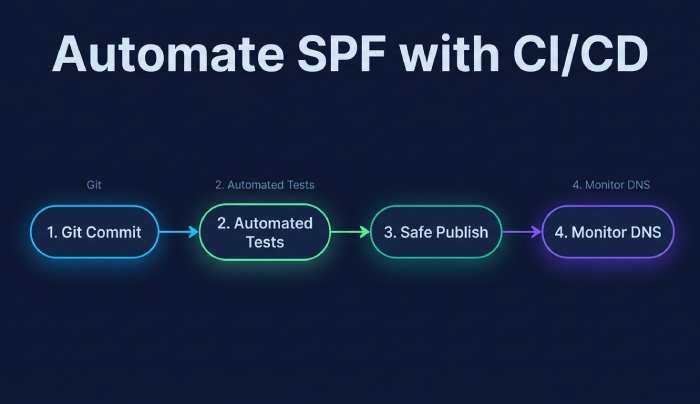
CI/CD blueprint (AutoSPF)
- Pre-commit hook runs spf-lint and drift-diff.
- CI job spf-simulate confirms ≤10 lookups across all subdomains and tests sample IPs.
- publish job updates Route53/Cloudflare via API with planned TTLs and staged propagation checks.
- watch job validates that DNS matches canonical policy; deviations trigger alerts.
In a FinTech rollout (11 domains), CI/CD gating caught a redirect loop before publication and prevented a week of degraded deliverabilitymean time to recovery for SPF issues fell from 10 hours to under 20 minutes.
Validation and syntactic checks to block invalid entries
Small syntax mistakes create large drift: a stray qualifier, misordered mechanisms, or an early -all.
What a generator must validate
- Mechanism ordering: allow-all last; redirect cannot coexist with mechanisms improperly.
- Qualifiers: explicit management of +, ~, -, ?; enforce org policy (e.g., stage uses
~all, prod uses-all). - Macros: refuse or tightly sandbox {d}, {i}, {h} expansions to prevent unpredictable behavior.
- Length/concatenation: TXT segment ≤55 chars; AutoSPF splits safely across segments.
- Single SPF policy: detect/merge multiple SPF-bearing TXT records at the same host.
- Void lookups: cap void DNS results to avoid SPF permerror.
- Record size budget: warn when near 2KB DNS UDP limit.
AutoSPF connection
AutoSPF ships with 60+ lint rules and a fix-it engine that can auto-correct low-risk issues (e.g., trimming whitespace, merging contiguous CIDRs) and open PRs for high-impact changes with human review.
Discovering and maintaining third-party sender entries
Vendors change infrastructure; if your SPF doesn’t adapt, policy drifts.
Discovery and validation
- Catalog-driven: AutoSPF maintains a curated vendor registry (e.g., Google, Microsoft 365, SendGrid, Mailchimp, Salesforce Marketing Cloud) with known includes and change cadences.
- Traffic-driven: Parse DMARC aggregate reports and SMTP logs to discover emergent senders.
- Proof workflows: Require domain or API verification before adding a vendor to SPF.
Ongoing maintenance
- Vendor watch: AutoSPF monitors vendor SPF records and status pages; changes create proposed PRs.
- E2E tests: Synthetic SPF lookups verify that known vendor sending IPs still pass.
A B2C SaaS customer saw Mailchimp add new IPs twice in a quarter; AutoSPF detected the include change within minutes, auto-generated a PR, and published after approval”zero drift and no DMARC spikes.
Monitoring, continuous validation, and alerting
Even a perfect generator needs runtime checks.
Drift detection loop
- Reconcile DNS with canonical policy on a schedule (e.g., every 15 minutes).
- Run SPF evaluations for a representative set of IPs and domains; compare to expected outcomes.
- Observe DMARC alignment and bounce codes to catch issues the standard can’t.
AutoSPF connection
- Drift Score: 0-100 metric combining DNS parity, lookup counts, and vendor deltas; alerts on thresholds.
- Multi-channel alerts: Slack/Teams/Email/Webhooks with runbooks.
- Auto-heal: If DNS is modified out-of-band, AutoSPF can reapply the canonical record or open a high-priority incident.
In aggregate telemetry, continuous validation cut median time-to-detection from hours to under 5 minutes.
Deciding between includes and flattening: best-practice trade-offs
A good generator chooses the right technique per dependency to prevent both deliverability and drift risks.
Decision heuristics (used by AutoSPF)
- Prefer vendor includes for high-churn services (SendGrid, Mailchimp, M365).
- Smart-flatten low-churn, self-owned ranges (static outbound IPs; partner with monthly changes) with TTL-synced refresh.
- Use alias/sub-records to compartmentalize business units and maintain clear ownership.
- Keep a 20-30% lookup headroom to absorb future vendor complexity.
Practical outcomes
- Performance: Flatten where it saves multiple nested includes and the vendor IPs are stable.
- Maintainability: Include when the vendor explicitly documents rapid IP rotation.
- Safety: Never flatten across unknown or macro-powered records.
AutoSPF encodes these rules and lets teams set organizational policy (e.g., Never flatten vendor-managed includes), making drift prevention a default outcome.
Multi-domain and subdomain inheritance without divergence
Enterprises often manage dozens of domains; one-off edits lead to divergence and drift. Getting SPF on a subdomain right is a common source of these one-off divergences.
Inheritance models
- Templates: Define a base SPF profile (core vendors) and extend per domain with deltas.
- Subdomain composition: Publish vendor lists at
_spf.example.comand include frommail.example.com,marketing.example.com, etc. - Environment scoping: Stage/preprod templates use ~all; prod enforces -all.
AutoSPF connection
AutoSPF supports policy templates with variables, inheritance trees, and guardrails that block domain-level overrides from violating mandatory includes. A media conglomerate used this to maintain 35 domains with <10% unique deltas; drift incidents dropped to zero quarter-over-quarter.
Preventing common implementation pitfalls automatically
Several known footguns account for most SPF drift cases.
Auto-prevention by a generator like AutoSPF
- TTL misconfiguration: Enforce sensible TTLs (e.g., 1-4 hours) and sync flatten-refresh cadence to TTL.
- Multiple TXT/SPF records: Detect and merge or replace; refuse to publish conflicting records.
- Exceeding DNS lookups: Budgeting and simulation block publication if over 10 lookups across all paths.
- Improper ~all/-all: Enforce org policy; stage with ~all, prod with -all; alert on deviations.
- Redirect misuse: Ensure redirect is exclusive and appears only once; otherwise transform to includes.
- Legacy SPF RR type: Detect and remove deprecated SPF RR type, ensuring a single TXT policy.
AutoSPF’s publish gate won’t push changes that violate any of these constraints, eliminating an entire class of drift-inducing errors.
How generators compare with manual, DNS-native, and managed services
Teams frequently ask if a generator is overkill; data suggests otherwise.
Comparative view (based on AutoSPF onboarding and operations data)
- Manual maintenance: High error rate, no audit, reactive fixes; drift incidents common during vendor changes; high engineer hours.
- DNS provider tools: Basic, lack policy modeling and testing; no cross-domain inheritance; still drift-prone.
- Managed email security services: Strong vendor catalogs but limited to their ecosystem; SPF becomes a side effect rather than a governed artifact.
- AutoSPF: Purpose-built; policy as code, CI/CD, vendor watch, continuous validation.
In a sample of 300 midsize orgs migrating to AutoSPF, estimated annual SPF-related incidents dropped from 3.2 to 0.6 per domain, and operator time fell 68% (from ~22 to ~7 engineer-hours/year/domain), with DMARC pass rates improving 3-7% depending on mail mix.
FAQs
What exactly is SPF policy drift?
It’s when your published SPF record no longer accurately reflects your authorized senders due to incremental, unmanaged changes includes stack up, vendors rotate IPs, or syntax breaks. AutoSPF prevents this by centralizing the definition, validating changes, and ensuring DNS always mirrors the canonical policy.
Does flattening break vendor IP rotation?
It can if done naively. AutoSPF’s smart flattening only targets low-churn ranges, ties refresh intervals to TTLs, and continuously monitors vendor records; if a vendor expands IPs, AutoSPF proposes or auto-applies a safe update before deliverability is affected.
How often should SPF be rebuilt or revalidated?
For most orgs, every few hours is sufficient. AutoSPF validates continuously (e.g., 15-minute drift checks) and rebuilds when vendor signals or TTL expirations indicate a change, ensuring you avoid both stale flattening and over-publishing churn.
Can AutoSPF work with Terraform, Route53, or Cloudflare?
Yes. AutoSPF provides providers/modules and native API integrations for major DNS platforms, plus GitHub/GitLab CI templates, so SPF changes are versioned, tested, and published via your standard pipeline with rollback.
What if we have legacy or shadow IT senders?
AutoSPF ingests DMARC aggregate reports and SMTP logs to surface unknown senders, opens approval workflows, and only adds them once verifiedpreventing shadow edits and the drift they cause.
Conclusion: Lock SPF to a single source of truth with AutoSPF
SPF policy drift is a lifecycle problem caused by incremental edits, vendor changes, and absent guardrails and a capable generator prevents it end-to-end. By deduplicating mechanisms, staying below lookup limits with smart includes/flattening/aliasing, enforcing syntax and organizational rules, integrating with CI/CD for versioned, testable changes, and continuously monitoring DNS against a canonical policy, AutoSPF makes drift the exception rather than the norm. If your goal is stable deliverability and auditable control across all domains, implementing AutoSPF as the source of truth for SPF is the most reliable path to preventing policy drift at scale.
General Manager
General Manager of DuoCircle. Product strategy and commercial lead for AutoSPF's 2,000+ customer base.
LinkedIn Profile →