How Does Third-Party Server Maintenance Handle Hardware Failures?

Quick Answer
Third-party server maintenance providers handle hardware failures by diagnosing faulty components, sourcing compatible replacement parts, and performing remote or on-site repairs. These services help businesses reduce downtime and maintain older servers beyond OEM support.
Server hardware failures can happen without warning, even when equipment has been running reliably for years. A failed power supply or storage drive can interrupt business applications and leave IT teams dealing with unexpected downtime. The situation gets worse when the affected server is no longer under manufacturer support.
Third-party server maintenance offers another way to handle these failures without relying entirely on OEM support. Independent providers can diagnose hardware problems and arrange repairs using compatible replacement parts. However, the actual repair process depends on the affected component and the service agreement.
This article explains how third-party maintenance providers handle server hardware failures and what businesses can expect during repairs.
How Does Third-Party Server Maintenance Work?
Third-party maintenance (TPM) lets businesses get hardware repair services from an independent provider instead of the original manufacturer. These providers maintain supported servers from brands such as Dell, HPE, and Lenovo under separate service agreements. Their services can include remote troubleshooting and on-site repairs, depending on the contract.
When a covered server fails, the provider investigates the problem and identifies the affected hardware. The provider then arranges replacement parts through its inventory or supply network. The response time depends on the service level agreed upon before the failure.
Unlike manufacturer support, TPM can remain available after a server reaches its official end-of-service date. This makes it useful for businesses that keep older hardware running while planning future replacements.
How Third-Party Maintenance Providers Handle Server Hardware Failures
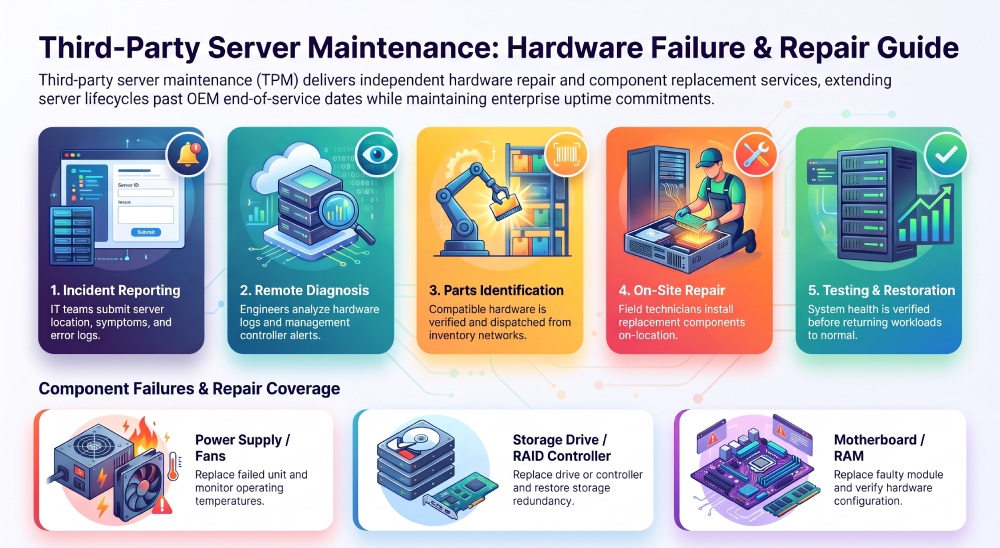
Third-party maintenance providers generally follow a defined repair process when covered equipment fails. Steps vary by provider, but most hardware incidents follow these stages.
1. Hardware Failure Reporting
The repair process begins when an IT team reports a server problem to its maintenance provider. The initial request usually includes the server model, location, and symptoms observed during the failure. Monitoring alerts and error logs can also help describe the problem.
The provider creates a support ticket and checks the server’s maintenance coverage. Critical incidents may receive higher priority under contracts with shorter response commitments. The assigned engineer can then begin investigating the reported issue.
2. Remote Hardware Diagnosis
Engineers can investigate many hardware failures before a technician visits the site. Engineers may review hardware logs and management controller alerts to identify the affected component. This helps determine if the problem involves a failed drive or another physical part.
However, not every failure can be diagnosed remotely. Some problems require physical inspection, particularly when a server cannot power on. The provider may arrange an on-site visit when remote troubleshooting cannot identify or resolve the fault.
3. Replacement Parts Identification
Once the maintenance provider identifies the failed component, it checks for a compatible replacement. Older servers may require specific parts that are no longer available through standard OEM channels. Third-party providers often maintain independent inventories to support these systems.
Part compatibility is particularly important for components such as system boards and memory modules. An incorrect replacement can create additional problems even when the component fits the server. Providers should verify hardware specifications before sending parts to the repair location.
4. On-Site Hardware Repair
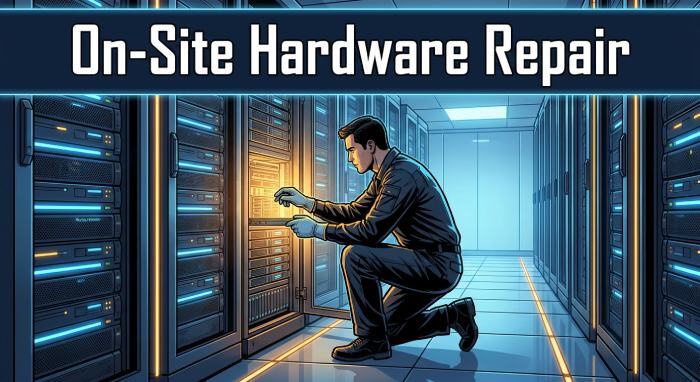
A technician may be dispatched on-site when the failed hardware cannot be replaced remotely or by the customer’s IT team. The technician inspects the affected server and installs the replacement component. Depending on the hardware design, some repairs can be completed without shutting down the entire system.
However, motherboard failures and certain other repairs may require a complete shutdown. Businesses running critical applications may need to move workloads before maintenance begins. The repair schedule should account for these requirements when the server remains partially operational.
5. Hardware Testing and Service Restoration
Replacing the failed component is not always the final step. The technician may need to check hardware health and confirm that the server recognizes the new part. Additional testing can identify problems that were not visible during the initial diagnosis.
The IT team can then check the affected workloads before returning the server to normal operation. Some incidents may also require reviewing system logs or storage health. The support ticket can be closed once the agreed repair work and testing are complete.
What Types of Server Hardware Failures Can Third-Party Maintenance Cover?
Third-party maintenance can cover many common server component failures. However, the available repairs depend on the server model and the services included in the agreement.
| Hardware Failure | Typical Repair Approach |
|---|---|
| Power supply failure | Replace the failed power supply |
| Hard drive or SSD failure | Replace the drive and restore storage redundancy where applicable |
| Memory failure | Identify and replace the faulty memory module |
| Cooling fan failure | Replace the fan and check operating temperatures |
| Motherboard failure | Repair or replace the system board as supported |
| RAID controller failure | Replace the controller and verify storage configuration |
| Network adapter failure | Replace the affected adapter or supported module |
Some hardware failures also create problems beyond the damaged component. For example, replacing a failed drive doesn’t automatically recover data that’s already lost. Businesses still need suitable backups and recovery procedures alongside their maintenance agreements.
How Do Third-Party Maintenance Providers Reduce Server Downtime?
Hardware repairs can take longer when technicians or replacement parts aren’t readily available. Third-party maintenance providers use different service arrangements to reduce these delays. The available options depend on the provider’s coverage and the customer’s location.
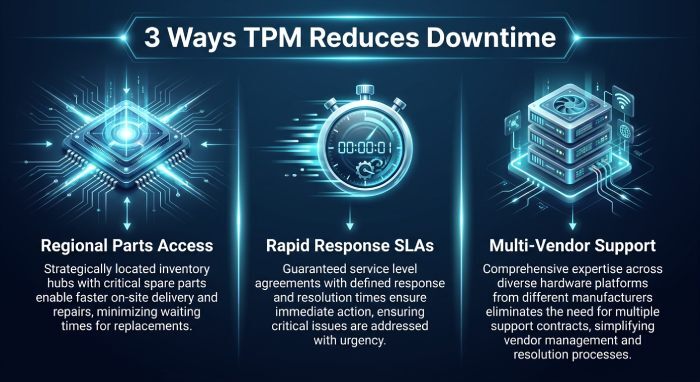
Faster Access to Replacement Parts
Some maintenance providers keep replacement components in regional stocking locations. This lets technicians access commonly needed parts without waiting for a manufacturer shipment. For older servers, independent parts inventories can also provide access to components that OEMs no longer stock.
On-Site Response Agreements
Maintenance contracts can include defined response times for hardware failures. Four-hour on-site and next-business-day support are common options for covered enterprise equipment. Faster coverage is generally better for servers, where prolonged downtime can disrupt critical operations.
However, a four-hour response agreement doesn’t necessarily guarantee repair completion within four hours. Complex hardware failures may require additional investigation or replacement parts. Businesses should review the exact SLA terms before choosing a support level.
Support for Multiple Server Brands
Businesses often operate servers from different manufacturers within the same environment. A multi-vendor maintenance provider may support these systems through one agreement. This can simplify incident reporting when hardware failures affect equipment from different brands.
What Should Businesses Look for in a Third-Party Server Maintenance Provider?
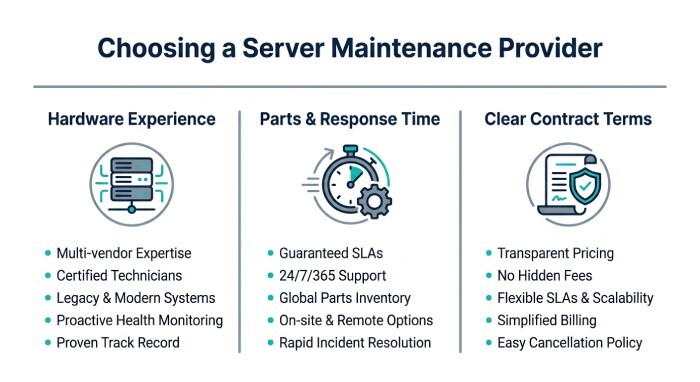
The quality of third-party maintenance depends on the provider’s ability to deliver repairs when hardware failures occur. Experience with older equipment matters, but availability of replacement parts and service coverage are equally important. Businesses should compare these capabilities before choosing a maintenance partner.
Experience With Enterprise Server Hardware
A reliable provider should have experience maintaining the server brands and generations your business uses. Some companies support newer enterprise hardware but have limited coverage for discontinued models. Confirming support for individual server models can prevent problems during future repairs.
Reliable Parts Availability and Response Times
A maintenance agreement is only useful when the provider can respond to hardware failures within the agreed period. Businesses should check the availability of field technicians and compatible replacement components in their operating locations. The SLA should also explain how it escalates unresolved incidents.
For example, Dataknox provides third-party server maintenance for Dell, HPE, Lenovo, Cisco, and other enterprise hardware brands. The company offers four-hour on-site response options backed by a network of more than 700 stocking locations. It also advertises support for eligible servers up to 10 years beyond OEM end of life, making it an option for businesses maintaining older infrastructure.
Clear Maintenance Contract Terms
Maintenance contracts should explain which hardware components are covered and what happens during a failure. Some agreements include replacement parts and on-site labor, while others exclude them, which can affect the final repair cost. These differences matter when businesses compare providers with similar annual fees.
Businesses should also strengthen email security by implementing DMARC, DKIM, and SPF to authenticate email communications and protect their IT infrastructure from spoofing and phishing attacks.
Contract terms should also reflect each server’s importance. Critical production systems may require round-the-clock coverage, while development servers can often operate with standard support hours. Choosing the right service levels helps businesses control maintenance costs without leaving critical hardware unprotected.
What Are the Limitations of Third-Party Server Maintenance?
Third-party maintenance primarily addresses physical hardware failures. Although providers can replace damaged components, they may not have access to manufacturer-controlled software or firmware updates. These services can require separate support entitlements.
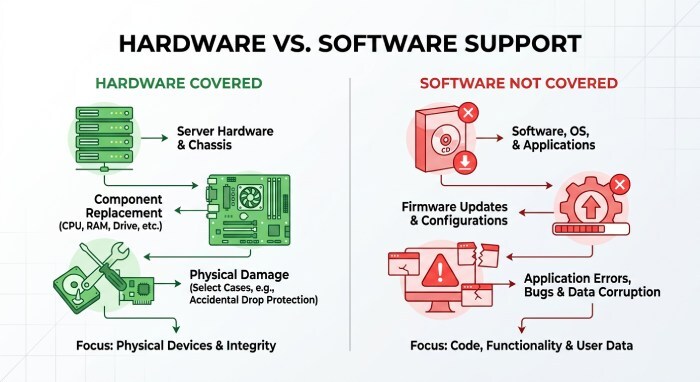
Hardware repairs also cannot resolve every server problem. Application errors and unsupported operating systems may need assistance from other vendors or internal IT teams. A maintenance agreement should clearly distinguish hardware support from software troubleshooting.
Some failures may also require a complete server replacement rather than another repair. Repeated hardware problems and unavailable replacement components can make continued maintenance less practical. Businesses should review these risks when deciding how long to keep older servers operational.
Frequently Asked Questions
Can third-party maintenance repair servers after end of life?
Yes, third-party maintenance providers can repair many servers after manufacturers discontinue official support. Coverage depends on the specific hardware model and the availability of compatible replacement parts.
How quickly can a third-party provider repair a failed server?
Repair times depend on the failure type and the maintenance agreement. Some providers offer a four-hour on-site response, but repairs may take longer if they need additional parts or further investigation.
Does third-party server maintenance include replacement parts?
Many maintenance agreements include replacement parts for covered hardware failures. However, businesses should review contract exclusions and confirm if labor costs are included.
Can third-party maintenance providers support multiple server brands?
Yes, many independent providers maintain equipment from Dell, HPE, Lenovo, Cisco, and other manufacturers. Supported server models and response times vary by company.
Conclusion
Third-party server maintenance handles hardware failures by diagnosing issues and replacing components under agreed service terms. It can provide continued repair coverage for older servers when manufacturer support is unavailable or too expensive.
However, the service’s reliability depends on the provider’s technical expertise and access to replacement parts. Businesses should compare these factors alongside response commitments before choosing a maintenance agreement.
General Manager
General Manager of DuoCircle. Product strategy and commercial lead for AutoSPF's 2,000+ customer base.
LinkedIn Profile →