Why Do Cyber Attackers Use Social Engineering? Risks, Detection, Prevention, and Best Practices

Quick Answer
Cyber attackers use social engineering because manipulating people is often easier than exploiting technology. By using trust, urgency, fear, and deception, attackers steal credentials, spread malware, commit fraud, and bypass security controls.
What Social Engineering Is and Why It Matters
Social engineering is the use of deception, psychological manipulation, and emotional triggers to influence people into taking unsafe actions—clicking malicious links, sharing login credentials, approving payments, installing malware, or disclosing sensitive information. Unlike attacks that rely only on exploiting software bugs, social engineering targets the human element: trust, routine, curiosity, fear, urgency, greed, and helpfulness.
Cyber attackers use social engineering because people are often easier to manipulate than hardened digital networks, devices, accounts, firewalls, or endpoint tools. A single employee mistake can bypass layers of cybersecurity controls, especially when cybercriminals craft convincing messages that appear to come from Microsoft, Apple, Google, a Government agency, a National or global bank, an Online retailer, or an online payments provider.
Organizations such as IBM, ISACA, and the FBI have repeatedly warned that social engineering remains central to scams, identity theft, information theft, ransomware, and Business Email Compromise (BEC). IBM’s Cost of a Data Breach report and X-Force Threat Intelligence Index have also highlighted how stolen credentials, phishing, and human error contribute to costly incidents. From the classic Nigerian Prince or Nigerian royal scam to modern spear phishing on LinkedIn, Facebook, Twitter, WhatsApp, and other social networking site platforms, the core method is the same: exploit trust before technology can stop the attack.
Why Social Engineering Is So Effective
Social engineering works because it feels personal and timely. Cybercriminals use psychological tactics that mimic normal business communication, customer support, loyalty rewards, contests, surveys, delivery notices, IRS alerts, or technical support requests. The message may look harmless, but the goal is to trigger action before the victim thinks critically.
The Human Element Is the Primary Target
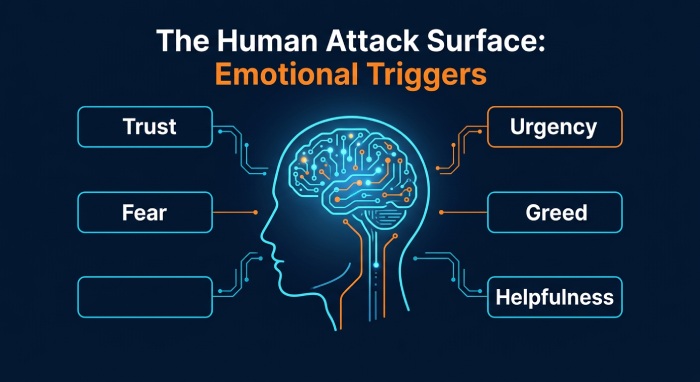
The human element creates an attack surface that security teams cannot fully eliminate. Even strong data security programs can suffer when employee trust is abused. A realistic spoofing attempt, fake websites, company brand impersonation, or impersonation of an authority figure can convince a user to reveal a password, financial information, bank account numbers, credit card numbers, social security numbers, or other confidential information.
Why Cyber Attackers Use Social Engineering: Exploiting Human Trust Instead of Technical Flaws
Cyber attackers use social engineering because it is efficient, scalable, and often cheaper than developing advanced exploits. Instead of breaking encryption or defeating hardened systems, cybercriminals persuade someone to open the door. That “door” may be a malicious attachment, a password reset page, a cloud account, a VPN login, or an internal approval workflow.
Trust Is Easier to Exploit Than Code
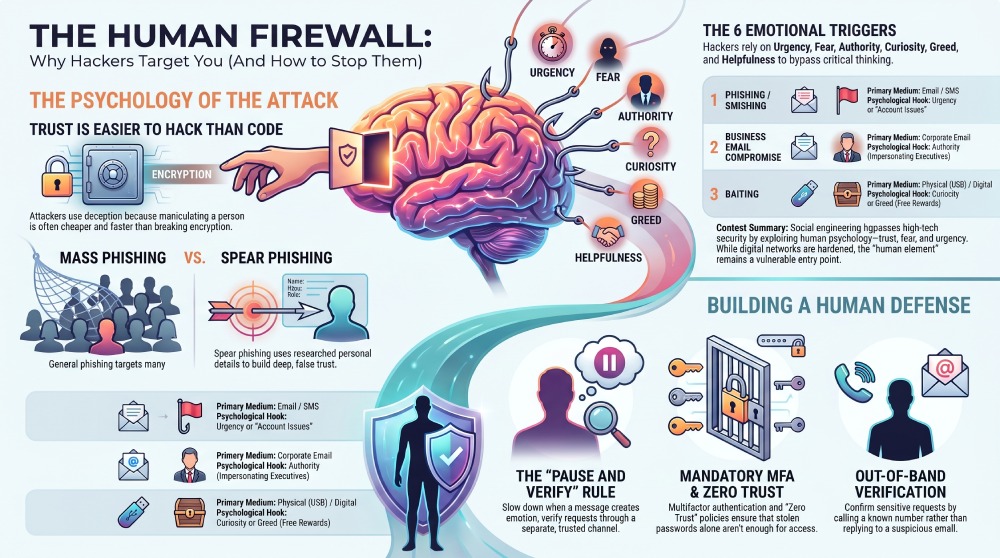
Trust is the foundation of workplace collaboration, but it is also a weakness. Threat actors exploit trust by pretending to be executives, vendors, customers, IT administrators, recruiters, celebrities, government officials, or banking representatives. In business email compromise, for example, cybercriminals may impersonate a CEO or finance leader and create urgency around a wire transfer. In spear phishing, cyber attackers customize the message using LinkedIn details, public posts, or breached personal data to make the request believable.
Human Error Turns Small Deceptions Into Major Incidents
Human error is not simply carelessness; it is often the predictable result of psychological manipulation. A rushed employee may approve an invoice, click phishing links, download malware, or provide login credentials because the request appears normal. When cybercriminals combine urgency, fear, greed, and authority, human error can lead to data breach, network compromise, ransomware, and account takeover.
Technical Controls Help, But They Do Not Remove Risk
Spam filters, email gateways, firewalls, antivirus software, Endpoint Detection and Response (EDR), Extended Detection and Response (XDR), and endpoint detection and response tools reduce exposure, but social engineering can still succeed when users are manipulated. Email authentication also matters: tools such as AutoSPF can help organizations simplify SPF management, while SPF, DKIM, and DMARC work together to authenticate email and reduce domain spoofing. An SPF checker confirms a domain’s policy is valid.
Common Social Engineering Tactics: Phishing, Pretexting, Baiting, Quid Pro Quo, and Impersonation
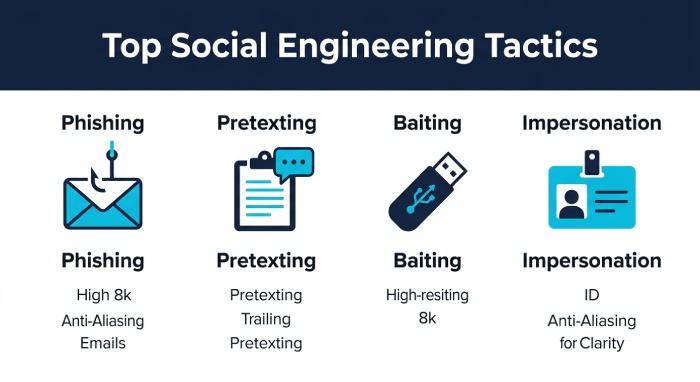 Social engineering includes many attack patterns, but the most common tactics rely on deception, trust, and emotional triggers. Cybercriminals constantly adapt these tactics to email, phone, text messaging, search engines, collaboration tools, and social media.
Phishing and Spear Phishing
Phishing is a broad category of social engineering in which cyber attackers send fraudulent messages that appear legitimate. These messages may imitate Microsoft, Apple, Google, a National or global bank, an Online retailer, the IRS, or a delivery service. The goal is to steal login credentials, install malware, capture financial information, or redirect victims to fake websites.
Spear phishing is more targeted. Instead of sending generic phishing messages, cybercriminals research a person, team, or organization. They may reference job titles from LinkedIn, interests from Facebook, or recent company news from a Think Newsletter or public announcement. Spear phishing often supports business email compromise, ransomware access, and data theft.
Related Phishing Variants
Search engine phishing manipulates search results or ads to lead users to fake websites. Smishing uses SMS or messaging apps such as WhatsApp. Vishing uses voice calls and fake technical support scripts. Angler phishing targets customers who complain to a company on social media, including Twitter. A watering hole attack compromises a website that a specific group is likely to visit, sometimes leading to a drive-by download or malware infection on Windows or other systems.
Pretexting, Baiting, and Quid Pro Quo
Pretexting uses a fabricated scenario to build trust. A cybercriminal might claim to be from IT, HR, a government agency, a bank, or a vendor conducting an audit. Pretexting is powerful because it gives the victim a reason to comply. In pretexting, psychological manipulation is often subtle: the attacker may sound calm, helpful, and professional.
Baiting uses greed, curiosity, or convenience. A malicious USB drive labeled “Payroll,” “Contest Winners,” or “Loyalty rewards” may entice someone to plug it into a device. Digital baiting may offer free software, pirated media, gift cards, or exclusive access. Quid pro quo scams promise a benefit in exchange for action, such as “complete this survey to receive a reward” or “verify your account to unlock support.”
Impersonation and Physical Social Engineering
Impersonation is common in business email compromise, spear phishing, and pretexting. Cyber attackers may pose as an authority figure, executive, customer, auditor, celebrity, or support technician. Tailgating is a physical tactic in which an attacker follows an authorized person into a restricted area, exploiting politeness and employee trust. Poor access control can turn tailgating into a serious organizational security issue.
Psychological Triggers Attackers Rely On: Urgency, Fear, Authority, Curiosity, and Helpfulness
Social engineering succeeds because cybercriminals understand emotional triggers. They design messages to reduce skepticism and increase speed. The strongest emotional triggers include urgency, fear, authority, curiosity, greed, and helpfulness.
Urgency and Fear
Urgency pressures victims to act quickly: “Your account will be suspended,” “Payment is overdue,” or “Approve this invoice immediately.” Fear amplifies urgency by suggesting loss, discipline, legal trouble, or account closure. Scareware is a classic example: a pop-up claims the device is infected and pushes the user to download fake antivirus software or call fraudulent technical support.
Authority and Trust
An authority figure can override normal caution. A message from a supposed CEO, attorney, IRS agent, bank fraud team, or IT administrators may convince an employee to ignore policy. Cyber attackers use trust to make malicious instructions appear legitimate. In business email compromise, trust and urgency often combine to push fraudulent payments or changes to bank account numbers.
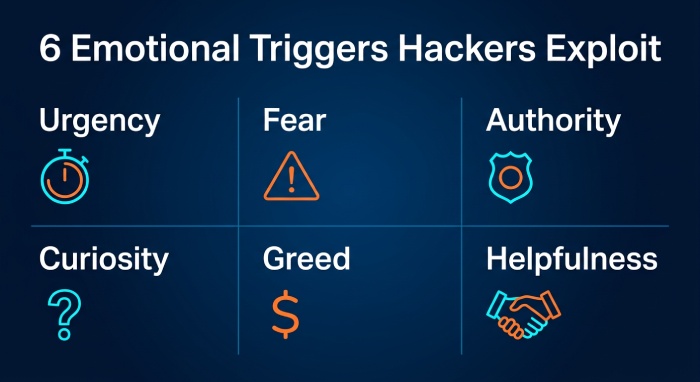
Curiosity, Greed, and Helpfulness
Curiosity drives users to open attachments labeled “confidential,” “salary changes,” or “private photos.” Greed drives clicks on contests, loyalty rewards, investment scams, and “too good to be true” offers. Helpfulness is also exploited: employees may share sensitive information because they believe they are assisting a coworker, customer, or vendor.
Psychological Manipulation Is Rehearsed and Iterative
Modern cybercriminals test subject lines, spoofing patterns, fake websites, and scripts. They adjust phishing and spear phishing campaigns based on what gets clicks. Increasingly, attackers lean on generative AI and phishing toolkits to scale these campaigns. This repeated psychological manipulation makes social engineering a business process for hackers, not a random trick.
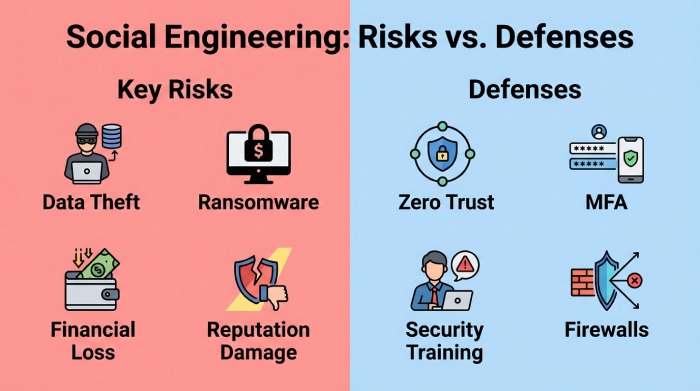
Business and Personal Risks: Data Theft, Financial Loss, Account Takeover, and Reputational Damage
The impact of social engineering can be severe. A single phishing email, pretexting call, or business email compromise message can expose confidential information, trigger ransomware, or cause financial loss. For individuals, the result may be identity theft, stolen accounts, fraudulent purchases, or compromised personal data. For companies, the result may be data breach, regulatory scrutiny, operational disruption, and reputational damage.
Data Theft and Account Takeover
Cyber attackers often seek login credentials because accounts provide direct access to email, cloud storage, payment systems, customer records, and internal applications. Once inside, cybercriminals may steal sensitive information, change recovery settings, monitor conversations, or launch additional spear phishing from trusted accounts.
Ransomware and Network Compromise
Social engineering is a common entry point for ransomware. A malicious attachment, stolen password, or malware download can lead to network compromise and lateral movement. If cybersecurity controls are weak, attackers may disable backups, spread ransomware, and demand payment.
Financial Loss and Reputational Damage
Business email compromise can cause direct losses through fraudulent invoices, altered bank account numbers, and executive impersonation. Personal scams may target credit card numbers, social security numbers, and online payments provider accounts. A public data breach can also damage customer trust, employee trust, and company brand reputation.
Practical Risk Reduction
Organizations reduce social engineering risk through security awareness training, user awareness campaigns, multifactor authentication, zero trust architecture, access control reviews, and layered tools such as Spam filter technology, Email gateways, Firewall controls, Antivirus software, EDR, and XDR. A Zero Trust approach assumes no request is automatically trusted, even if it appears internal. Combined with phishing simulations, reporting channels, and strong verification processes, these measures reduce human error while strengthening organizational security.
Real-World Attack Scenarios: How Social Engineering Leads to Breaches
Business Email Compromise and Executive Impersonation
Business Email Compromise (BEC), often tracked by the FBI as Business Email Compromise (BEC), is one of the clearest examples of how social engineering turns psychological manipulation into financial loss. Cyber attackers may spoof a CEO, CFO, online payments provider, national or global bank, or trusted vendor and create urgency around a wire transfer, invoice change, or payroll update. The message often relies on trust, fear, and authority: “I’m in a meeting, process this now.”
In many business email compromise cases, cybercriminals use pretexting to establish a believable story before requesting financial information, bank account numbers, credit card numbers, or confidential information. A single employee mistake—such as replying to a fake executive or bypassing approval workflows—can become a data breach, information theft incident, or network compromise.
Common BEC Pattern
A typical business email compromise attack may include spoofing, fake websites, and carefully timed spear phishing. Cybercriminals study LinkedIn, Facebook, Twitter, Google results, and other social networking site data to understand reporting lines and employee trust relationships. They then use emotional triggers such as urgency, fear of disappointing an authority figure, or greed tied to bonuses, contests, loyalty rewards, or urgent deals.
Phishing, Spear Phishing, and Ransomware Delivery
Phishing remains the most common social engineering entry point because it targets the human element rather than just technical weaknesses. Cyber attackers send malicious emails, smishing texts on WhatsApp, vishing calls, or angler phishing messages through fake Technical support accounts. Spear phishing is more targeted: the attacker references a project, colleague, Government agency notice, IRS issue, Microsoft 365 alert, Apple ID warning, Google account problem, or LinkedIn invitation to build trust.
Once the victim clicks, the result may be malware, scareware, a drive-by download, or ransomware. Ransomware campaigns frequently start with human error: downloading a fake Windows update, opening a malicious attachment, or entering login credentials into fake websites. IBM’s X-Force Threat Intelligence Index and Cost of a Data Breach report have repeatedly shown how phishing, ransomware, and compromised credentials contribute to costly breaches.
From Email Click to Data Breach
Cybercriminals often combine phishing with pretexting and emotional triggers. Fear pushes users to “verify immediately,” urgency makes them skip checks, greed draws them toward a fake Survey, Contest, USB drive giveaway, or Loyalty rewards offer, and trust makes them accept impersonation as real. In older scams, the “Nigerian Prince” or Nigerian royal story promised wealth; modern scams use the same greed and trust dynamic but with better branding, better spoofing, and stronger psychological tactics.
Physical and Hybrid Social Engineering
Not every social engineering attack begins online. Baiting with a USB drive, tailgating into a restricted office, or posing as a vendor are physical techniques that exploit helpfulness and trust. A watering hole attack may compromise a website employees already use, while a man-in-the-middle attack can intercept traffic on insecure Wi-Fi. Search engine phishing also manipulates curiosity by placing malicious pages where users expect legitimate results.
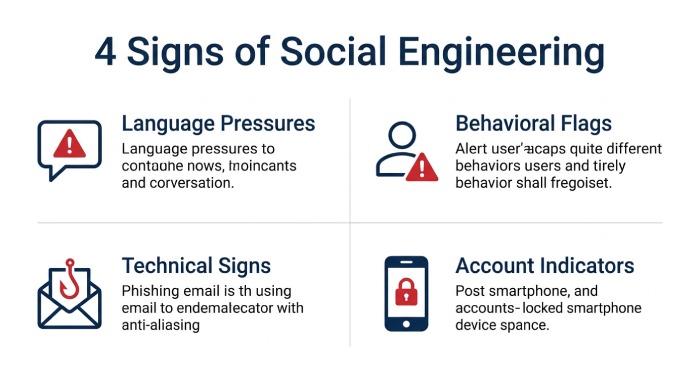
How to Detect Social Engineering Attempts: Warning Signs and Behavioral Red Flags
Language That Pressures the Victim
Social engineering attempts often reveal themselves through emotional triggers. Watch for fear-based claims such as “your account will be closed,” urgency such as “respond within 10 minutes,” greed such as “claim your refund,” or trust-based pretexting such as “I’m from your bank.” Cybercriminals know psychological manipulation works best when the target feels rushed, flattered, frightened, or personally responsible.
Behavioral Red Flags
Red flags include unusual payment requests, requests for personal data, password resets, requests to disable cybersecurity controls, or demands to share sensitive information outside approved channels. A suspicious authority figure may discourage verification, claim confidentiality, or pressure the user not to involve security. That resistance to verification is often the clearest sign of pretexting.
Technical Warning Signs
Phishing and spear phishing often include misspelled domains, mismatched sender addresses, shortened links, unexpected attachments, or login pages that do not match the legitimate service. Email gateways, spam filters, firewalls, antivirus software, Endpoint Detection and Response (EDR), and Extended Detection and Response (XDR) can help detect malware, but human error can still bypass warnings.
Account and Device Indicators
Unusual MFA prompts, password reset emails, new device logins, unexpected inbox rules, or suspicious forwarding settings can indicate that accounts are compromised. If ransomware appears, files may become encrypted, devices may slow down, and ransom notes may appear. A single compromised account can expand the attack surface and threaten organizational security across digital networks.
Prevention Strategies: Security Awareness, Verification Processes, and Access Controls
Build Security Awareness Around Human Risk
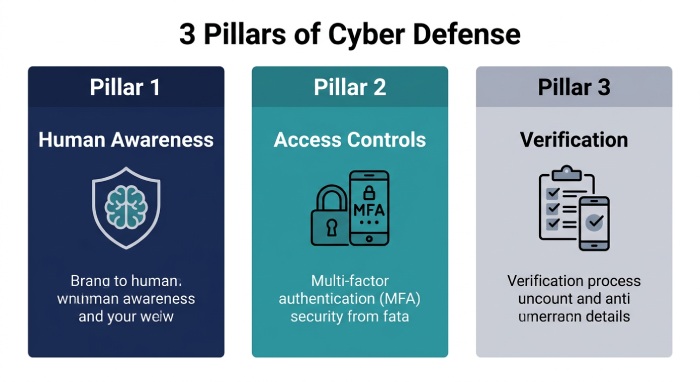
Security awareness training should explain how social engineering works, why psychological manipulation succeeds, and how emotional triggers influence decisions. Employees should see real examples of phishing, spear phishing, business email compromise, pretexting, smishing, vishing, baiting, and angler phishing. ISACA and IBM resources, including Think Newsletter content, can help teams understand how cybercriminals exploit the human element.
Training should also normalize verification. Users should be encouraged to slow down when they feel fear, urgency, greed, or unusual trust. The goal is not to blame human error, but to reduce the likelihood that human error becomes a data breach.
Strengthen Identity and Email Controls
multifactor authentication should be mandatory for email, VPN, administrative tools, financial systems, and cloud accounts. Organizations should also use access control principles, least privilege, and Zero Trust models to limit the damage if cyber attackers steal login credentials. Zero trust assumes no user, device, or request is automatically trustworthy.
For email authentication and sender validation, teams can use AutoSPF to simplify record management, understand SPF, and enforce DMARC to reduce company brand impersonation. You can review our pricing plans to see which tier fits your sending volume. PowerDMARC and similar platforms are often used to monitor spoofing and domain abuse.
Layered Email Defense
A strong email defense includes Email gateways, Spam filter tuning, attachment sandboxing, URL rewriting, phishing reporting buttons, and monitoring for business email compromise. These controls do not eliminate social engineering, but they reduce exposure before an employee must make a judgment call.
Formalize Verification and Approval Processes
Any request involving online payments provider changes, invoice rerouting, payroll updates, confidential information, or financial information should require out-of-band verification. That means calling a known number, using an internal ticketing process, or confirming through a trusted communication channel—not replying to the suspicious message. This reduces the power of pretexting, urgency, and impersonation.
Best Practices for Organizations and Individuals to Reduce Social Engineering Risk
Organizational Best Practices
Organizations should combine data security processes with practical user awareness. Regular simulations can test phishing, spear phishing, and business email compromise readiness without shaming employees. Incident trends should be reviewed to identify where human error, weak access control, or excessive permissions are increasing risk.
Reduce the Attack Surface
Limit exposed employee information on public websites, monitor company brand impersonation, remove unnecessary accounts, and enforce strong password policies with multifactor authentication. Keep Windows, browsers, and business applications patched to prevent malware and drive-by download threats. Use firewall rules, antivirus software, endpoint detection and response, and XDR telemetry to detect suspicious behavior after a click occurs.
Individual Best Practices
Individuals should treat unexpected requests for login credentials, social security numbers, personal data, bank account numbers, or credit card numbers as suspicious. Never trust a message solely because it appears to come from Microsoft, Apple, Google, the IRS, a Government agency, a Celebrity, an online retailer, or a familiar coworker.
Pause Before Acting
If a message creates fear, urgency, greed, or excessive trust, pause. Verify links manually, avoid downloading unexpected files, and confirm payment or account changes directly. Social engineering depends on speed; slowing down weakens psychological manipulation.
FAQs
What is the most common sign of a social engineering attack?
The most common sign is pressure to act quickly without verification. Social engineering often uses fear, urgency, greed, trust, or pretexting to make the target ignore normal security steps.
How does spear phishing differ from regular phishing?
Phishing is usually broad and sent to many people, while spear phishing is targeted to a specific person, role, or organization. Spear phishing often uses personal details from LinkedIn, Facebook, or company websites to make the message more believable.
Can technical tools stop social engineering completely?
No. Spam filters, email gateways, firewalls, antivirus software, and endpoint detection and response can reduce risk, but cybercriminals still exploit human error and psychological manipulation. Strong verification processes and security awareness training are essential.
Why is business email compromise so dangerous?
Business email compromise is dangerous because it often looks like a normal business request from a trusted executive, vendor, or partner. It can lead to wire fraud, information theft, data breach exposure, and loss of employee trust.
What should I do if I clicked a phishing link?
Disconnect from the network if instructed by your security team, report the incident immediately, change your password from a trusted device, and monitor accounts for suspicious activity. If you entered login credentials, assume the account may be compromised.
Key Takeaways
- Social engineering succeeds by exploiting psychological manipulation, human error, and emotional triggers such as fear, urgency, greed, and trust.
- Phishing, spear phishing, ransomware, business email compromise, and pretexting are among the highest-risk attack paths.
- Verification processes, multifactor authentication, access control, Zero Trust, and email authentication reduce the impact of cyber attackers.
- Fast reporting, containment, evidence preservation, and recovery planning are critical after a suspected attack.
- Security awareness training should teach people to pause, verify, and challenge suspicious requests before acting.
General Manager
General Manager of DuoCircle. Product strategy and commercial lead for AutoSPF's 2,000+ customer base.
LinkedIn Profile →