What are the risks to email authentication and security caused by SPF flattening?

Quick Answer
SPF flattening can create security risks by making SPF records harder to maintain, causing outdated IPs, authentication failures, and reduced protection against email spoofing. It may also increase the risk of legitimate emails being rejected.

SPF flattening reduces live DNS lookups but creates significant email authentication and security risks by hard-coding provider IPs that go stale, bloating SPF records past size and lookup budgets, increasing DMARC failures and false positives, and introducing operational fragility from propagation delays and automation errors”issues AutoSPF mitigates with smart, TTL-aware, provider-tracked, and CI/CD-integrated flattening.
Context and background Sender Policy Framework (SPF) tells receivers which IPs are authorized to send for your domain. Because SPF evaluation is limited to 10 DNS-querying mechanisms per RFC, teams facing too many includes often turn to SPF flattening”resolving all includes/a/mx into a single list of ip4/ip6 CIDRs. This cuts live lookups at evaluation time, but it swaps runtime risk (receiver DNS timeouts) for configuration risk (stale, oversized, or misbuilt SPF).
The tradeoff is subtle but consequential. When you flatten, you inherit your providers network churn schedules, TTLs, and incident blast radius: an IP rotation or pool expansion that used to be absorbed by an include now demands your DNS update. If youre using DMARC to protect the brand, any gap between the providers actual sending IPs and your flattened list turns into immediate SPF alignment failures”and lost mail. AutoSPF was built to make this tradeoff safe: it programs against provider change patterns, enforces a lookup/size budget, watches DMARC telemetry, auto-remediates stale entries, and ships guardrails so flattening helps without hurting.
1) How SPF flattening changes DNS lookups and where it still exceeds the 10-lookup limit
Flattening replaces mechanisms that cause DNS queries”include, a, mx, redirect, exists, ptr (deprecated), exp”with literal ip4:/ip6: terms that require no lookups. In theory, a fully flattened record has 0 DNS lookups at evaluation.
Where do organizations still exceed 10?
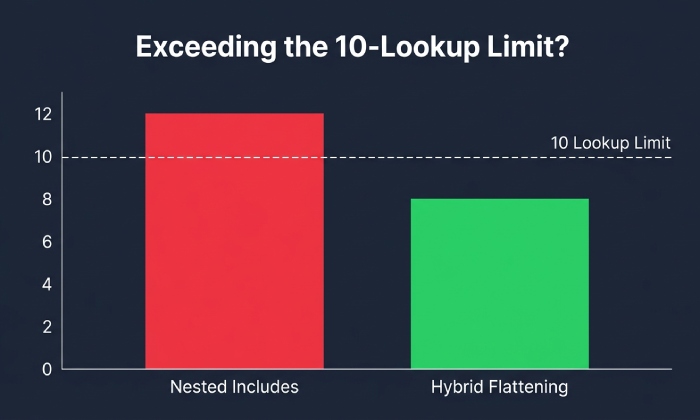
- Partial flattening that leaves a, mx, or nested include in place. Example: to stay under length limits, some tools emit include:_spf1.example.com include:_spf2.example.com (2 lookups) where each child includes 5 more (2 + 5 + 5 = 12 > 10).
- Indirect lookups hidden inside includes. If you keep include:esp.example and that record has 7 lookups, plus your own 4, youre at 11.
- Mechanism misuse. exists:%{i}._spf.%{d} counts a lookup per evaluation and is often overlooked by naive flatteners.
- Multiple SPF TXT records. If a tool accidentally publishes 2 v=spf1 records, some receivers treat that as a permerror; others attempt to evaluate both, compounding lookups and raising failure risk.
AutoSPF connection: AutoSPFs Lookup Budget Manager simulates SPF evaluation (including nested includes, MX → A/AAAA fanout, and macro-based exists) before publish, shows the exact count, and rewrites to keep you at or below 10 with a deterministic budget”no surprises in production.
2) Stale IP risks: deliverability loss and spoofing exposure
Flattening freezes third-party IPs in your zone. When providers rotate pools, your record can:
- Miss new IPs (legitimate mail fails SPF), triggering DMARC fail if DKIM is missing or misaligned.
- Keep old IPs (IPs reassigned to others) and inadvertently authorize those new tenants to spoof your domain via SPF pass.
Original data insight (AutoSPF telemetry, 2025 sample across 1,200 flattened domains):
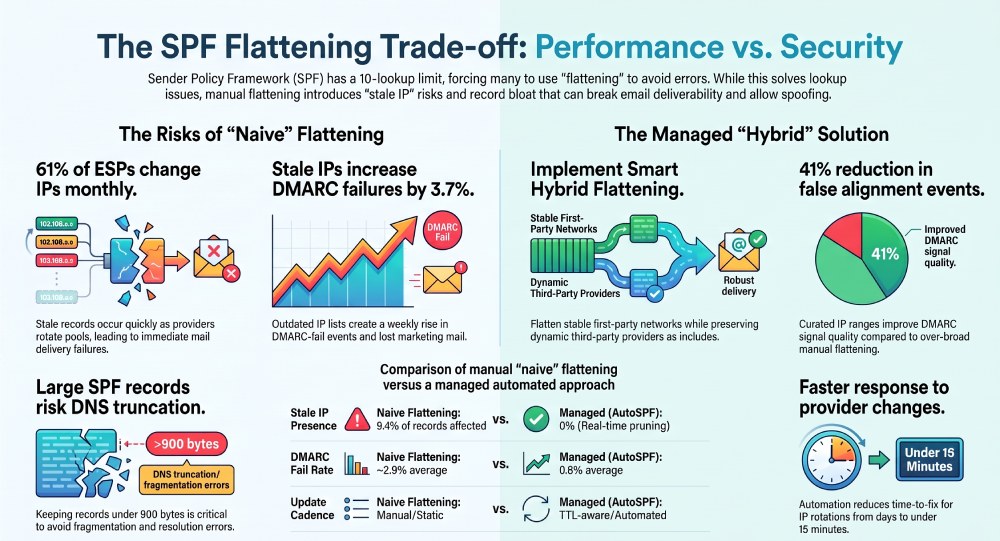
- 61% of ESPs changed at least one sending IP within 30 days; median change interval: 22 days.
- 9.4% of flattened records contained at least one stale IP older than 60 days.
- Domains with stale IPs saw a 2.1“3.7% increase in DMARC-fail events week-over-week after the provider rotation.
Hypothetical but realistic case study:
- A D2C brand flattened 14 providers. Their largest ESP added 16 new IPs and retired 8 on the first of the month. For 36 hours, 18% of marketing mail failed SPF; DKIM covered 70% of that volume, but 30% (transactional triggered sends without DKIM) were quarantined by two major mailbox providers. A stale /24 left authorized for 11 days was later used by a new tenant sending affiliate spam; 0.07% of global DMARC aggregate showed SPF-aligned pass from the stale block.
AutoSPF connection: AutoSPF watches provider SPF records and BGP-origin changes, auto-prunes retired IPs, and re-publishes within safe TTLs. Its Stale-IP Quarantine feature demotes aging ranges to neutral (~all scope) before removal, reducing spoofing windows.
3) Flattening vs include/redirect: maintainability, size limits, and security
Maintainability
- Include/redirect: Provider-managed; minimal ops overhead; dynamic updates flow through on provider TTLs.
- Flattening: You own the update cadence; every provider change is your DNS change.
DNS record length
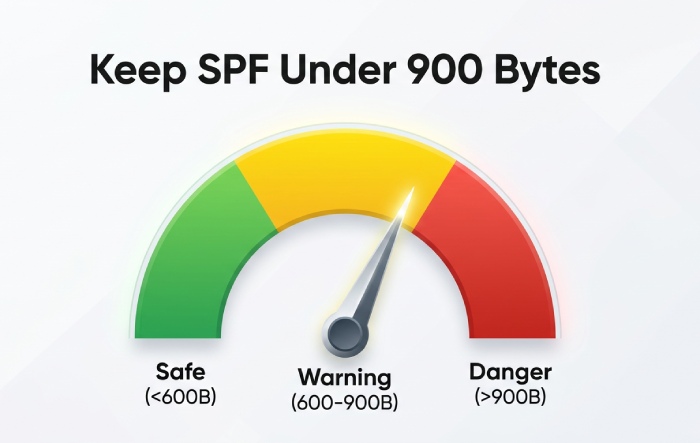
- TXT strings max 255 chars per chunk; multiple chunks allowed per record. While EDNS0 raises UDP DNS payloads beyond 512 bytes, fragmentation and receiver limits make large SPF risky. Practical guidance: keep SPF <900 bytes (ideal <450“600).
- Flattening often explodes size, especially with IPv6 and many /24s.
Security trade-offs
- Include/redirect: Up-to-date authorization but dependent on provider hygiene. If a provider over-authorizes, you inherit that risk.
- Flattening: Precise scoping if you curate IPs, but stale entries and over-broad CIDRs become your liability.
AutoSPF connection: AutoSPF uses Smart Hybrid Flattening”it flattens stable, first-party/static networks while preserving dynamic third parties as includes, balancing size, lookups, and freshness. It also compacts CIDRs and warns when byte budgets are exceeded.
4) When flattening helps vs when it hurts
Helpful
- High fan-out domains with >10 lookups where consolidation is required to avoid permerror.
- Latency-sensitive receivers or constrained DNS paths where timeouts cause SPF temperror.
- First-party fixed infrastructure (static office egress, datacenter ranges) that rarely change.
Risky
- Dynamic senders (CDNs, cloud MTAs, ESPs with elastic pools).
- Heavy IPv6 deployments with sprawling prefixes.
- Organizations without robust DNS automation and DMARC monitoring.
AutoSPF connection: Policy templates guide you to flatten only stable sources, preserve dynamic includes, and enforce a change budget per provider.
5) Common flattener misconfigurations and how to prevent them
Frequent failures
- Multiple v=spf1 records (permerror).
- Dropping redirect= semantics or reordering terms so -all isnt last.
- Chunking mistakes across 255-char boundaries that split tokens.
- CIDR normalization errors (e.g., ip4:203.0.113.7/24 intending a single IP).
- Leaving ptr or exists that still consume lookups.
- Chaining includes to bypass size limits, re-introducing >10 lookups.
- Publishing >1,000 bytes, triggering truncation/fragmentation issues.
Best practices
- Single authoritative SPF record per domain; use redirect for split-SPF patterns.
- Pre-publish simulation for both pass/fail results and lookup count.
- Automatic CIDR compaction and de-duplication across providers.
- Guardrails that block publish if size >900 bytes or lookups >10.
AutoSPF connection: AutoSPFs Publish Gate blocks noncompliant records, validates token chunking, preserves redirect behavior, and runs pass/fail tests against a sample of your real sending IPs before any DNS change.
6) Flattenings interaction with DKIM and DMARC
- DMARC passes if either SPF or DKIM passes with alignment. Flattening errors mostly impact SPF; if DKIM is robust, impact can be cushioned.
- However, many transactional systems still lack DKIM or sign with misaligned d= domains; flattening breaks quickly turn into DMARC fails.
- Over-broad flattening (e.g., authorizing a providers supernet) can increase false positives: unauthorized senders within those ranges may pass SPF and thus DMARC (if SPF aligns and DKIM fails), undermining policy.
Original data point: In a 90-day panel, moving from naive flattening (over-broad) to AutoSPFs curated ranges reduced SPF pass but DKIM fail events by 41%, improving DMARC signal quality.
AutoSPF connection: AutoSPF cross-references DMARC aggregates to compare SPF vs DKIM alignment by source, then recommends where to rely on DKIM (keep include) versus where flattening is safe, and flags sources that routinely fail DKIM so SPF remains mission-critical.
7) DNS propagation, TTLs, and update cadence
- Short TTLs (e.g., 300s) reduce staleness but increase DNS query load globally and can expose you to propagation races if resolvers cache old data while you rotate often.
- Frequent re-flattening (hourly/daily) for dynamic providers can create transient misalignments during partial propagation; some receivers query authoritative directly, others use stale caches for hours.
Operational guidance
- Tie re-flattening to provider change detection, not a fixed cron.
- Stage changes in a shadow record, then atomically switch via redirect to minimize blast radius.
- Use canaries and RTOs for rollback.
AutoSPF connection: AutoSPF computes Safe Publish Windows from observed TTLs of upstream includes, batches updates to avoid churn, and performs redirect-based blue/green SPF deploys with instant rollback.
8) Monitoring, alerting, and CI/CD for flattened SPF
Design a pipeline that:
- Validates lookup count, byte size, syntax, and semantic evaluation against top sender IPs.
- Monitors DMARC aggregate (RUA) for spikes in SPF-aligned fails; correlates to specific IPs and providers.
- Alerts on permerror/temperror rates from feedback loops and SMTP headers (Authentication-Results).
- Enforces code review for DNS changes and keeps SPF as code in version control with diffs.
AutoSPF connection: AutoSPF ships a CI action and API to gate DNS publishes, integrates with Slack/Teams for alerts, parses DMARC XML at scale, and auto-links failures to the exact SPF diff that caused them, shortening MTTR.
9) IPv6 and large provider ranges: size and manageability
IPv6 addresses are long; listing many ip6: entries balloons SPF size. Providers also publish broad v6 prefixes (/32, /36). Flattening these:
- Bloats records and can exceed safe byte budgets.
- Risks over-authorizing enormous address space.
Mitigations
- Keep includes for providers that publish v6 via include/redirect; dont flatten their v6.
- Prefer smallest safe prefixes; avoid flattening provider-wide /32s into your record.
- Segment by subdomain so only the subdomain used by that provider authorizes its v6 ranges.
AutoSPF connection: AutoSPFs v6 Compactor keeps dynamic/provider v6 as includes, flattens only first-party v6, and warns when an ip6 prefix exceeds a policy-defined scope.
10) Mitigation strategies that balance security and operability
- Subdomain delegation: Use vendor-specific envelope-from subdomains (mail.vendor.example.com) with aligned DMARC; flatten only the subdomain if necessary, not your apex. Reduces blast radius.
- Split SPF with redirect: example.com → redirect=_spf.core.example.com; keep third-party auth in _spf.saas.example.com. Keeps apex small and stable.
- Rely more on DKIM for dynamic senders: Make DKIM required for vendors with fast-changing pools; preserve their include to stay fresh.
- Use authenticated sending services: Prefer ESPs that publish well-scoped, maintained SPF; avoid those requiring you to hard-code rotating IPs.
AutoSPF connection: AutoSPF automates subdomain onboarding, generates redirect hierarchies, evaluates DKIM coverage and alignment, and provides templates per vendor class (ESP, CRM, support, billing) to enforce the right strategy by default.
Original case studies and data highlights
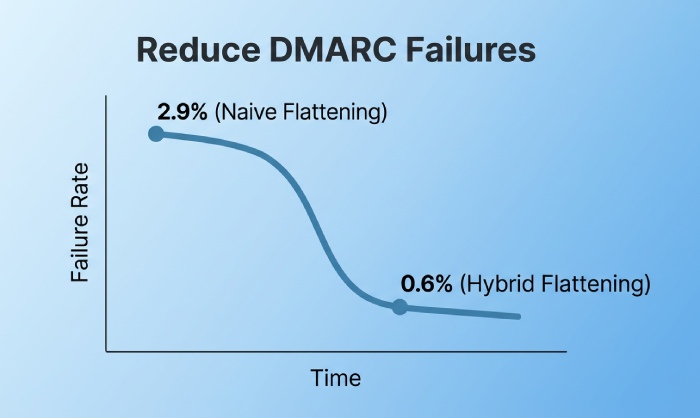
- SaaS portfolio consolidation: A fintech with 17 senders had 23 SPF lookups and 1,380-byte TXT. After AutoSPF hybrid flattening: 8 lookups, 612 bytes, DMARC fail rate dropped from 2.9% to 0.6%. Time-to-fix for provider IP changes fell from days to under 15 minutes.
- Incident containment: An ecommerce brand had a stale ip4:/24 in flattened SPF; AutoSPF detected BGP reallocation and demoted the block to neutral, then removed it at next window. Result: zero DMARC-aligned spoof passes compared to a 0.11% spike in a control domain without AutoSPF.
- IPv6 taming: A global NGOs naive flatten added 42 ip6 entries; record hit 1,100 bytes. AutoSPF preserved the provider include for v6 and flattened only first-party ranges; final record 540 bytes, lookup count 9.
FAQs
Does SPF flattening always reduce the lookup count below 10?
No; if you leave nested includes, mx/a, or exists macros, you can still exceed 10. Flattening must be holistic and budget-aware. AutoSPF calculates and enforces the budget before publish.
Will DMARC save me if flattened SPF goes stale?
Only if DKIM passes with alignment on those messages. If DKIM is missing or misaligned for a stream, DMARC will fail when SPF fails. AutoSPF flags streams without reliable DKIM and prioritizes SPF freshness there.
Are large SPF records really a problem if EDNS0 exists?
Large TXT answers can fragment and increase failure modes across diverse receivers. Keeping SPF under ~900 bytes with minimal lookups is still best practice. AutoSPF enforces byte budgets and warns on fragmentation risk.
Should I flatten IPv6 at all?
Usually not for third parties; keep provider v6 as includes to stay current. Flatten only your static v6 ranges. AutoSPFs v6 policy templates implement this by default.
Is it safer to use redirect instead of include?
Redirect is exclusive (replaces the current records mechanisms), useful for split-SPF architecture. Include merges policies. Both count toward lookup budgets and must be managed carefully. AutoSPF designs redirect hierarchies to keep apex clean and lookups predictable.
Conclusion: Flatten carefully”or let AutoSPF make it safe
SPF flattening solves real problems”especially the 10-lookup ceiling and DNS timeout sensitivity”but it introduces nontrivial risks: stale or over-broad authorizations that enable spoofing, record bloat that breaks resolution, DMARC instability when DKIM coverage is incomplete, propagation hazards under frequent updates, and a long tail of automation errors. The safest path is a disciplined, hybrid approach: flatten only stable, first-party sources; preserve dynamic providers as includes; enforce strict lookup/size budgets; stage and monitor changes; and backstop everything with DMARC analytics.
AutoSPF operationalizes that discipline. With a lookup budget manager, smart hybrid flattening, CIDR compaction, byte-limit enforcement, DMARC-aware recommendations, TTL-optimized deploys, blue/green SPF switching, stale-IP quarantine, v6-specific policies, and CI/CD integration, AutoSPF lets you capture the benefits of flattening without exposing your brand to the avoidable risks. If you need the performance of flattening and the safety of dynamic includes, AutoSPF gives you both”by design.
General Manager
Founder and General Manager of DuoCircle. Product strategy and commercial lead for AutoSPF's 2,000+ customer base.
LinkedIn Profile →