SPF Is Widespread: Email Protection by Domain Coverage

Quick Answer
SPF adoption varies across domain populations, with 2026 studies reporting rates from 56.0% to 93.2%. Strong email protection requires more than publishing SPF records; organizations must verify configurations, ensure authentication alignment, enforce DMARC policies, and assess transport security.
Executive takeaway
SPF can look nearly universal or incomplete, depending on which domains researchers count. The supplied 2026 studies report 56.0% publication across a broad Tranco sample and 93.2% among popular mail-receiving domains. Neither measures all senders or protected message volume. More importantly, record publication does not establish correct configuration, aligned messages, or effective enforcement. Organizations should choose relevant benchmarks, inventory authorized senders, and test legitimate traffic before tightening DMARC policies. Market forecasts provide commercial context, not evidence of protection. Sender authentication and transport security also require separate assessment.
How SPF can be both common and incomplete
SPF publication ranges from 56.0% to 93.2% across the supplied 2026 studies. Both figures can be accurate because they describe different domain populations. The central question is not simply whether SPF is widespread, but what each study counts.
SPF, or Sender Policy Framework, identifies servers authorized to send email for a domain. Publishing a record is a starting point, not proof that messages authenticate reliably. Adoption figures therefore require two checks: which domains were counted, and which configuration was measured?
Three research snapshots show how much those choices matter:
- Broad Tranco population: DMARCguard’s research covers 5,499,028 domains across the complete Tranco Top Sites list, a popularity-ranked web population. It reports 56.0% SPF publication, 30.4% DMARC publication, and 12.8% with quarantine-or-reject DMARC policies.
- Resolvable top-million population: SpamCipher’s study samples the Tranco top-million and calculates adoption among domains returning definitive DNS answers. It reports 62.8% SPF and 47.2% DMARC publication, using the relevant resolvable set for each measurement.
- Popular mail-receiving population: Shipmail’s November 2026 analysis filters the Tranco top-10,000 to 7,252 domains with mail-receiving records. Within that population, 93.2% publish SPF, 82.9% publish DMARC, and 60.9% specify quarantine or rejection.
These are cross-sectional snapshots, not a time series showing improvement. The studies differ in popularity thresholds, mail-receiving eligibility, scan timing, and treatment of unresolved DNS queries. Their percentages cannot isolate the contribution of any single difference.
The broad sample includes domains that may not send email. The resolvable sample describes domains with definitive lookup results. The mail-receiving sample is more focused, but receiving configuration does not prove authenticated sending. None measures authentication across all email traffic.
Publication and enforcement also answer different questions. As DMARCReport’s comparison emphasizes, a DMARC record can request monitoring rather than quarantine or rejection. Record presence alone therefore cannot establish an enforcement posture.
This paper synthesizes the supplied study summaries rather than conducting new measurements. Its argument is straightforward: select a relevant denominator, then assess correctness, alignment, and enforcement separately. A useful benchmark identifies the population; meaningful protection requires evidence beyond publication.
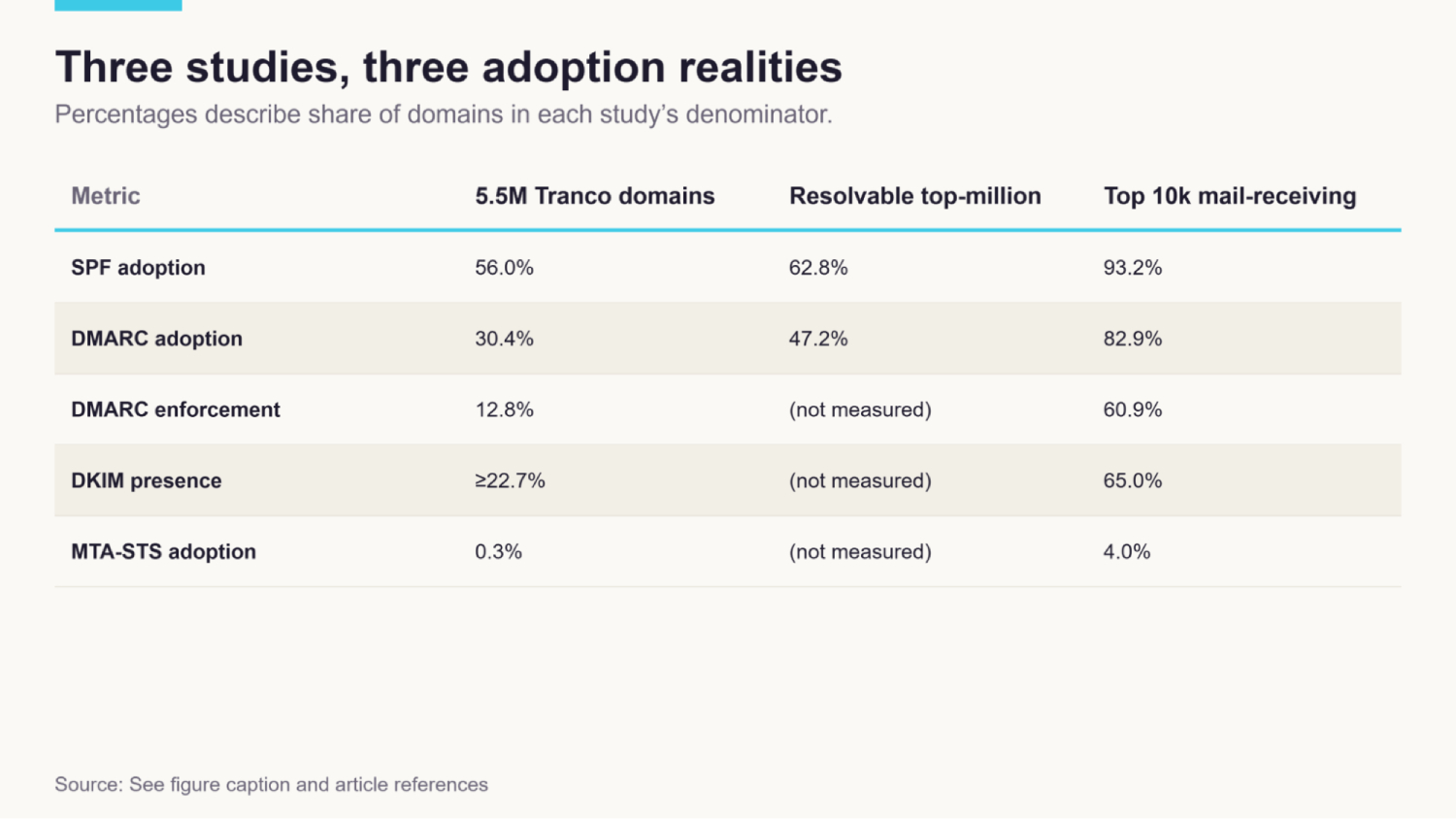
Comparison of SPF and DMARC adoption and enforcement across DMARCguard’s Tranco-wide scan, SpamCipher’s resolvable top-million, and Shipmail’s mail-receiving domains. Method: Values are taken directly from the three 2026 measurement studies and aligned by protocol and policy definition. SPF and DMARC adoption are measured as record presence; enforcement counts domains with p=quarantine or p=reject policies among all scanned domains in each study.
What an authentication statistic actually measures
An authentication statistic measures a defined configuration across a defined population—not email safety itself. Interpreting it requires separating protocol functions from what a DNS scan can establish.
SPF checks whether a sending server is authorized for the domain used in the message’s delivery envelope. That domain need not match the visible From address. AutoSPF configuration analysis distinguishes record presence from successful evaluation and appropriate authorization.
DKIM, or DomainKeys Identified Mail, attaches a cryptographic signature to a message. Receivers verify it using a public key published in DNS. Finding a key at a commonly used name, called a selector, does not establish that outgoing messages carry valid signatures.
DMARC connects authentication to the domain readers see in the From address. It requires successful SPF or DKIM authentication with a domain matching that visible identity under its alignment rules. Authentication success without alignment is insufficient for DMARC.
These distinctions produce three separate measurement questions:
- Presence: Does the domain publish an identifiable authentication record?
- Correctness: Can the record evaluate successfully, and does it authorize the intended infrastructure?
- Published enforcement policy: Does DMARC request restrictive handling when messages fail its authentication-and-alignment requirements?
DMARC policies express requests to receivers, not guarantees of identical handling. The DMARCReport analysis distinguishes publication from the policies commonly classified as enforcement:
p=nonerequests no DMARC-based disposition change; reporting can support monitoring.p=quarantineasks receivers to treat failing messages as suspicious, potentially placing them in spam.p=rejectasks receivers to reject failing messages.
Throughout this paper, “enforcement” means a published quarantine-or-reject policy unless otherwise stated. It does not mean observed receiver compliance or measured attack prevention. These policies address domain impersonation, not every form of phishing.
SPF softfail and hardfail are separate from DMARC enforcement. An SPF record ending in ~all returns softfail for unmatched senders; -all returns fail, commonly called hardfail. Neither result substitutes for alignment with the visible From domain.
Before comparing benchmarks, check five details:
- Population: Ranked websites, businesses, and mail-receiving domains represent different sampling frames.
- Scan date: Publication dates do not necessarily identify measurement windows.
- DNS failures: Inconclusive queries may be excluded, classified as unknown, or counted as absent records.
- Method: Record detection, configuration validation, DKIM-key discovery, and message inspection measure different things.
- Denominator: Percentages may describe all sampled domains, resolvable domains, or protocol adopters.
A publication scan can answer a useful infrastructure question. Establishing reliable authentication requires configuration checks and evidence from actual messages.
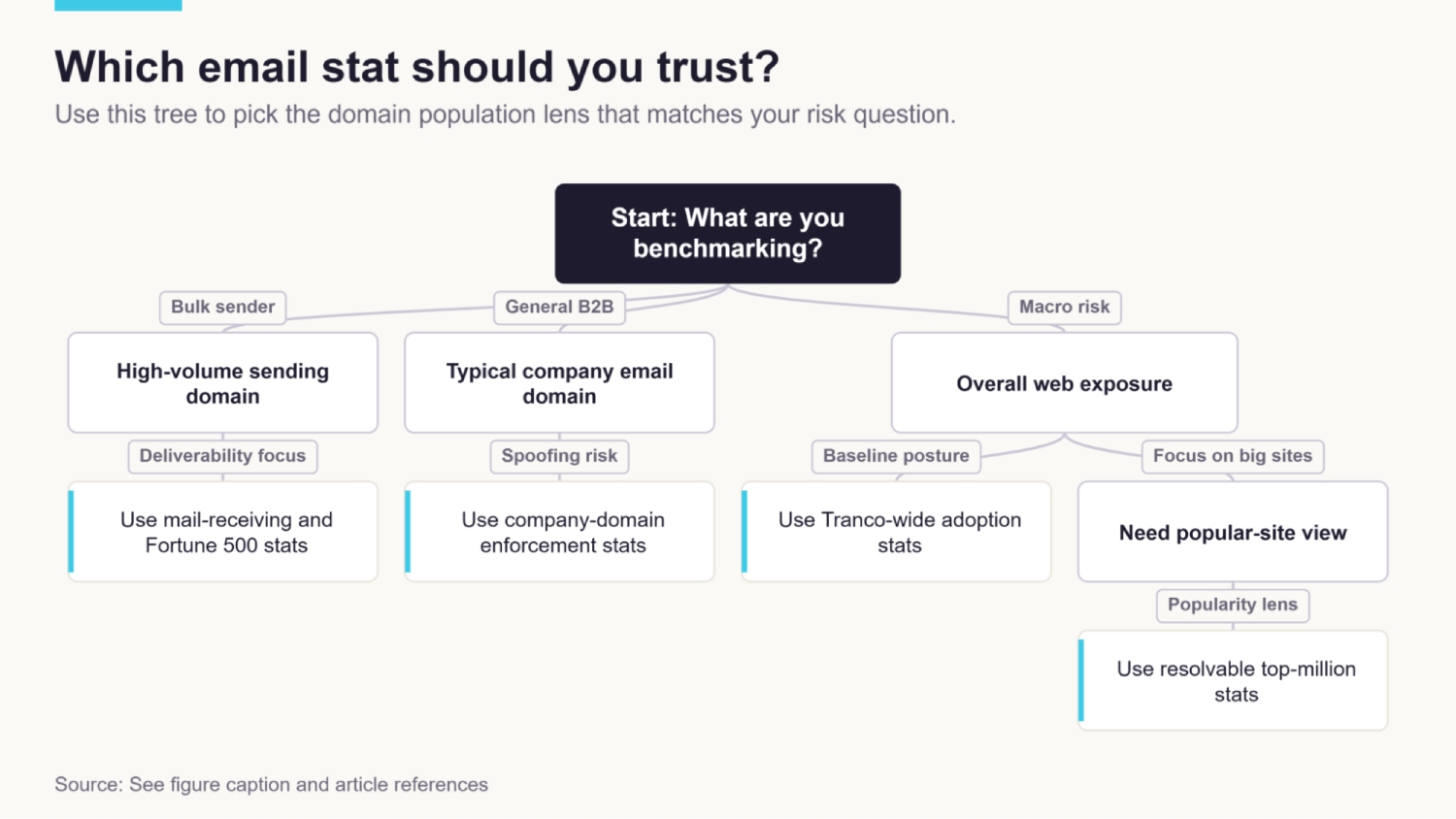
Decision guide to choosing the most relevant email authentication statistics based on domain population and use case. Method: Tree nodes reflect interpretive advice synthesized from measurement and commentary studies, mapping sender type and assessment goal to the most informative domain population reality. No quantitative values are encoded; this is a qualitative decision aid.
The broad-web view reveals SPF’s operational weaknesses
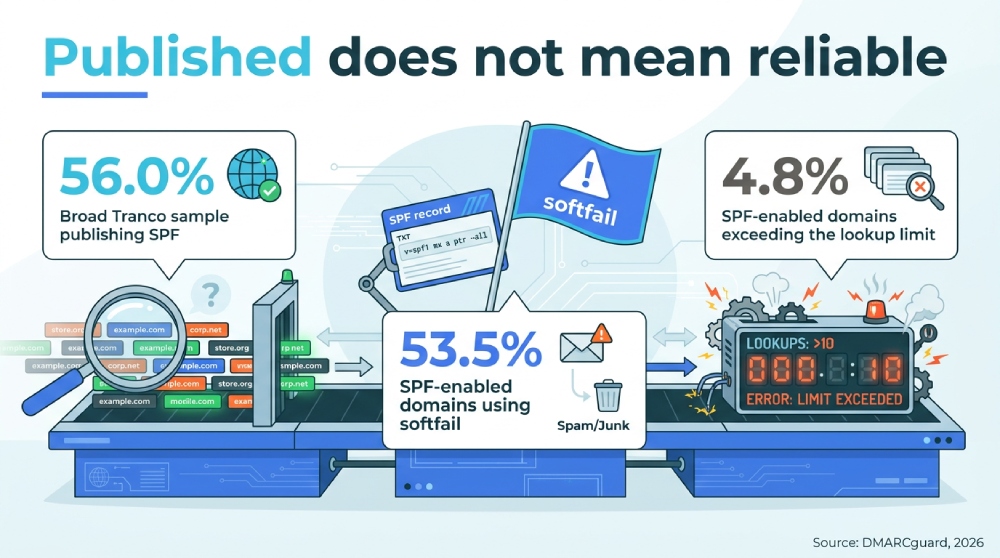
The broad-web sample reveals gaps in both publication and configuration. DMARCguard’s research reports SPF on 56.0% of 5,499,028 domains, DMARC on 30.4%, and quarantine-or-reject policies on 12.8%. These figures describe the complete Tranco list used in the study, not all registered domains or verified senders.
The supplied evidence identifies the measurement as a February 2026 scan. The source metadata lists November 11, 2026 as the research page’s publication date. These dates describe different events; the findings should not automatically be treated as November conditions.
The enforcement denominator changes the interpretation substantially. DMARCguard reports 702,246 enforcing domains among 1,670,975 DMARC publishers in its adoption research. Dividing those counts gives approximately 42.0% enforcement among adopters. The reported 12.8% instead describes enforcement across all scanned domains.
Both proportions are useful, but they answer different questions. The first describes policy choices among adopters; the second describes sample-wide coverage. Monitoring-only records contribute to DMARC publication without requesting quarantine or rejection.
SPF configuration exposes another gap between presence and dependable operation. DMARCguard’s SPF supply-chain study reports that 53.5% of SPF-enabled domains use softfail, written ~all. It also reports that 4.8% exceed SPF’s ten-lookup evaluation limit.
Softfail alone does not prove vulnerability. Its significance depends on authorized infrastructure, DMARC alignment, and receiver handling. A softfail ending and a lookup-limit violation should therefore not be treated as equivalent weaknesses.
Lookup-limit violations create a more specific evaluation problem. An SPF include delegates authorization checks to another domain’s policy, which may contain further includes. These dependencies can consume the lookup allowance and produce a permanent evaluation error, or permerror. A published record can consequently fail during evaluation.
Provider includes also reveal shared dependencies, but not exclusive market shares. The supply-chain study finds Microsoft 365 includes in 19.6% of SPF-enabled domains and Google Workspace includes in 13.6%. The denominator is SPF publishers, not all scanned domains.
A domain can authorize multiple providers, so these categories may overlap. Includes document configured authorization rather than verified sending activity, customer ownership, or message volume. Their strongest analytical use is identifying infrastructure dependencies that require ongoing management.
Source: DMARCguard, 2026
Resolvable domains produce a different benchmark
SpamCipher offers a conditional benchmark: publication where DNS queries returned definitive answers. Its July 2026 study reports 62.8% SPF and 47.2% DMARC presence among the relevant resolvable domains sampled from Tranco’s top-million. Those percentages do not describe every domain in that ranking.
The study drew a seeded random sample from a pinned Tranco list. Fixing the list and random seed supports reproducibility, but does not establish representativeness beyond that sampling frame. The scan queried apex TXT records for SPF and _dmarc TXT records through six public anycast resolvers.
The exclusions differ by protocol and cannot be added together. About 13% of sampled domains lacked a definitive apex answer; about 20% lacked a definitive DMARC answer. The supplied evidence does not establish how much those groups overlap.
An inconclusive lookup differs from a confirmed absence. Counting both as “no record” converts uncertainty into absence. Excluding inconclusive responses avoids that conflation, but leaves adoption among excluded domains unresolved. Here, “resolvable” describes a measurement condition, not a fully functioning or secure domain.
The supplied summary describes a different rule in DMARCguard’s broader scan: failed lookups were counted as missing records. Its 56.0% SPF and 30.4% DMARC estimates therefore differ in both population and DNS-response handling. The comparison cannot establish improvement over time.
Popularity, DNS reachability, and scan timing could each contribute to the difference. The available evidence neither isolates their effects nor establishes which matters most. Higher publication among resolvable top-million domains does not prove that popularity causes stronger authentication practices.
SpamCipher reports a cross-check against OpenINTEL’s longitudinal DNS measurements, with agreement within about 1.5 percentage points. This reported comparison corroborates aggregate presence estimates. It does not demonstrate identical domain-level classifications or validate every sampling decision.
Finally, this scan did not measure enforcement. Its 47.2% DMARC figure answers a publication question while leaving quarantine-or-reject policy coverage unmeasured. That boundary matters when comparing it with studies reporting both presence and policy.
Popular mail domains show what higher adoption looks like
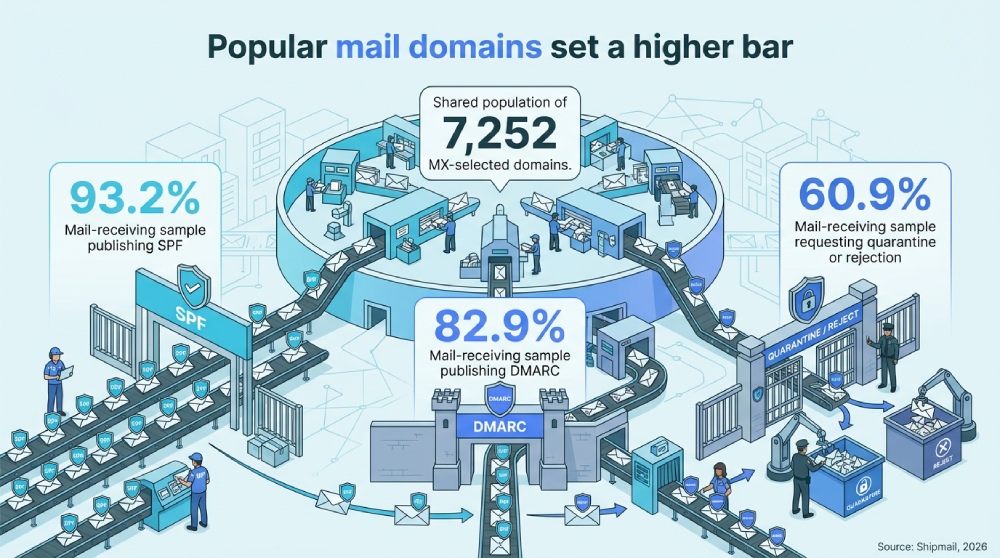
Popular domains with mail-receiving infrastructure show much higher authentication publication. Shipmail’s November 2026 study selected 7,252 domains with MX records from Tranco’s top-10,000. MX records identify incoming-mail destinations; they do not establish outbound sending activity.
Within that population, 93.2% published SPF, 82.9% published DMARC, and 60.9% published quarantine-or-reject policies. These findings establish a higher publication baseline than the broader samples. They do not measure successfully authenticated messages or inbox delivery.
The counts clarify the enforcement denominator. Shipmail reports 6,013 DMARC publishers and 4,417 domains requesting quarantine or rejection. Enforcement among publishers is approximately 73.5%, calculated as 4,417 divided by 6,013. The reported 60.9% uses all 7,252 sampled domains instead.
Source: Shipmail, 2026
A chart comparing the three core DMARC estimates should make their populations explicit:
- 30.4%: the complete Tranco population scanned by DMARCguard.
- 47.2%: domains with definitive DMARC-query answers in SpamCipher’s top-million sample.
- 82.9%: Shipmail’s MX-selected top-10,000 population.
These bars represent a cross-sectional comparison, not successive stages of improvement. The studies did not follow one fixed population through deployment. Popularity, MX selection, scan timing, and DNS exclusions vary together, preventing attribution to any single factor.
Shipmail’s 65.0% observed DKIM-key rate requires a different caveat. The supplied evidence does not establish exhaustive selector discovery. An undiscovered key therefore cannot safely establish non-deployment. Conversely, discovering a key does not show that outgoing messages carry valid signatures.
The distinction between infrastructure and message evidence limits claims about security and deliverability. Establishing aligned authentication requires inspection of actual sending paths and messages. Deliverability requires separate evidence about receiver acceptance and inbox placement.
Non-sending domains are not necessarily irrelevant to impersonation risk. Rather, receiving infrastructure, sending activity, and protection against forged identities remain distinct questions. Shipmail provides a useful benchmark for popular MX-equipped domains, not a census of protected senders.
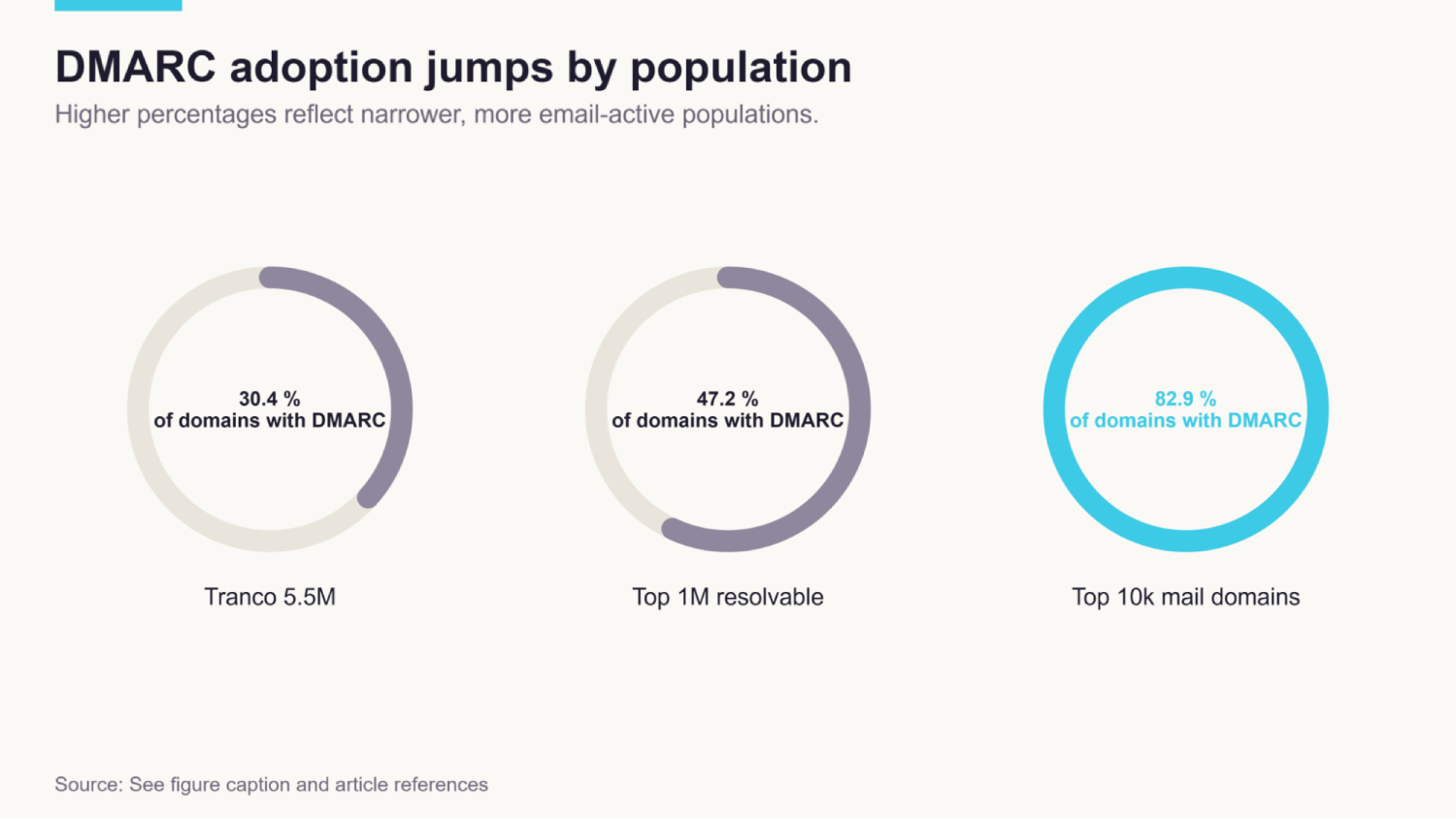
DMARC record presence as a share of domains in three 2026 studies: Tranco-wide, resolvable top-million, and top-10k mail-receiving. Method: Percentages are drawn directly from DMARCguard’s Tranco scan, SpamCipher’s resolvable top-million measurement, and Shipmail’s mail-receiving study. Each segment shows DMARC adoption in its respective denominator without adjusting for enforcement.
Business domains expose the gap between defaults and enforcement
Business-domain data expose a substantial gap between DMARC publication and enforcement. SpamCipher’s 2026 company-domain study covers 2,330,020 domains that receive email. It reports DMARC publication on 55.4% and quarantine-or-reject policies on 19.7% of the full sample.
That enforcement total comprises 11.4% using p=quarantine and 8.3% using p=reject. The monitoring figure uses a different denominator: 64.3% of published DMARC records use p=none. Nearly two-thirds of adopters therefore request no DMARC-based restrictive handling.
Monitoring may represent an intermediate deployment stage rather than neglect. However, the findings do not establish how long domains have retained those policies or why. The scan identifies a configuration gap without showing whether organizations are progressing, stalled, or deliberately maintaining their settings.
Provider comparisons reveal further variation. SpamCipher reports these DMARC enforcement rates by mail host, using domains associated with each provider as the denominator:
- Mimecast: 55.5%
- Microsoft 365: 26.9%
- Google Workspace: 10.7%
These are observed configurations, not a controlled comparison of provider effectiveness. Customer mix, security resources, and configuration choices could contribute to the differences. The supplied evidence does not separate those explanations or establish causal effects.
The figures should therefore prompt procurement questions rather than a simple provider ranking. What does the service configure automatically? What requires customer action? Who owns subsequent policy changes? Aggregate enforcement cannot establish the settings applied to any particular customer domain.
IONOS illustrates how high presence can coexist with limited enforcement. SpamCipher reports 93.6% DMARC presence among IONOS domains, with 96.0% of those records monitoring-only. The study identifies default publication as one mechanism behind that high presence rate. Defaults can raise adoption without producing comparable enforcement, but this does not establish provider-level security outcomes.
A separate finding needs equally careful wording: 7.7% of company domains publish neither SPF nor DMARC. That establishes the measured absence of those two controls—not the absence of DKIM or every authentication mechanism.
Business reporting should consequently keep publication, policy, and demonstrated operation separate. A convenient default can complete the first task while leaving the others unresolved.
Strong sender identity leaves transport questions unanswered
Strong sender authentication does not establish strong transport protection. Authentication checks domain identity; transport controls address protection between mail servers. A high score for one cannot substitute for evidence about the other.
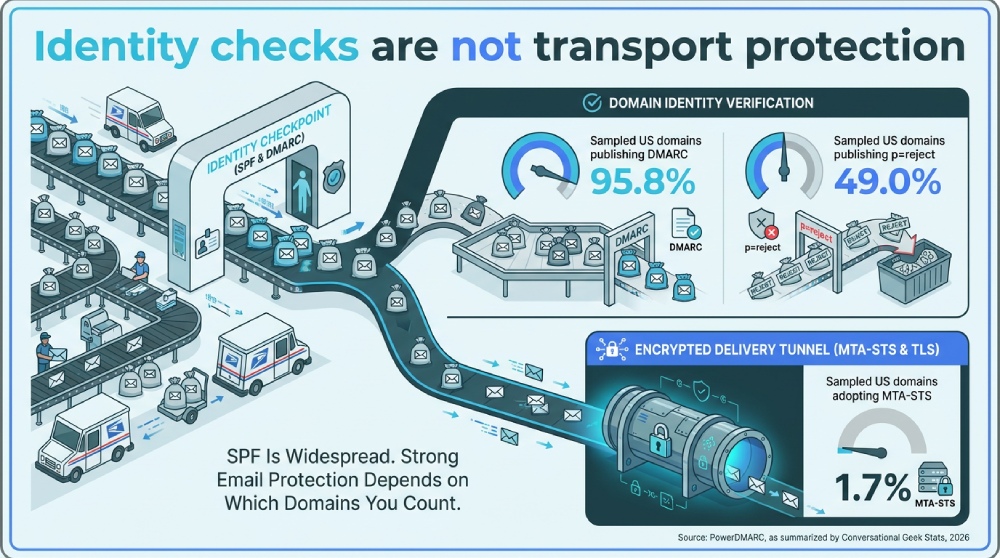
A roughly 900-domain US sample illustrates this separation. Conversational Geek’s summary of PowerDMARC’s 2026 report reports 95.8% DMARC presence, 49.0% with p=reject, and 1.7% MTA-STS adoption. The supplied summary does not establish nationally representative sampling, so these findings cannot describe all US domains.
Source: PowerDMARC, as summarized by Conversational Geek Stats, 2026
The 49.0% figure measures rejection policies, not total DMARC enforcement. Quarantine also qualifies as enforcement under the studies’ convention. Without its share, the difference between publication and rejection cannot be classified entirely as monitoring-only deployment.
MTA-STS allows receiving domains to specify requirements for encrypted delivery using TLS, which protects connections in transit. High DMARC presence and low MTA-STS adoption are therefore not contradictory. They describe different control layers.
Other samples also report limited MTA-STS publication. DMARCguard’s February 2026 scan reports 0.3% across 5,499,028 Tranco domains. That denominator includes domains not selected for mail-receiving capability.
Shipmail’s November 2026 study reports 4.0% among its 7,252 MX-equipped domains. The US sample’s 1.7% lies numerically between these estimates, but the comparison cannot establish national performance or an adoption trend.
The supported conclusion is narrower: each sample shows limited deployment of this particular mechanism. Missing MTA-STS does not prove successful encryption-downgrade exposure, because the scans do not establish alternative protections or actual delivery conditions. A missing control is a configuration finding, not a complete vulnerability assessment.
BIMI belongs in a separate category again: branding through logo display. Shipmail reports 13.2% BIMI adoption, but this is neither an encryption measure nor an authentication guarantee. Combining branding, identity policies, and transport controls into one security score would conceal their different functions.
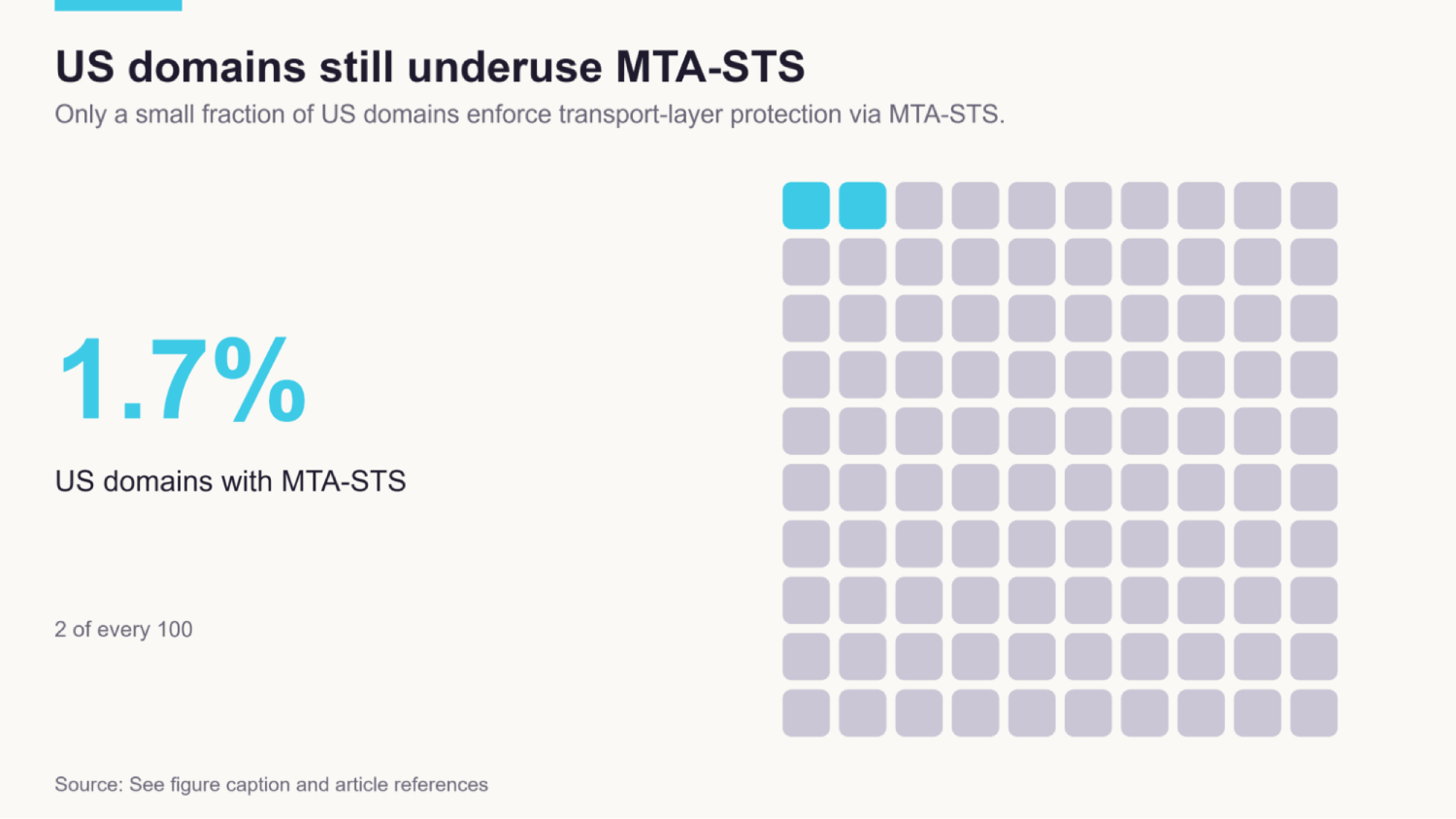
Share of US domains in PowerDMARC’s 2026 report that adopt MTA-STS, visualized as a 10x10 grid percentage. Method: The waffle encodes the 1.7% MTA-STS adoption rate reported in the United States DMARC & MTA-STS Adoption Report 2026 as summarized by Conversational Geek Stats. The remaining 98.3% of the grid represents domains without MTA-STS.
A growing market is not proof of better protection
Market growth measures commercial expectations, not protection delivered. Revenue estimates concern products and services; DNS studies concern published configurations. Neither directly measures reductions in successful attacks.
For comparison with the 2026 assessment, Dataintelo’s email authentication report provides a historical 2024 baseline of USD 2.16 billion. It forecasts an 18.7% compound annual growth rate through 2033. These figures are an older estimate and an annualized growth projection, not observed 2026 revenue.
A separate DMARC market forecast projects growth from USD 1.8 billion in 2025 to USD 6.7 billion in 2034. Again, the historical baseline and projected endpoint provide context for 2026, not evidence of growth already achieved.
These categories overlap and should not be summed. Email authentication, SPF/DKIM management, DMARC software, and authentication services may cover related purchases. Without reconciled definitions and accounting boundaries, adding estimates risks double counting.
The supplied evidence also does not establish comparable methods across forecasts. Their precision should not be mistaken for certainty about coverage, revenue, or future demand. They describe commercial expectations more defensibly than a combined market total.
Mailbox-provider requirements offer a plausible adoption pressure, but their causal contribution remains unmeasured here. DuoCircle’s 2026 overview describes Google, Yahoo, and Microsoft requirements as deployment incentives. This commercial account supports describing reported pressure, not attributing measured adoption gains to those policies.
Organizations should verify applicable provider documentation before assuming uniform thresholds or rejection rules. Provider sending requirements and statutory obligations are different claims. The supplied material does not justify treating them as interchangeable.
Service spending likewise cannot establish operational success. As a historical comparison, Mordor Intelligence’s analysis reports that monitoring and reporting represented 37.34% of the DMARC management services market in 2025. That share describes purchased services, not the proportion of customers achieving effective enforcement.
Procurement should therefore test capabilities against actual needs:
- Can the service validate SPF syntax and identify excessive DNS lookups?
- Can it help assess authentication and alignment on legitimate messages?
- Can teams identify authorized senders before tightening policy?
- Does it support monitoring, controlled changes, and recovery when legitimate mail fails?
These are evaluation criteria, not vendor endorsements. Buyers need configuration and message-level evidence rather than assurances inferred from market growth.
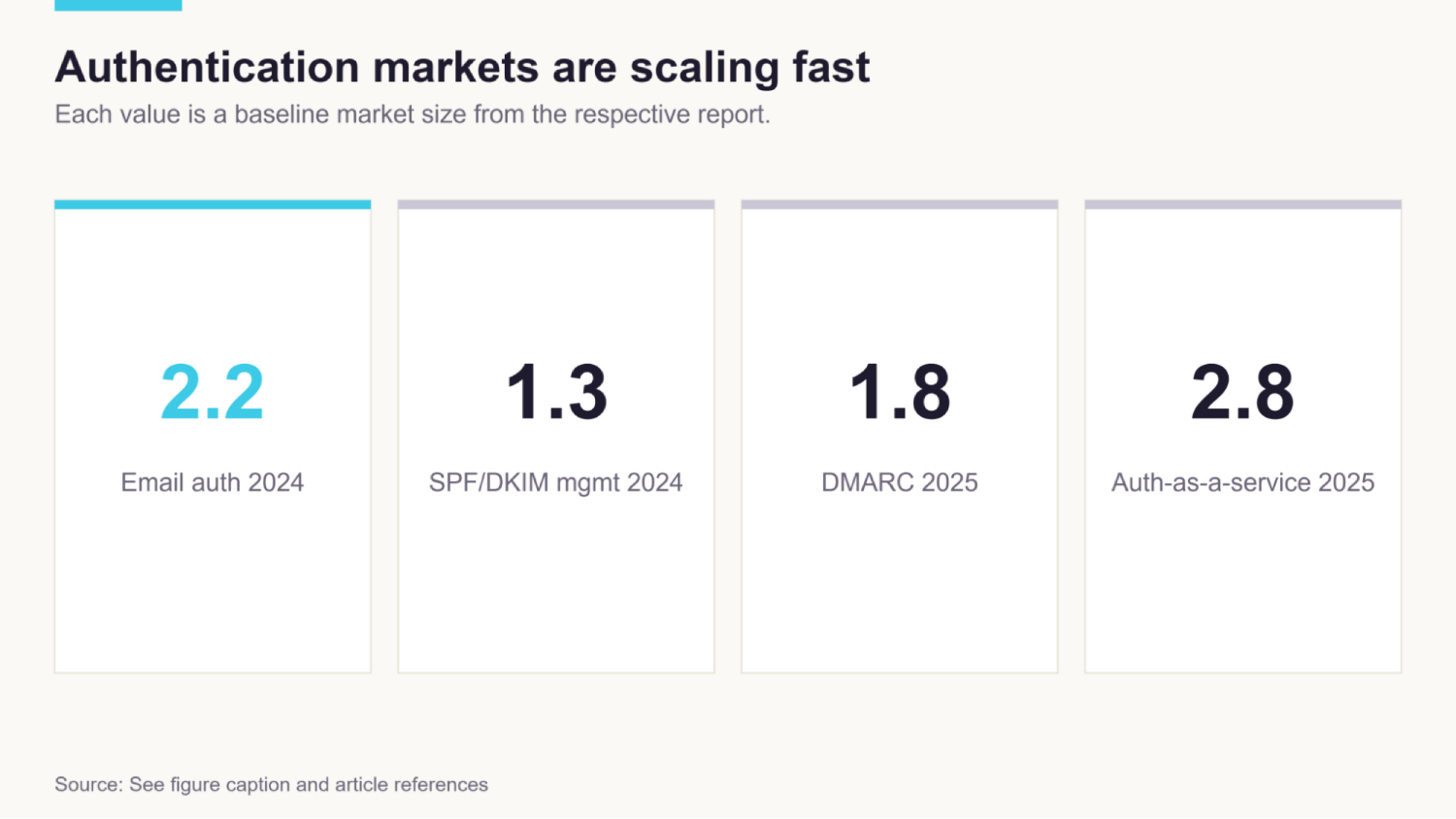
Key market sizes and forecasts for email authentication, SPF/DKIM management, DMARC, and authentication-as-a-service segments. Method: Headline market values and forecast endpoints are taken from Dataintelo’s email authentication, SPF DKIM management, DMARC, and email authentication as a service reports. Figures are rounded to two decimal places where needed.
Turn the right benchmark into an SPF action plan
Start with a comparable population, not the highest adoption percentage. Choose a benchmark relevant to your portfolio: broad-web, resolvable, popular mail-receiving, or business domains. Document its sampling rules, DNS exclusions, and definition of adoption before using it to set priorities.
A benchmark provides context, not a test of your own mail.
- The Shipmail study, for example, measures popular mail-receiving domains rather than authenticated outbound traffic.
- Operational assessment must bridge that gap with evidence from your systems.
Use the following sequence:
- Inventory authorized senders. List services sending for each domain, including business applications and external providers. Confirm which remain authorized rather than preserving every existing entry by default.
- Inspect SPF correctness and dependencies. Check syntax, follow nested include references, and verify compliance with the ten-lookup evaluation limit. Publication alone cannot establish successful evaluation.
- Test alignment on actual messages. Confirm that legitimate messages pass SPF or DKIM with a domain aligned to the visible From address. Investigate sending paths that fail.
- Review evidence before tightening DMARC. Use aggregate reports and legitimate-traffic checks to assess failures. Move toward quarantine or rejection through controlled changes, rather than treating policy edits as administrative cleanup.
Choose tools around demonstrated problems. AutoSPF’s discussion of correctness presents flattening—replacing indirect references with explicit authorized addresses—as one approach to lookup complexity. This is a management option, not a universal fix or demonstrated product outcome.
Evaluate any approach against your own configuration and message evidence.
- Reducing lookup counts addresses one failure mode; it does not establish appropriate authorization or aligned legitimate traffic.
- Policy management must account for both technical evaluation and actual sending behavior.
Assess transport protection separately. Review TLS and applicable transport-policy mechanisms rather than inferring secure delivery from SPF or DMARC. Branding indicators should remain separate from both authentication and transport measurements.
Keep the operational dashboard equally explicit, with consistent scope and stated denominators:
- Record presence: managed domains publishing SPF and DMARC.
- Configuration errors: records failing syntax or lookup checks.
- Aligned legitimate traffic: verified legitimate messages passing aligned authentication.
- Enforcement: domains requesting quarantine or rejection rather than monitoring-only treatment.
Track changes within those measures rather than inventing universal targets from unlike samples. Keep domain-based percentages separate from message-based results, and assess transport controls independently.
The useful SPF statistic identifies its population and measures a clearly defined control.
- Publication, reliable evaluation, aligned messages, enforcement, and protected transport answer different questions.
- Treating them separately turns adoption headlines into a defensible action plan.
Limitations
- This synthesis relies on supplied summaries, mostly of vendor research. Full source text, scan code, and underlying datasets were not independently inspected.
- Different populations, scan dates, DNS exclusions, and protocol definitions limit direct comparisons. Domain counts do not measure protected message volume or establish causal explanations.
- The raw evidence contains denominator errors and unsupported generalizations. Its purported NIST citation points to a market report; that attribution is excluded.
- Source metadata and measurement dates describe different events. The supplied evidence does not establish every scan window or fully document DKIM discovery methods.
- Market forecasts use overlapping categories and historical baselines, not observed 2026 security outcomes. Provider requirements and regulatory claims require authoritative confirmation before operational or compliance decisions.
References
- DMARC, SPF & DKIM Adoption Research - DMARCguard
- Email authentication adoption 2026: SPF, DKIM and DMARC in the top 10,000 domains
- Email Authentication at Scale: A Systematic Review and 2026 …
- SPF Is Not a Checkbox: What Published Records Really …
- Email Authentication Market Research Report 2033
- Why 2026 Email Authentication Numbers Don’t Agree
- DMARC Management Services Market Size & Share Analysis …
- Email Authentication in 2026: DMARC and SPF … - SpamCipher
- DMARC, SPF, and DKIM in 2026: Why Email Authentication Is Now …
- What the PowerDMARC United States DMARC & MTA-STS Adoption Report 2026 Says About Email Security | Conversational Geek Stats
- SPF Supply Chain 2026: Email Sender Market Share Across …
- DMARC Market Size, Share & Forecast Report 2025 to 2034
General Manager
General Manager of DuoCircle. Product strategy and commercial lead for AutoSPF's 2,000+ customer base.
LinkedIn Profile →