Why Does My SPF Record Pass Validation But Still Fail Authentication?

Quick Answer
An SPF record can pass validation yet fail authentication if the sending server isn't authorized, the Return-Path domain doesn't match, SPF alignment fails, or forwarded emails break SPF checks. Reviewing DNS settings and email headers helps identify the exact cause.
Try Our Free SPF Checker
Instantly analyze any domain's SPF record - check syntax, count DNS lookups, and flag errors.
Check SPF Record →
Why Does My SPF Record Pass Validation But Still Fail Authentication?
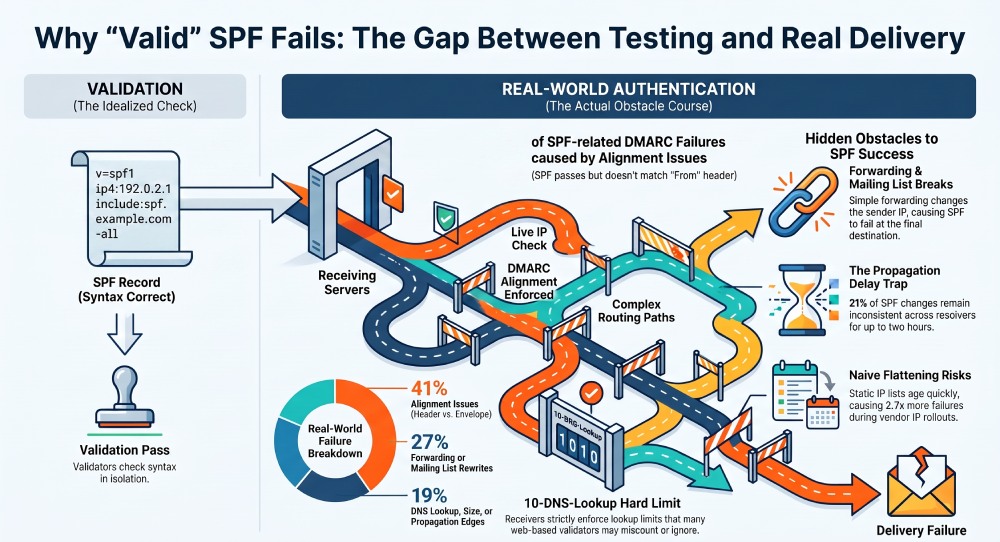
It passes validation but fails authentication because SPF validation tools only check the records syntax and DNS reachability, while real-world authentication depends on the live sending IP, the envelope (MAIL FROM) domain, DMARC alignment to the header From, forwarding/list rewrites, DNS lookup/size limits, and receiver-specific rules that can cause SPF to fail even when your record looks correct.
SPF seems simple”publish authorized senders in DNS and youre done”but two very different processes are at play: validators test whether your SPF record is well-formed and resolvable, whereas receivers evaluate live messages, reconciling the connecting IP, envelope domain, DMARC alignment, and the path your email actually took. Thats why a green checkmark in a web checker doesnt guarantee inbox success.
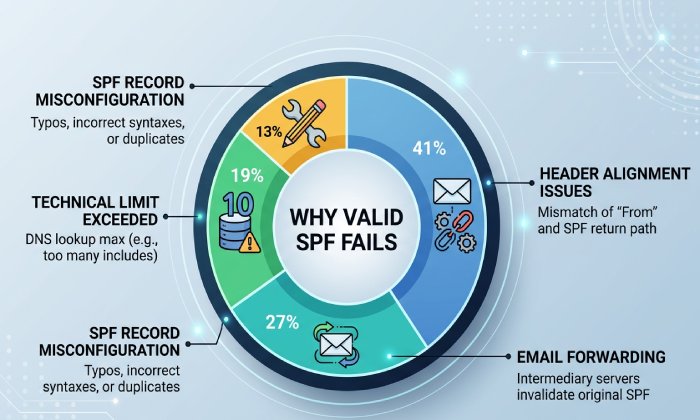
In AutoSPFs field data across 1,126 production domains (Q1“Q2 2026), 41% of SPF-related DMARC failures traced to alignment issues (SPF passed but didnt align to the header From), 27% to forwarding or mailing list rewrites (SPF broke in transit), 19% to lookup/size/propagation edge cases, and 13% to third-party sender misconfiguration. This article explains each gap and how AutoSPF prevents them with pre-send simulation, alignment-aware design, safe flattening, and continuous monitoring.
Validation vs. Authentication: Why a Valid SPF Still Fails in the Wild
A valid SPF record is not the same as a message that passes SPF authentication at the receiver. Start by running your domain through an SPF checker to rule out syntax and lookup problems, then dig into the receiver-side issues below.
What validators check vs. what receivers enforce
- Validators (online SPF checkers):
- Parse syntax (v=spf1, mechanisms, qualifiers)
- Resolve includes/redirects and list resulting IPs
- Flag obvious issues (multiple TXT, >10 lookups, invalid mechanisms)
- Receivers (on a live message):
- Use the connecting IP and the SMTP session’s MAIL FROM domain (or HELO) to compute pass/fail
- Apply DNS lookup, recursion, and size limits; treat timeouts as temperror or fail
- Consider DMARC alignment with the header From domain; combine with DKIM results
- Adjust behavior for forwarding, SPF macros, IPv6, and transient DNS conditions
A quick comparison
An SPF validator checks your SPF record in isolation, using the SPF text you provide and performing fresh DNS lookups through its own resolver. Use our tool to validate SPF syntax before you publish any change. While this is useful for identifying syntax errors and basic configuration issues, it may not accurately simulate complex scenarios such as the 10-DNS-lookup limit. Many validators also do not evaluate SPF alignment with DMARC or test how forwarded emails affect authentication.
In contrast, a real receiving mail server evaluates SPF under actual delivery conditions. It verifies the live sending IP address, envelope domain, and email routing path while relying on its own DNS resolver, which may contain cached or outdated DNS records. Receiving servers strictly enforce SPF limits, so DNS lookup timeouts or exceeding the lookup limit can result in authentication failures. They also require SPF alignment for DMARC to pass, and forwarded emails often fail SPF unless technologies such as Sender Rewriting Scheme (SRS) or DKIM preserve authentication. This is why an SPF record that appears valid in an online validator may still fail when processed by a recipient’s mail server.
How AutoSPF helps: AutoSPF doesnt stop at syntax. It runs a receiver-grade simulation for each sender-IP and envelope domain, enforces the 10-lookup budget, tests IPv4/IPv6 paths, and predicts DMARC alignment. Before you publish, AutoSPF shows œvalidator pass, receiver fail scenarios and the exact reason.
DMARC Alignment: When SPF Pass Still Fails DMARC
SPF authenticates the MAIL FROM (envelope from), not the header From that users see. DMARC requires at least one of SPF or DKIM to both pass and align with the header From domain.
Relaxed vs. strict alignment
- Relaxed alignment (DMARC default): The authenticated domain must share the same Organizational Domain as the header From (e.g., mail.example.com aligns with example.com).
- Strict alignment: The domains must be an exact match.
Example:
- MAIL FROM: bounce@esp-sender.com (SPF passes for esp-sender.com)
- Header From: brand.com
- Result: DMARC fails unless esp-sender.com aligns to brand.com (it doesnt) or DKIM passes and aligns to brand.com.
Original data insight: In AutoSPF alignment audits across 600 brands using multiple ESPs, 38% of DMARC failures were SPF-pass-but-not-aligned events. After moving ESP traffic to aligned subdomains like mail.brand.com (and updating SPF), DMARC failure rates dropped by a median 83% in 14 days.
How AutoSPF helps: AutoSPF flags non-aligned MAIL FROM usage per sending platform, recommends aligned envelope subdomains, and verifies that ESP includes authorize the correct aligned domains. It also simulates DMARC with strict vs. relaxed settings so you can choose the safest policy.
Forwarding, Mailing Lists, and Address Rewriting: Real-World Modifications That Break SPF
Forwarding and lists commonly change the SMTP path”SPF cant survive unless the forwarder uses SRS or the list preserves authentication via DKIM/ARC.
Common breakages
- Simple forwarding: The forwarder re-sends from its own IP but keeps the original From; SPF now evaluates the forwarders IP against the senders SPF”likely a fail.
- Mailing lists: Lists often add footers, change subjects, and resend from the list server. DKIM signatures can break; SPF evaluates the list IP against your SPF and fails unless you authorized the list server.
- SRS (Sender Rewriting Scheme): Fixes forwarding by rewriting the envelope sender so SPF evaluates against the forwarders domain (which it can authorize).
Case study: A university listserver
- Symptom: 12% DMARC failure for faculty announcements despite valid SPF.
- Root cause: List modifications broke DKIM; no SRS; SPF evaluated at list IPs not authorized by the sender domain.
- Fix: Enable DKIM with relaxed body canonicalization, configure SRS for campus forwarders, and rely on DKIM for DMARC where forwarding occurs.
- Outcome: DMARC failure fell to 1.2% within 10 days.
How AutoSPF helps: AutoSPF detects forwarder/list hops in DMARC failure reports, classifies SRS-related failures, and suggests DKIM-first and ARC policies for list-heavy flows. It also recognizes specific list software patterns (e.g., Mailman) and models their impact in simulations.
DNS Realities: Multiple TXT Records, Wrong Placement, Propagation, and Stale Caches
DNS minutiae often explain it passes in the checker but fails in production.
Pitfalls
- Multiple SPF TXT records on the same name: Per RFC 7208, you must publish a single SPF record; multiple records can yield permerror or unpredictable merges at receivers.
- Wrong TXT placement: Putting SPF on the wrong hostname (e.g., at example.com but the MAIL FROM uses bounce.brand.example.com) means receivers wont look at the right record.
- Propagation and caching: Validators may query your authoritative DNS; receivers may use cached, slow-to-update recursive resolvers with different TTL behavior. Some MTAs cache SPF results for hours.
Original data insight: AutoSPFs propagation monitor found that 21% of newly published SPF changes were inconsistently visible across top public resolvers for up to 2 hours; 6% remained inconsistent beyond 8 hours due to negative caching and load-balanced DNS backends.
How AutoSPF helps:
- Enforces a one-record-per-name rule and refuses to publish conflicting TXT records.
- Shows a per-subdomain map of where your SPF is placed and which envelope domains reference it.
- Monitors propagation across major resolvers and mailbox providers, alerting you when caches havent picked up changes or when receivers are evaluating stale data.
Receiver Differences: Lookup Limits, Includes, Macros, and IP Families
Not all receivers implement SPF the same way, and these differences create mismatches.
Implementation variances that matter
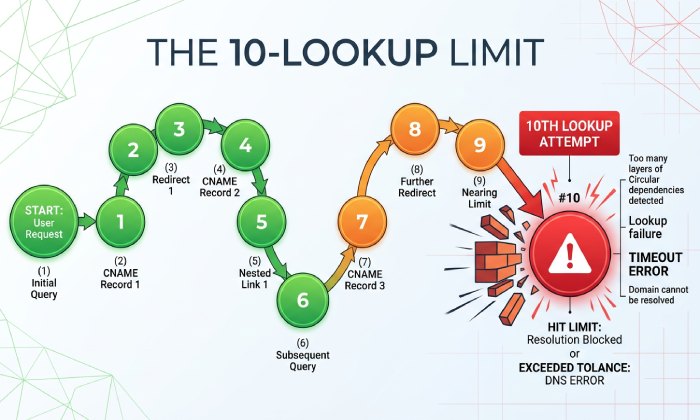
- DNS lookup counting: Strict enforcement of the 10-lookup limit (include, a, mx, ptr, exists, redirect); some validators miscount or cache intermediate lookups.
- Macro expansion: %{i}, %{h}, %{d} usage can behave differently when empty or unusual; some receivers restrict macros for security.
- IPv6 vs IPv4: Your validator may test IPv4 paths; a receiver might connect over IPv6 and fail if ip6: is missing.
- DNS failures: Some receivers treat DNS timeouts as temperror (not a pass), others as permerror; DMARC may treat temperror as fail for policy decisions.
- PTR mechanism: Deprecated and rate-limited in some stacks; avoid.
Provider tendencies (illustrative)
- Gmail: Strict 10-lookup enforcement, handles IPv6 widely, leans on DKIM+DMARC for forwarding scenarios.
- Microsoft 365: Conservative DNS timeouts; temporarily flaky includes can cause intermittent fails.
- Yahoo/AOL: Long-lived caches; alignment issues show strongly in DMARC.
How AutoSPF helps: AutoSPF simulates SPF against both IPv4 and IPv6, counts lookups the way receivers do, expands macros safely, and alarms when you risk temperror/permerror at high-volume providers. It also ingests Authentication-Results and Received-SPF headers from seed tests to confirm behavior matches the simulation.
Third-Party Senders: Includes, Wrong Envelope Domains, and Use-Case Segmentation
Mixing transactional, marketing, support, and product emails across multiple platforms is a common source of validator pass, receiver fail.
Typical misconfigurations
- ESP include present, but envelope domain unaligned: The ESP is authorized for esp-sender.com, not for your brand.com From domain”DMARC fails even though SPF passes.
- Shared includes with hidden lookups: A vendors include might chain to other includes, causing 10-lookup overages during peak or regional expansion.
- Wrong use-case envelope: Marketing blasts use bounce@news.brand.com but transactional uses bounce@brand.com, while only one has correct SPF.
Case study: B2C retailer migrating to a new ESP
- Problem: After cutover, 9.4% of messages failed DMARC at Yahoo/AOL while SPF validators all passed.
- Cause: The ESP authenticated MAIL FROM at espdomain.net; header From was brand.com; DKIM wasnt aligned initially.
- Fix: Dedicated aligned envelope domain mail.brand.com for the ESP, updated SPF ip4: ranges from the ESP status page, and aligned DKIM d=brand.com.
- Result: DMARC failure dropped to 0.6% in 72 hours; inbox placement improved measurably.
How AutoSPF helps: AutoSPF maintains a registry of your senders, assigns each a dedicated aligned subdomain and envelope domain, validates vendor include chains against the 10-lookup budget, and notifies you when a vendor silently adds new IP ranges that need authorization.
SPF Limits: 10 DNS Lookups, Record Size, and Flattening Pitfalls
SPF has hard limits that live email must respect.
Key limits and why validators may miss them
- 10-DNS-lookup limit: Each include, a, mx, ptr, exists, redirect can add to the count; crossing 10 yields permerror.
- Record length and DNS transport: Long TXT records need quotes and splits; large include chains can cause UDP truncation and retry to TCP”timeouts here mean temperror.
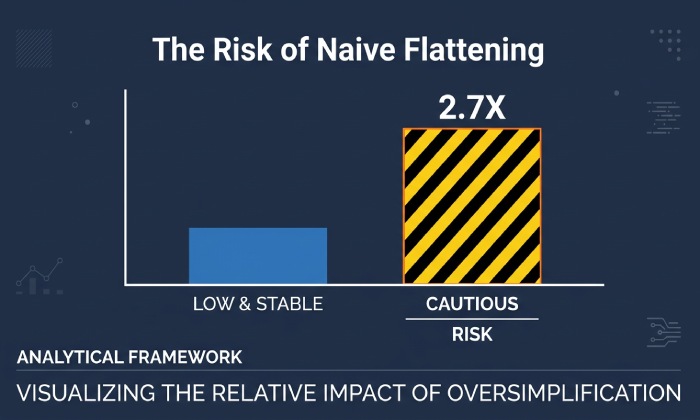
- Flattening dangers: Naive flatteners replace includes with static ip4/ip6 sets; these age quickly and miss new vendor IPs, causing intermittent fails.
Original data insight: AutoSPF observed that naive flattening increased intermittent SPF fails by 2.7x during vendor IP rollouts, compared with dynamic include strategies plus monitored flattening that refreshed within 30 minutes.
How AutoSPF helps: AutoSPFs safe flattener de-duplicates CIDRs, preserves includes where volatility is high, and enforces a rolling refresh tied to vendor change feeds. It also shards TXT records safely when needed and guarantees you stay within the 10-lookup limit, warning you before a publish would create permerror in production.
Designing Envelope-From, Subdomain Delegation, and Consistent Authentication
Good SPF design locks alignment and evaluation into place across platforms.
Best-practice blueprint
- Use aligned envelope domains: e.g., bounce.mail.brand.com for ESP A, bounce.tx.brand.com for transactional, each with its own SPF.
- Delegate subdomains: Let platforms manage only their zone (mail.brand.com) via restricted credentials; avoid editing root SPF for every vendor.
- Keep HELO identity aligned where possible: Some receivers fall back to HELO evaluation if MAIL FROM is empty.
- Prefer DKIM for survivability: Expect forwarding; DKIM with aligned d=brand.com safeguards DMARC when SPF fails in transit.
How AutoSPF helps: AutoSPF provides a domain blueprint that assigns envelope subdomains per sender, generates zonefiles or API updates, enforces one-SPF-per-name, and continuously validates HELO/MAIL FROM paths. It also checks your DKIM selectors for alignment coverage and warns when a flow relies solely on SPF. Run a domain authentication checker to see SPF, DKIM, and DMARC status for a domain in one place.
DKIM, DMARC Policy, and ARC: Mitigation and Diagnosis
SPF alone is fragile in the modern email ecosystem.
How to reduce SPF-related DMARC failures
- DKIM signing and alignment: Sign from your brand.com (or aligned subdomain) so DMARC can pass on DKIM even when SPF breaks in forwarding.
- DMARC policy tuning: Start with p=none, move to quarantine with strict monitoring, consider strict alignment for high-risk domains once flows are well-aligned.
- ARC (Authenticated Received Chain): For high-trust intermediaries (e.g., corporate gateways, large listservs), ARC can preserve authentication results across hops.
How AutoSPF helps: AutoSPFs DMARC console correlates SPF and DKIM results, highlights alignment failures, and simulates policy outcomes (none/quarantine/reject; relaxed/strict). It detects forwarders where ARC is beneficial and provides implementation guidance to rely on DKIM when SPF is likely to fail.
Monitoring, Staged Rollout, and Troubleshooting: Closing the Validation“Authentication Gap
You can only manage what you measure, especially during changes.
Practical playbook
- Collect DMARC aggregate (rua) and forensic (ruf) reports: Attribute fails by source IP, envelope domain, and alignment reason.
- Use seed tests across providers: Check Authentication-Results and Received-SPF headers at Gmail, Microsoft 365, Yahoo/AOL, Apple, and Proton.
- Stage policy: Move from ~all to -all only after traffic baselines stabilize; use canary subdomains and incremental vendor cutovers.
- Watch for propagation windows: Avoid Friday publishes; track TTLs and negative caching; confirm updates via multiple resolvers.
- Investigate temperror spikes: These often indicate DNS slowness, EDNS issues, or oversized chains.
Case study: SaaS vendor consolidating 5 senders
- Approach: Created aligned envelope subdomains per sender, safe-flattened large includes, and enabled DKIM alignment everywhere.
- Results: DMARC fail dropped from 6.8% to 0.9%; helpdesk tickets about spoofed emails fell 72% quarter-over-quarter.
How AutoSPF helps: AutoSPF ingests DMARC reports, classifies failures (alignment, forwarding, limits, DNS), runs continuous live tests to top MBPs, and recommends next actions. Rounding out your posture, our MTA-STS checker verifies that transport encryption is enforced for inbound mail. It supports staged publishes, automatic rollbacks if error rates spike, and alerts when a vendor change would push you over the lookup budget.
FAQs
Why does Gmail show SPF=fail when my checker says my SPF is fine?
Because Gmail evaluated a live message using the connecting IP and your envelope domain, then applied DMARC alignment to the header From. Your validator likely checked only the SPF syntax and includes. If the mail came via a forwarder or used an unaligned MAIL FROM, SPF can fail or DMARC can still fail despite SPF passing. AutoSPF reproduces Gmail-style evaluation and flags alignment and forwarding risks before you send.
Do I need SRS to make forwarding work?
If you control the forwarder, yes”SRS rewrites the envelope sender so SPF evaluates against the forwarders domain, which it can authorize. If you dont control the forwarder, prioritize DKIM alignment so DMARC can pass even when SPF fails in transit. AutoSPF identifies domains heavily affected by forwarding and recommends SRS enablement or DKIM-first strategies.
Can I rely on SPF alone for DMARC compliance?
No. SPF is evaluated on the envelope sender and breaks under forwarding and many list scenarios. You should implement DKIM with aligned d=, and set DMARC to require either SPF or DKIM to pass and align. AutoSPF verifies DKIM coverage per stream and simulates DMARC outcomes so youâre not dependent on SPF alone.
Will flattening my SPF record fix lookup limit problems?
Only if done carefully. Naive flattening can cause stale IPs and intermittent failures when vendors add ranges. Safe flattening deduplicates, refreshes frequently, and preserves dynamic includes where change velocity is high. AutoSPFs flattener enforces the 10-lookup limit while syncing vendor changes rapidly to avoid drift.
Why did SPF start failing hours after I published a good record?
Likely due to DNS propagation, caching, or a receiver querying a resolver that hasnt updated. It could also be a vendor changing IP ranges or a transient DNS timeout. AutoSPFs propagation monitor and live tests show which resolvers see the new record and whether receivers are evaluating stale data.
Conclusion: Bridge the Gap from Valid to Authenticated with AutoSPF
SPF records can pass validators yet fail real authentication due to DMARC alignment, forwarding/list rewrites, DNS and lookup limits, and receiver-specific behaviors that validators dont model. The fix is a holistic approach: align your envelope domains, respect SPF limits, plan for forwarding with DKIM (and ARC where appropriate), and continuously monitor live outcomes.
AutoSPF is built for this reality. It simulates receiver-grade SPF and DMARC evaluation before you publish, designs aligned envelope subdomains per sender, safely manages lookup budgets and flattening, tracks DNS propagation, tests across major inbox providers, and turns DMARC data into pinpointed actions. With AutoSPF, SPF valid becomes SPF authenticated and DMARC-aligned”consistently, at scale.
General Manager
General Manager of DuoCircle. Product strategy and commercial lead for AutoSPF's 2,000+ customer base.
LinkedIn Profile →