Why Sender Policy Framework (SPF) Has a Lookup Limit of 10?

Quick Answer
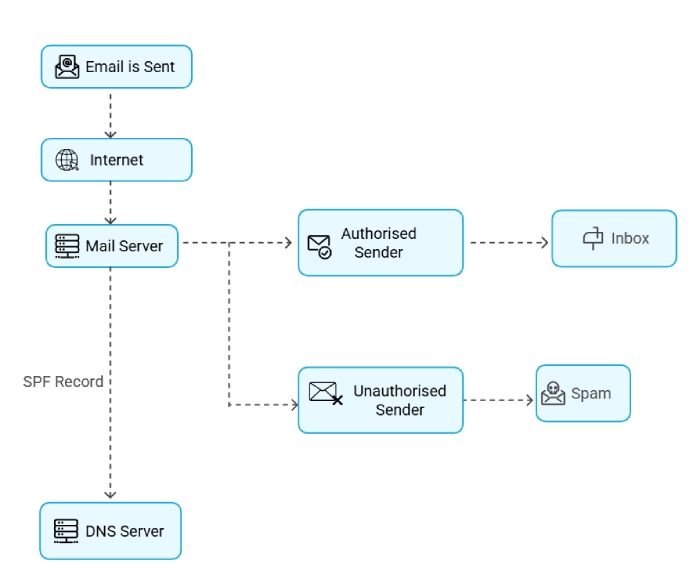
SPF helps recipients’ mailboxes verify the authenticity of senders’ domains by referring to their predefined policies. To do this, the receiving server retrieves the SPF record linked to the sender’s domain. A standard SPF record consists of one or more mechanisms (like ip4, ip6, include, mx, etc.) that specify which IP addresses and domains are officially authorized to send emails.
Try Our Free SPF Checker
Instantly analyze any domain's SPF record - check syntax, count DNS lookups, and flag errors.
Check SPF Record →
SPF helps recipients’ mailboxes verify the authenticity of senders’ domains by referring to their predefined policies. To do this, the receiving server retrieves the SPF record linked to the sender’s domain. A standard SPF record consists of one or more mechanisms (like ip4, ip6, include, mx, etc.) that specify which IP addresses and domains are officially authorized to send emails on the domain owner’s behalf.
“From an engineering perspective, the 10-lookup limit is a resource protection mechanism, not a security feature,” says Adam Lundrigan, CTO of DuoCircle. “RFC 7208 caps lookups to prevent SPF evaluation from becoming a DNS amplification vector. But the practical effect is that any enterprise using more than 3-4 email services hits the wall. The fix is either flattening - which trades lookup count for record length - or macros, which delegate resolution entirely.”
“The 10-lookup limit is the single most common reason enterprise SPF records silently break,” says Brad Slavin, General Manager of DuoCircle and founder of AutoSPF. “In our experience managing SPF for 2,000+ customer domains, the failure mode is always the same: a team adds a new SaaS tool, its include pushes the total past 10, and legitimate email starts failing - but nobody notices until a customer complains about missing invoices or password resets.”
Per RFC 7208, SPF evaluation is capped at 10 DNS mechanism lookups and 2 void lookups per check - exceeding either limit produces a PermError that fails authentication for every message from the domain.
Once the SPF record is retrieved, the recipient’s mail server evaluates it to determine whether the sender’s IP address is allowed to send emails to the specified domain. The email passes the SPF authentication check if the sender’s IP address matches one of the authorized entries in the SPF record. Otherwise, if the sender’s IP address is not listed or is listed as unauthorized, the email may be marked as suspicious or rejected, depending on the recipient’s email server configuration.
However, there is a lookup limit of 10, which is a headache for domain owners, especially the ones with intricate and extensive email infrastructures. If your SPF record has also reached the maximum lookup limit, try SPF flattening. It’s a technique to resolve this issue by compressing all the domains within the SPF, eliminating the need for frequent DNS lookups.
But why does this limit even exist? Well, this restriction prevents overburdening resources and blocks phishing attempts. Let’s understand this better.
Reasons Why the Lookup Limit Exists
DNS Query Overhead
When recipients’ servers retrieve SPF records, they send queries to DNS that sometimes involve multiple lookups. If unlimited lookups were allowed, the DNS server would get overloaded, leading to technical issues and frequent instances of false positives or negatives.
Network Latency
Excessive DNS lookups can introduce network latency, causing delays in email delivery. This delay can negatively impact the user experience, especially in time-sensitive communications.
Also, spam filters consider high network latency as an indicator of poorly configured or malicious servers. This triggers recipients’ mailboxes to mark your emails as spam or reject them outright, irrespective of SPF results.
Network latency also affects the SMTP handshake process, which involves securing a connection between the sending and receiving mail servers.
Resource Consumption
DNS servers have finite resources, including bandwidth, processing power, and memory. Allowing unlimited SPF lookups could strain DNS servers, leading to resource exhaustion and potential service disruptions.
Prevention Against DDoS Attacks
Multiple SPF lookups allow threat actors to exploit vulnerable DNS servers by crafting spoofed SPF lookup requests with the recipient’s IP address as the source. The DNS server then sends large responses to the victim’s IP address, significantly increasing the volume of traffic directed at the victim and potentially leading to a DDoS scenario.
Complexity
If unlimited SPF lookups were allowed, email processing algorithms would have been far more complex and dynamic, making it challenging for administrators to manage SPF records. Moreover, a higher lookup limit invites vulnerabilities and bugs, whereas limited lookups help email servers implement simpler and more efficient SPF validation mechanisms.

Wrapping it
The limit of 10 SPF lookups aligns with industry best practices and recommendations. It strikes a balance between email security, performance, and operational efficiency, ensuring that legitimate emails are delivered promptly while minimizing the risk of abuse and disruption. But if you have hit the maximum limit, get in touch with us for help. Also, please feel free to explore our blog section to educate yourself more on topics related to SPF, DKIM, DMARC, and phishing.
CTO
CTO of DuoCircle. Architect of AutoSPF's SPF flattening engine and DNS monitoring infrastructure.
LinkedIn Profile →