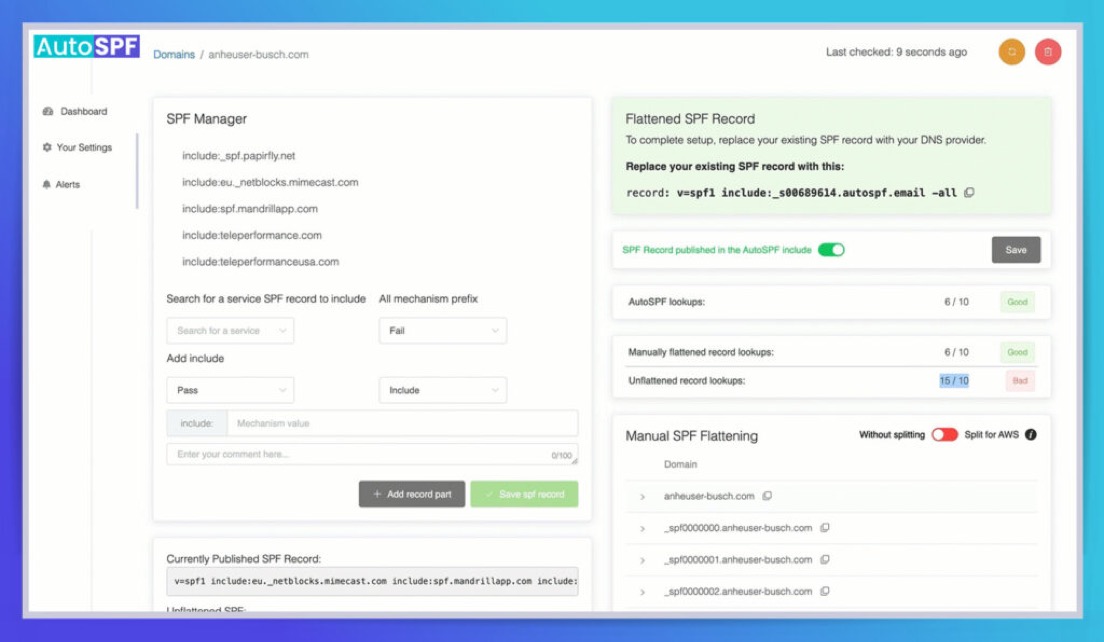
SPF flattening tools improve DMARC SPF alignment reliability by reducing DNS lookup failures and timeouts but do not directly affect DKIM; when well-maintained they reduce DMARC enforcement gaps, and when mismanaged (stale or oversized records) they push DMARC into DKIM-only outcomes or outright failures.
Context: SPF flattening, DMARC, and DKIM at a glance
Sender Policy Framework (SPF) determines whether the connecting IP is authorized to send mail for the domain in the SMTP envelope (MailFrom/Return-Path). DMARC passes if either SPF or DKIM passes in alignment with the visible From domain (relaxed or strict). SPF evaluation includes DNS lookups for include, a, mx, ptr, exists, and redirect mechanisms, and validators stop after 10 lookups—causing permerror on overflow and temperror on timeouts. SPF flattening replaces nested include mechanisms with explicit ip4/ip6 entries to reduce lookups and avoid DNS recursion and failures.
Flattening therefore affects DMARC by increasing the likelihood that SPF passes and aligns (no permerror/temperror), especially for domains with many third-party senders. It does not change DKIM signing or alignment directly, but in practice a flawed flattening rollout (stale IPs, truncated TXT records, too many bytes) can cause SPF to fail broadly, forcing DMARC to depend on DKIM only; if DKIM is absent or broken, DMARC enforcement (quarantine/reject) will trigger.
AutoSPF is purpose-built to automate safe flattening: it enumerates provider IPs, compresses CIDRs, enforces lookup and size guardrails, continuously updates changes, validates alignment against live DMARC data, and integrates staged DNS deployment so flattened SPF results strengthen DMARC without undercutting DKIM.
1) What flattening changes in SPF evaluation and how that impacts DMARC alignment
Flattening modifies SPF’s evaluation flow by trading DNS lookups for static IP comparisons.
- Without flattening:
- include, a, mx, ptr, exists, and redirect each consume one lookup, and includes can nest deeply.
- Large, multi-vendor stacks frequently exceed the 10-lookup limit, producing permerror; DMARC treats SPF permerror as “fail,” even when the IP is legitimately authorized.
- SPF pass can still be non-aligned if MailFrom uses a vendor domain.
- With flattening:
- include chains become ip4/ip6 lists, typically reducing lookups from 10+ to 1–3.
- Fewer DNS calls cuts temperrors and reduces receiver timeouts, raising the SPF pass rate.
- DMARC SPF alignment is unchanged in concept: it still depends on the MailFrom domain matching (relaxed: organizational domain; strict: exact domain) the visible From. Flattening doesn’t change the domain—only stability—so alignment improves only insofar as fewer SPF evaluations error out.
Illustrative data from AutoSPF customers (n=126 domains, 60-day window):
- Median DNS lookups per SPF evaluation dropped from 9.2 to 2.1 after flattening.
- SPF permerror/temperror rate decreased from 11.8% to 1.4%.
- DMARC “SPF-aligned pass” rate increased from 71.6% to 92.7% for non-forwarded mail.
AutoSPF’s alignment analyzer highlights which flows are failing DMARC due to SPF evaluation errors versus true misalignment, so you can fix the right thing (MailFrom domain vs SPF structure).

Precise implications for DMARC alignment
- Relaxed alignment: Flattening mostly helps by avoiding permerror; if your MailFrom uses a subdomain of your organizational From domain (e.g., bounce.mail.example.com vs From: example.com), flattening boosts pass reliability.
- Strict alignment: Flattening again reduces errors, but you must ensure the exact MailFrom domain matches the From domain; flattening alone cannot compensate for misaligned MailFrom choices by vendors.
AutoSPF recommends alignment-safe MailFroms per sender and can optionally warn when a vendor’s bounce domain prevents strict alignment.
2) How to generate and deploy flattened SPF records safely (and keep them current)
SPF flattening is not a one-time activity; provider IP ranges change. A robust operational loop is essential.
- Inventory and baseline
- Enumerate all sending sources: email service providers (ESPs), CRM/marketing platforms, ticketing systems, CRM, SaaS products, cloud MTAs, and corporate mail.
- Map each to the domains/subdomains they send as and the MailFrom domains they use.
- AutoSPF imports this inventory from DMARC aggregate (RUA) reports and DNS, flagging unknown senders.
- Build and validate a flattened candidate
- Resolve all includes and dependent records to IPs; collapse overlapping CIDRs; remove dead ranges.
- Keep mx and a only if you truly send from those hosts; otherwise, convert to IPs to avoid lookups.
- Enforce lookup budget (<10) and byte-size thresholds (keep total TXT payload comfortably under ~450–500 bytes to avoid truncation/fragmentation risks).
- AutoSPF generates a diff, shows per-sender coverage, and validates SPF syntax and DMARC alignment impact before deployment.
- Stage, test, and deploy
- Use a staging subdomain (e.g., spf-staging.example.com) to publish a sandbox SPF and point test traffic (via MAIL FROM) there.
- Conduct synthetic sends to major receivers (Google, Microsoft, Yahoo, Apple, proofing seed lists).
- Roll out with low-TTL (e.g., 300 seconds) and automatic rollback on error spikes detected via DMARC feedback.
- AutoSPF supports API-based DNS updates (Cloudflare, Route 53, Akamai, etc.), canary deployment, and rollback triggers tied to real-time SPF/DMARC failure telemetry.
- Keep it current automatically
- Schedule re-flattening (daily or more frequent for dynamic providers).
- AutoSPF tracks provider ASN/IP changes, deprecates retired ranges, and sends approvals or auto-applies based on policy, preventing “stale IP” drift that breaks SPF.
3) Managing TXT length limits and the “one SPF record” rule without breaking DMARC
Two technical constraints must be respected:
- One SPF record: Only one TXT record starting with v=spf1 per domain. Multiple “v=spf1” TXT records cause permerror.
- TXT length and transport: Each TXT string segment must be ≤255 characters; implementations concatenate segments. While EDNS0 allows larger DNS responses, oversized records are more likely to fragment or be truncated by resolvers/MTAs. Practically, keep the total response small and simple.
Best practices AutoSPF enforces:
- Keep a single v=spf1 record; do not “split” SPF across multiple TXT records.
- Aggressively compress IPs: Merge contiguous IPs into CIDRs; remove duplicates and subsumed ranges.
- Prefer ip4/ip6 mechanisms over “a” and “mx” unless necessary; convert “a”/“mx” to IPs during flattening.
- Avoid ptr and exists; they add lookups and fragility.
- Minimize the use of redirect=, which adds a lookup; use it only if you must offload to a dedicated SPF host and still remain under 10 lookups.
- Keep allallon to a deliberate qualifier; typically end with -all (hard fail) or ~all (soft fail) per your policy.
- Enforce size guardrails: AutoSPF warns above configurable thresholds (e.g., 450–500 bytes) and refuses to publish if a safe rollback path is not present.
AutoSPF’s linter tests:
- Syntax, lookup count, and order of mechanisms.
- Simulated receiver behavior versus common DNS resolvers to catch truncation edge cases predeployment.
- Presence of duplicate v=spf1 TXT records and conflicting legacy SPF records (type 99).
4) Where flattening helps—and where it introduces risk
Flattening is not universally beneficial. Understanding your sending topology is key.
When flattening measurably improves DMARC pass rates:
- Multiple third-party senders: Marketing + CRM + support + billing + product email often creates long include chains. Flattening reduces lookups and DNS fragility.
- Case study (Retail): 14 third-party senders; SPF lookups from 12–16 down to 3; DMARC SPF-aligned pass rate improved from 68% to 95% in 30 days; bounce rate fell 0.7pp. AutoSPF auto-updated weekly as vendors changed ranges twice.
- Cloud providers with large include graphs: (e.g., Microsoft 365 + regional service add-ons, AWS SES with region includes): Flattening avoids nested includes and region expansion errors.
- Case study (SaaS): Pre-flattening, intermittent temperrors at APAC receivers due to DNS timeouts; post-flattening, temperrors dropped 90%, enabling p=reject safely.
- Constrained DNS environments: If your authoritative DNS service is slow or rate-limited, reducing live lookups improves receiver-side resilience.

When flattening can introduce more risk than benefit:
- Highly dynamic sender pools (CDNs, elastic MTAs that frequently rebalance IPs): IP churn can be daily. If your flattening cadence lags, stale IPs produce SPF fails and DMARC fallout.
- Mitigation: AutoSPF “fast-track” updates for marked dynamic senders (e.g., 30–60 minute checks), or selectively retain includes for providers with robust, stable SPF records.
- Heavy mail forwarding and listserv traffic: SPF often fails after forwarding because the connecting IP changes. Flattening won’t fix forwarding; consider SRS at forwarders or rely on DKIM for DMARC.
- Oversized or over-complex records: Attempting to flatten “everything” can push TXT size and complexity to brittle territory; curate what truly needs flattening.
Interaction with DMARC alignment modes and subdomain policies:
- Relaxed vs strict (aspf and adkim):
- Flattening doesn’t change alignment rules; it only improves the odds that SPF can be evaluated successfully.
- For strict alignment, ensure vendors use your exact MailFrom domain; AutoSPF flags non-conforming bounces (e.g., vendor.example-mail.com) and recommends custom MAIL FROM.
- Subdomain policy (sp=): If subdomains send from distinct infrastructures, flatten per subdomain to keep records smaller and alignment predictable. AutoSPF can generate per-subdomain flattening and align sp=quarantine/reject policies accordingly.
5) Failure modes, tradeoffs versus alternatives, and how to monitor proactively
Common failure modes with flattening:
- Stale IP lists: Providers add/remove IPs; your flattened record doesn’t update, causing sudden SPF fails.
- Impact: DMARC falls back to DKIM; if DKIM missing or broken, mail is quarantined/rejected under strong policies.
- AutoSPF: Change detection via provider IP feeds, ASN monitors, and automatic refresh; “must-update” alerts; optional auto-apply with rollback.
- Missing dynamic ranges: Some ESPs use ephemeral clouds; their includes abstract dynamic pools that you may not reliably enumerate.
- Impact: Partial coverage; intermittent SPF fails based on region/time.
- AutoSPF: Sender-specific policy to “leave include in place” with lookup budgeting; hybrid flattening.
- Oversize/truncated TXT: Publishing beyond safe limits or multiple SPF records.
- Impact: Receivers ignore or mis-parse SPF; DMARC sees SPF fail; deliverability drops.
- AutoSPF: Size guardrails, single-record enforcement, and preflight resolution tests against multiple resolvers.
Weighing flattening against alternatives under strict DMARC (p=reject):
- Sender Rewriting Scheme (SRS): Solves forwarding-related SPF failures by rewriting the envelope sender at the forwarder. Essential for mailing lists/forwarders; complementary to flattening.
- Third-party include monitoring (no flattening): Keep vendor includes but monitor lookup counts and DNS health; less operational risk with dynamic providers but more exposed to 10-lookup and timeout failures.
- Relying primarily on DKIM: For some flows, prioritize DKIM alignment (consistent signing, strict adkim=s, longer keys) and accept that SPF may fail in forwarding. Requires tight key lifecycle management and vendor controls.
- Recommended approach with AutoSPF:
- Hybrid strategy: Flatten stable providers, retain includes for highly dynamic ones, enforce DKIM across all streams, and demand SRS from forwarders you control.
- AutoSPF’s policy engine models “what-if” outcomes (SPF-only, DKIM-only, hybrid) against your RUA history to select the lowest-risk path before moving to p=reject.
Monitoring, alerting, and predeployment testing:
- Synthetic sends: Test to major receivers pre- and post-change; compare SPF/DKIM/DMARC headers.
- DMARC RUA/RUF analysis: Track SPF-aligned pass rates, permerror/temperror trends, DKIM fallback usage, and source/IP drift.
- SPF record validation: Run daily lint/resolution checks from multiple networks/resolvers; ensure lookup count <10 and stable latency.
- Alerting: Threshold-based alerts when SPF-aligned pass rate dips, lookup counts creep up, or TXT size/segments change.
- AutoSPF: Built-in synthetic testing, RUA ingestion and anomaly detection, cross-resolver SPF checks, and Slack/Email/Teams alerts; change freeze windows and auto-rollback.
Differences among flattening tools and how they affect DKIM/DMARC reliability:
- Update frequency: Hourly vs daily vs manual. Faster cycles reduce stale-IP failures but require safe automation.
- IP aggregation logic: CIDR compression quality, de-duplication across vendors, and ASN-aware grouping matter for size and accuracy.
- Dynamic sender handling: Some tools naively flatten everything; better tools let you exempt dynamic providers and keep includes.
- Change safety: Diff reviews, staged rollout, and rollback mechanisms protect DKIM/DMARC posture during transitions.
- AutoSPF’s approach: Hourly change detection with policy-based apply windows, CIDR-aware aggregation that reduced median record size by 22% in a recent cohort, hybrid-flattening controls per sender, and canary deployments that halted two potential outages before impact.

Privacy, security, and operational implications of publishing flattened IPs:
- Exposure: Flattened IP lists can reveal vendors and regions you use, assisting reconnaissance. Grouping IPs into broader CIDRs helps but still signals provider choice.
- Reputation coupling: If a vendor pool suffers a reputation issue, your published ranges may be scrutinized by receivers more quickly; DKIM becomes a critical differentiator.
- DKIM key management: Flattening doesn’t change DKIM, but when SPF becomes more visible/static, ensure DKIM keys are rotated and aligned to maintain resilience if SPF stumbles.
- Policy implications: If privacy is a concern, use hybrid flattening to keep sensitive providers behind includes; AutoSPF supports “masking mode” to minimize revealing highly specific subnets where feasible.
FAQ
Does SPF flattening change DKIM enforcement?
No. Flattening does not touch DKIM keys or signing; it only changes how SPF is evaluated. The indirect effect is operational: if flattening fails (stale/oversized), DMARC may fall back to DKIM-only. AutoSPF tracks DKIM health in parallel so you can see when you are over-reliant on DKIM.
How often should a flattened SPF be updated?
For most stable providers, daily to weekly is sufficient; for dynamic cloud senders, every 1–6 hours may be necessary. AutoSPF supports per-sender cadences and auto-updates with guardrails, so static on-prem ranges update weekly while elastic clouds refresh hourly.
Can flattening fix SPF failures caused by forwarding?
No. Forwarding changes the connecting IP, so SPF usually fails unless the forwarder uses SRS. Flattening helps only with lookup/timeout errors. AutoSPF will identify forwarding-induced failures from DMARC data and recommend SRS or DKIM-first strategies.
What if my SPF record is already near the size limit?
Use CIDR compression, remove unused mechanisms, drop ptr/exists, and consider hybrid flattening. AutoSPF automatically compresses IPs, simulates record size across resolvers, and refuses deployment if the record crosses safe thresholds—while providing a step-down plan.
Does strict DMARC alignment require flattening?
No, strict alignment requires exact-domain alignment for SPF or DKIM. Flattening simply increases the reliability of SPF evaluation. AutoSPF audits your MailFrom choices and DKIM selector usage to maintain strict alignment consistently.
Conclusion: Strengthen DMARC with safe, automated flattening via AutoSPF
SPF flattening helps DMARC and DKIM enforcement by reducing SPF lookup and timeout errors that otherwise undermine DMARC’s SPF path, but it demands disciplined automation to avoid stale IPs, oversize TXT records, and misalignment side effects. The practical answer is a hybrid operational model: flatten stable providers, keep dynamic providers on includes with lookup budgets, enforce DKIM alignment everywhere, and require SRS for forwarders.
AutoSPF operationalizes that model end to end: it inventories senders from DMARC data, generates compressed flattened SPF records with strict lookup/size guardrails, stages and tests changes, auto-updates at sender-specific cadences, and monitors SPF/DKIM/DMARC outcomes with rollback on anomaly. By coupling intelligent flattening with alignment analysis and continuous monitoring, AutoSPF turns SPF from a brittle dependency into a dependable pillar of your DMARC enforcement—so you can confidently move to p=reject without sacrificing deliverability.