What Is a AAAA Record and How Does an AAAA Lookup Work?

Quick Answer
An AAAA record maps a domain name to an IPv6 address. An AAAA lookup checks the DNS to find this record, helping identify the IPv6 address associated with a domain and verify its DNS configuration.

A AAAA record is one of the core building blocks that helps a client device find the right IP address for a domain name. In modern DNS, the DNS AAAA record maps a domain name to an IPv6 address, allowing browsers, apps, servers, and other client devices to connect with website resources over IPv6. Without the correct DNS record, a user device may not know where to go when it tries to load the website.
AAAA records matter because IPv6 adoption continues to grow as the internet moves beyond the limits of IPv4. The older IPv4 address space is constrained, and diminishing IPv4 availability has led to workarounds such as NAT, shared address usage, and address sharing across multiple devices. IPv6 was designed to solve this addressing problem with a much larger address space at the Internet Protocol network layer.
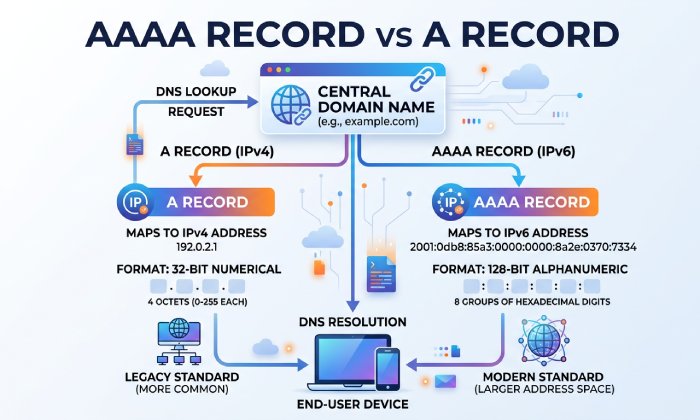
When organizations deploy IPv6 for a website or other network service, they may publish a DNS AAAA record alongside an existing A record. The A record maps a domain name to an IPv4 address, while the AAAA record maps it to an IPv6 address. Publishing both records supports dual-stack connectivity, allowing compatible clients to use IPv6 while IPv4 clients can continue connecting through the A record. Strong email security measures help protect businesses from phishing, spoofing, malware, and unauthorized access.
What Is a AAAA Record? A Simple Definition
A AAAA record is a DNS record type that stores the IPv6 address associated with a domain name. In simple terms, it tells DNS: When someone asks for this domain name over IPv6, return this IPv6 address. The DNS AAAA record does for IPv6 what the A record does for IPv4.
For example, if example.com has an AAAA record with the value 2001:db8::1, a DNS resolver can return that IPv6 address to a client device. The device can then use the address to attempt an IPv6 connection to the associated service. By comparison, an A record might return an IPv4 address such as 192.0.2.10.
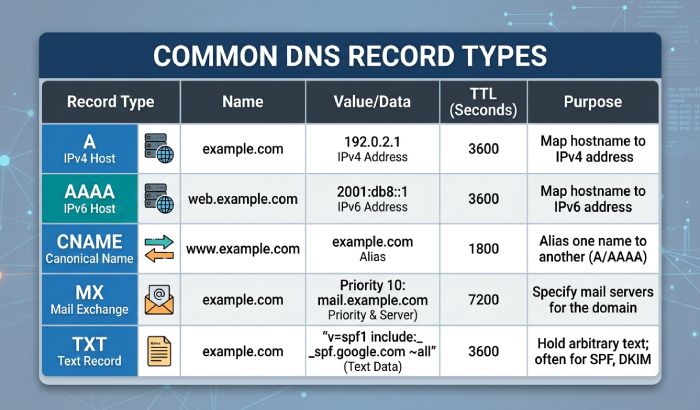
A AAAA record is part of a DNS zone, which contains DNS records types such as A, AAAA, CNAME, MX for email, TXT for authentication and security, and other record types. Each record includes a name, record type, value, and TTL. The TTL tells DNS resolvers how long they should cache the DNS record before checking for updates.
Anatomy of a DNS AAAA Record
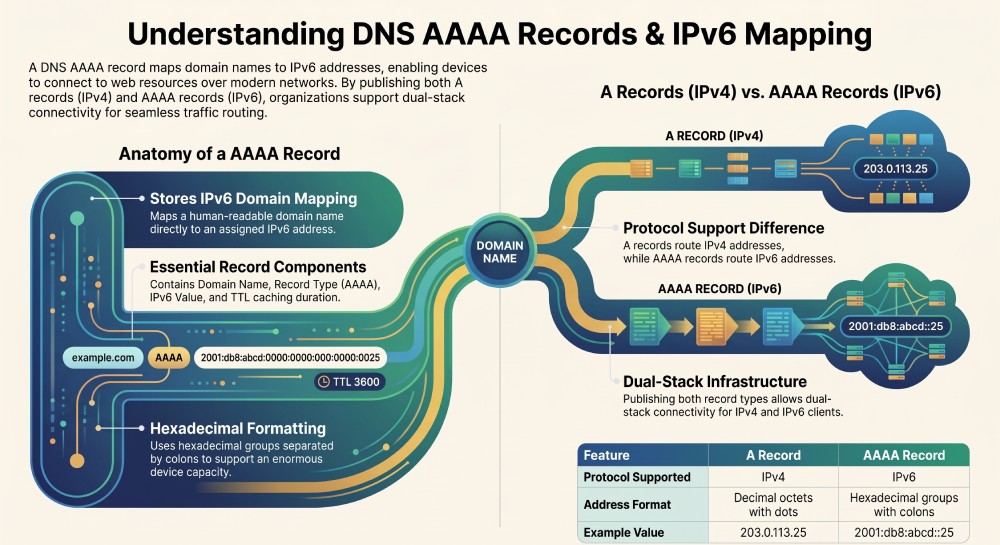
A typical DNS AAAA record includes:
- Name: The domain name or subdomain, such as www.example.com.
- Record type: AAAA.
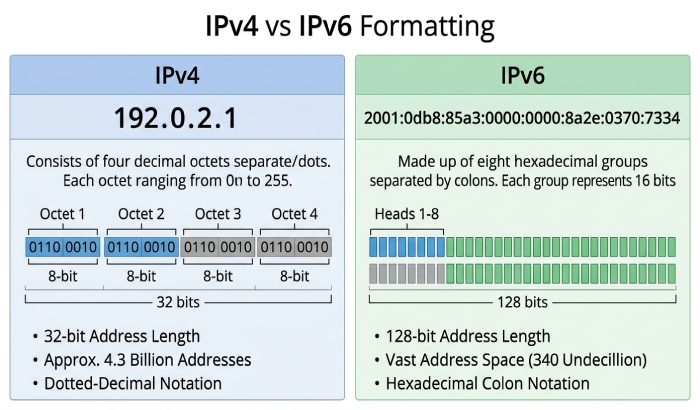
- Value: The IPv6 address, such as 2001:db8::1234.
- TTL: The caching duration for the record.
This address example shows how IPv6 address formats differ from IPv4 address formats. IPv6 uses hexadecimal groups separated by colons, while IPv4 uses four decimal octets separated by dots. Because IPv6 has far more permutations, it can support an enormous number of devices without relying as heavily on shared address models.
DNS providers typically allow administrators to create and manage AAAA records through a DNS management dashboard, API, command-line interface, or other configuration tools.
AAAA Records vs. A Records: IPv6 Compared With IPv4
The main difference between a AAAA record and an A record is the IP version they support. A AAAA record is used to store IPv6 address information, while an A record is used to store IPv4 address information. Both perform address mapping between a domain name and an IP address, but they use different Internet Protocol versions.
An A record returns an IPv4 address, such as 203.0.113.25. A DNS AAAA record returns an IPv6 address, such as 2001:db8:abcd::25. A client device may query both record types when trying to connect with website infrastructure. If the client device, network, and destination service all support IPv6, the device may prefer the IPv6 address. If not, it may fall back to the IPv4 address from the A record.
This behavior is important during IPv6 adoption. Many organizations run dual-stack DNS configuration, publishing both a DNS A record and a DNS AAAA record for the same domain name. This helps client devices on IPv4-only, IPv6-only, and dual-stack networks load the website reliably.
Records Example: A Record and AAAA Record Together
A practical records example might look like this:
The DNS records for www.example.com include an A record that points to the IPv4 address 203.0.113.25 and an AAAA record that points to the IPv6 address 2001:db8:abcd::25.
In this setup, the A record lets IPv4-capable clients connect, while the AAAA record allows IPv6-capable clients to connect. Publishing both records supports dual-stack connectivity, allowing an organization to serve clients over IPv4 and IPv6 where both are supported.
How AAAA Records Fit Into the DNS System
How AAAA Records Fit Into the DNS System
DNS is the distributed naming system that converts a human-readable domain name into an IP address. When a user enters a website address, the client device does not inherently know the servers location. It asks DNS for the correct DNS record. If it needs an IPv6 address, it requests the AAAA record. If it needs an IPv4 address, it requests the A record. DNS TXT records also support email authentication protocols such as SPF, DKIM, and DMARC, which help protect domains against email spoofing.
A DNS resolver handles this address lookup on behalf of the user device. Many networks use a public DNS resolver such as Cloudflare Public DNS. Cloudflares IPv4 resolver addresses include 1.1.1.1 and 1.0.0.1, while its IPv6 resolver addresses include 2606:4700:4700::1111 and 2606:4700:4700::1001. These public service resolvers help client devices resolve a domain name quickly and securely.
DNS records are managed within a DNS zone, which can contain different record types for a domain and its subdomains. Common records include A records for IPv4 addresses, AAAA records for IPv6 addresses, CNAME records for aliases, MX records for email delivery, and TXT records for authentication and other configuration purposes.
Operational Context for Cloud and Application Teams
For website and email infrastructure teams, a AAAA record can be an important part of IPv6 connectivity. A correctly configured record helps IPv6-capable clients reach the intended service, while an incorrect or missing record can cause connectivity problems. Checking the AAAA record can therefore be useful when troubleshooting IPv6-related DNS or email infrastructure issues.
If a DNS AAAA record is missing or points to an incorrect IPv6 address, IPv6-capable clients may be unable to connect to the associated service over IPv6. A stale cached record can also cause temporary connectivity issues after a DNS change. If a valid A record is available, IPv4 clients may still connect successfully, while users connecting over IPv6 could encounter problems.
General Manager
General Manager of DuoCircle. Product strategy and commercial lead for AutoSPF's 2,000+ customer base.
LinkedIn Profile →