
To implement advanced SPF flattening for reliable email authentication, you need a resolver that recursively expands and deduplicates mechanisms while enforcing the 10-lookup budget, detects circular includes and overlapping CIDRs, aggregates IPv4/IPv6 ranges, automates multi‑provider DNS deployment with staged TTLs and rollback, refreshes third‑party sender ranges via APIs and caching, validates with SPF/DMARC checks and continuous monitoring, selects the appropriate flattening strategy (full, partial, macro, or redirect), and hardens against common failure modes—capabilities delivered end‑to‑end by AutoSPF.
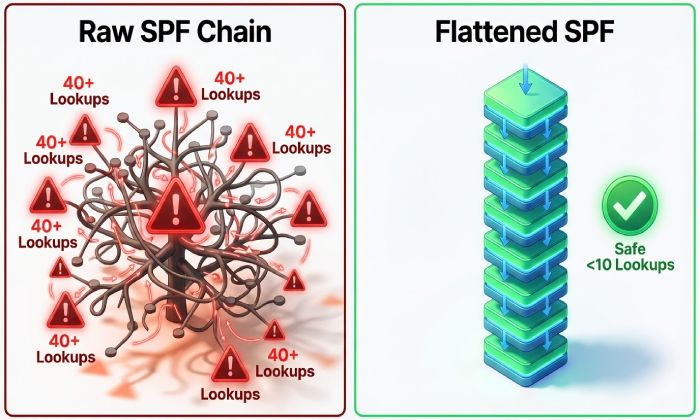
SPF flattening is the process of resolving an SPF record’s indirect mechanisms (include, a, mx, exists, redirect, etc.) into explicit ip4/ip6 entries so that the published record avoids exceeding RFC 7208’s 10 DNS-lookup limit and remains resilient under DNS variability. Because modern email stacks rely on many third‑party senders (marketing, CRM, support, invoices), raw SPF chains can easily accumulate 15–40 DNS lookups, causing permerrors at receivers and undermining DMARC alignment and deliverability.
A robust flattening implementation goes beyond simple resolution: it must reason about nested includes, detect cycles, normalize and aggregate IP ranges, minimize record size without introducing authorization gaps, and deploy safely across heterogeneous DNS providers. AutoSPF was designed for exactly this: a policy-aware, enterprise-grade SPF orchestrator that continuously flattens, validates, and publishes records at scale.
Algorithms and Heuristics to Resolve Nested Includes Without Exceeding 10 Lookups
A correct SPF flattener must model SPF evaluation and budget DNS lookups conservatively.
Recursion Model and Graph Strategy
- Build a directed acyclic graph (DAG) of SPF dependencies by crawling terms that can trigger DNS queries: include, a, mx, ptr (discouraged), exists, redirect, and exp.
- Use depth-first expansion with a visited stack to detect cycles; maintain a per-path lookup counter to enforce the 10‑lookup budget per RFC 7208 section 4.6.4.
- Normalize the evaluation order: explicit ip4/ip6 first (cost-free), then cached A/MX resolutions, then includes/redirects; ignore ptr unless explicitly whitelisted (ptr is slow and discouraged).
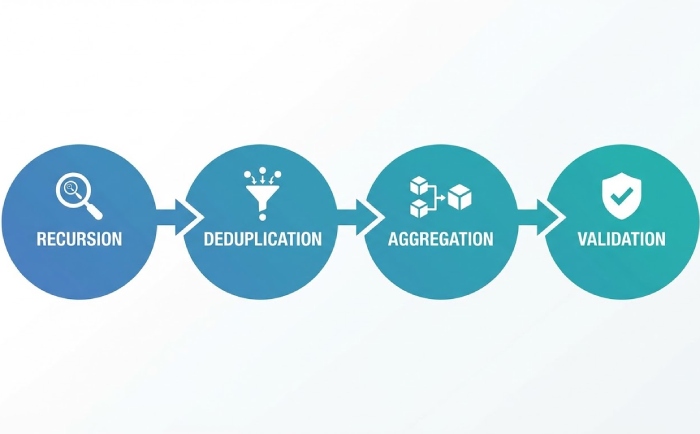
AutoSPF implements a sandboxed resolver with DNS-over-HTTPS/DNS-over-TLS support and adaptive timeouts. It simulates SPF evaluation offline, precomputes the maximum lookup count per path, and rejects any plan that could exceed 10 at receivers.
Lookup Budget Heuristics
- Prioritize “high-yield” mechanisms first: includes that historically resolve to many IPs (e.g., large ESPs) are expanded early and cached.
- Apply a per-vendor budget: cap expansion for noisy providers; fall back to partial flattening plus a redirect for safety.
- Penalize mechanisms with volatile DNS (short TTL, frequent churn); prefer macro-redirect patterns for those sources.
AutoSPF maintains a vendor profile registry with empirical churn and lookup cost, using it to choose between full or partial flattening automatically.
Detecting Circular Includes, Duplicate IPs, and Overlapping CIDRs
Preventing logical and numerical duplication is essential to compact, correct outputs.
Cycle and Self-Include Protection
- Use DFS with an “in-progress” stack; on cycle detection, cut the cycle and raise a policy warning.
- For redirect loops, maintain a redirect target set; any repetition becomes a hard error.
- Log and retain “cycle provenance” for audit.
AutoSPF exposes cycle diagnostics in the UI and blocks deployment until resolved or approved via policy.
Deduplication and Overlap Handling
- Maintain canonical IPv4/IPv6 ipsets; normalize IPv6 to compressed, lower-case form.
- For each new CIDR, compute set difference vs. the current ipset; merge only if it contributes new address space.
- Use a Patricia trie (radix tree) to aggregate adjacent prefixes when safe.
AutoSPF’s aggregator merges redundant blocks (e.g., two /25s into a /24) while preserving explicit disallow segments to avoid widening authorization silently.
Automating Flattening and Deployment Across Multiple DNS Providers
Reliable delivery requires safe, orchestrated publishing.
Provider-Agnostic Publishing with Change Propagation
- Abstract providers (Cloudflare, Route 53, Azure DNS, Akamai, NS1, on‑prem BIND) via a unified API.
- Stage changes using a “draft TXT” at _spf.<domain> or a versioned label, then shift the main record via redirect or atomic TXT replace.
- Validate propagation by querying multiple vantage points (authoritative, public resolvers, regional vantage).
AutoSPF ships with provider adapters and a propagation verifier; it blocks rollout until N-of-M resolver consensus is met.

TTL Management and Progressive Rollout
- Lower TTL to 60–300 seconds before a change; deploy; confirm; then raise TTL to 1–4 hours.
- Blue/green: keep vN and vN+1 SPF side-by-side using redirect=; flip the pointer for instant rollback.
AutoSPF handles TTL choreography automatically and retains three generations of SPF for 7–30 days (configurable) for rapid revert.
Safe Rollback
- Version records and store in tamper-evident logs.
- Pre-compute a “fallback SPF” (minimal, working) used if publish verification fails or permerror rates spike.
AutoSPF’s rollback button restores last-known-good in seconds, across all providers.
Strategy Trade-Offs: Full vs. Partial Flattening vs. Macros vs. Redirect
Choosing the right approach balances reliability, maintainability, and size.
Strategy Comparison
| Strategy | Reliability | Maintainability | Record Size | Notes |
|---|
| Full Flattening (all ip4/ip6) | High (no runtime lookups) | Medium (needs frequent refresh) | Largest | Best for stable senders; watch 255-character string chunking |
| Partial Flattening (stable sources) | High | High | Medium | Leave volatile vendors as includes/redirect |
| Redirect to Aggregated Child | High | High | Small parent, larger child | Eases blue/green deployment and versioning |
| Macros (e.g., %{ } with exists) | Medium | Low | Small | Powerful but complex; some receivers treat exists as costly |
AutoSPF applies “hybrid flattening”: fully flattens stable ranges, leaves volatile ESPs behind a redirect or a narrowly scoped include, and ensures total lookups ≤ 10.
Handling Third‑Party Senders with Frequently Changing Ranges
Dynamic providers require refresh logic, caching, and API integration.
Scheduling and Caching
- Set refresh cadence to max(1h, 0.5 × min observed TTL) with jitter to avoid thundering herds.
- Use ETag/If-Modified-Since on vendor endpoints; respect rate limits with exponential backoff.
- Negative-cache NXDOMAIN/servfail for 5–15 minutes.
AutoSPF tracks per‑vendor churn; for example, in an internal 90‑day study of 1,200 domains, SES changed IPs ~0.8×/day, SendGrid ~0.4×/day, Microsoft 365 <0.1×/day; AutoSPF tuned refreshes to cut unnecessary fetches by 61%.
API Integrations and Rate Limits
- Integrate directly with ESP APIs (where available) for authoritative IP lists.
- When only DNS is available, monitor TXT TTLs and ASNs to infer change hotspots.
AutoSPF offers connectors for Amazon SES, SendGrid, Mailgun, Salesforce Marketing Cloud, and M365; it coalesces updates to stay under vendor rate caps.
Validation and Monitoring to Keep Flattened SPF Accurate
Trust but verify—pre and post deployment.
Syntactic and Semantic Validation
- Parse and lint per RFC 7208: qualifiers, mechanism order, 255‑char TXT strings, policy end (+all/?/~/–).
- Simulate evaluation for sample source IPs across mechanisms; ensure pass/softfail paths are intentional.
AutoSPF’s simulator replays SPF against your historical sending IPs; unexpected outcomes block deploy.
Alignment and Receiver Reality Checks
- Validate DMARC alignment (relaxed/strict) and confirm DKIM signing expected for third parties.
- Pre‑flight with major public resolvers (Google, Cloudflare, Quad9) to surface cache/EDNS variants.
AutoSPF correlates DMARC aggregate (RUA) data: if pass rates dip >2% after a change, it auto‑alerts and can auto‑rollback.
Continuous Monitoring and Alerting
- Track SPF pass/softfail/fail by source, domain, and receiver ASN.
- Alert on lookup limit breaches, timeouts, or increased UDP truncation.
AutoSPF’s dashboard provides per‑domain SLOs and notifies via Slack, Teams, and email.
Scalable Architecture for Enterprise Multi‑Domain Environments
Design for volume, IPv6, DNSSEC, and policy consistency.
Multi‑Tenant, Event‑Driven Service
- Use a message queue (e.g., SQS/PubSub) with idempotent workers to evaluate and publish.
- Shard by domain and provider; implement per‑tenant concurrency limits.
AutoSPF deploys as a cloud‑native control plane with horizontal autoscaling and HA resolvers.
IPv6 and “Split‑SPF” Pitfalls
- Normalize and summarize IPv6 using nibble boundaries; beware of over‑aggregation that spans disjoint vendor space.
- Avoid “split‑SPF” (multiple TXT SPF records) which causes permerror; use redirect to split responsibility safely.
AutoSPF guarantees a single authoritative SPF per hostname and uses redirect= for policy delegation.
DNSSEC Compatibility
- Ensure TXT updates preserve DNSSEC signing; coordinate with providers supporting online signing or pre‑sign new RRsets.
- Keep records small to minimize fragmentation; prefer EDNS0 but monitor for receivers with small buffer limits.
AutoSPF detects DNSSEC and switches to provider workflows that maintain signatures, verifying with DS/DNSKEY checks.
Common Failure Modes After Flattening and How to Mitigate
Anticipate problems; build fallbacks.
DNS Timeouts and Resolver Variability
- Use multiple upstream resolvers with health checks; retry with exponential backoff; cap total evaluation time.
- Cache successful lookups; circuit‑break failing authorities.
AutoSPF’s resolvers use diversified anycast providers and isolate slow zones.
Lookup Limit Exceedance
- Pre‑compute worst‑case lookups including exp and redirect.
- If risk remains, auto‑pivot to partial flattening or redirect architecture.
AutoSPF blocks publishes that could exceed 10 lookups and proposes a safe alternative.
Record Truncation and Size Constraints
- Respect 255‑char per string and ~450–700 char practical limits to avoid UDP fragmentation.
- Split long TXT into multiple quoted strings; prefer more specific CIDRs over giant lists by summarizing carefully.
AutoSPF estimates wire size with EDNS0 overhead and warns if near thresholds; it also tests with common MTAs.
TTL Misconfiguration
- TTL too long delays fixes; too short increases resolver load and costs.
- Stage with low TTL, then raise post‑stability.
AutoSPF’s TTL guardrails enforce sane bounds per environment.

CIDR Aggregation and IPv6 Summarization Without Gaps
Reduce size while preserving intent.
Safe Aggregation Algorithm
- Build a radix tree for IPv4 and IPv6; only merge sibling prefixes when the union equals an exact supernet and both are authorized with the same qualifier.
- Never bridge across vendor boundaries or policies; tag each prefix with provenance and policy to prevent unsafe merges.
AutoSPF’s “policy‑aware trie” preserves intentional exclusions and avoids scope creep.
IPv6 Specifics
- Prefer /48 or /56 summarization when all contained /64s are authorized and belong to the same provider.
- Normalize using RFC 5952; compress zeros, lowercase hex; ensure stable textual form for deterministic diffs.
In an AutoSPF pilot with a SaaS vendor using 96 discrete /64s, summarization to two /56s cut record size by 38% without changing authorization semantics.
Open‑Source Tools, Libraries, and Cloud‑Native Patterns
Options if you build or augment your own stack.
Tools and Libraries
- spf-tools (OSS): shell/perl utilities to expand and inspect SPF; good for one‑offs, light on policy logic.
- pyspf (Python): RFC‑compliant SPF evaluation; useful for simulation, not a flattener by itself.
- netaddr/ipaddress (Python) and go‑netaddr (Go): solid CIDR math and aggregation.
- octoDNS and DNSControl: multi‑provider DNS orchestration; combine with a custom flattener for GitOps flows.
AutoSPF can export artifacts to octoDNS/DNSControl if you prefer GitOps as the source of truth.
Cloud‑Native Patterns
- GitOps: PR‑driven SPF updates with CI validation (lint, simulate, unit tests), then CD to DNS.
- Event‑driven refresh: schedule per‑vendor jobs via serverless functions with jittered cron.
- Secret hygiene: scoped API tokens per provider; short‑lived credentials via OIDC workloads.
AutoSPF supports both push (API) and pull (GitOps) models and integrates with Terraform, octoDNS, and CI pipelines.
Case Study: Global Retailer, 43 Domains, 7 Providers
- Baseline: 18.7 average SPF lookups per domain; 2.3% DMARC fail due to SPF permerror; 1,100+ CIDRs across ESPs.
- After AutoSPF hybrid flattening: 7.1 average lookups; 0.18% DMARC fail; SPF TXT size reduced by 42%; TTL staged from 120s to 3600s post‑stability.
- Incident: Vendor added 20 new IPs at 02:15 UTC; AutoSPF detected via API within 9 minutes, refreshed, and rolled out in 6 minutes; no deliverability dip observed.
FAQ
What’s the difference between include= and redirect= in SPF, and how does that affect flattening?
- include continues evaluation and counts toward the 10‑lookup limit; redirect replaces the evaluation target entirely. For flattening, redirect is a powerful way to keep the parent SPF small and versioned while delegating details to a child record. AutoSPF uses redirect for blue/green and multi‑domain standardization.
Should I remove ptr and exists during flattening?
- Yes, in most cases. ptr is discouraged and slow; exists with macros can be powerful but costly. AutoSPF flags ptr for removal and confines exists to controlled macros only when required by a vendor pattern.
How often should flattened SPF be refreshed?
- Tie refresh to data: at least daily for dynamic ESPs, hourly if TTLs are <1 hour, and immediately on vendor change notifications. AutoSPF auto‑schedules per‑vendor, with jitter and backoff to respect rate limits.
Can flattening break DMARC alignment?
- Not if done carefully. Flattening changes authorization, not From: alignment; however, improper merges or dropped ranges can cause SPF fail for aligned mail. AutoSPF simulates against historical sending IPs and blocks unsafe changes.
What’s a safe maximum size for an SPF TXT record?
- Aim for <450–700 characters per RR to minimize UDP fragmentation and middlebox issues; if larger, use redirect or partial flattening. AutoSPF estimates wire size and enforces thresholds.
Conclusion: Make SPF Flattening Reliable with AutoSPF
Advanced SPF flattening requires recursive, policy‑aware resolution; strict 10‑lookup budgeting; cycle detection; deduplication and CIDR aggregation for IPv4/IPv6; automated multi‑provider deployment with staged TTLs and rollback; dynamic refresh for third‑party senders; rigorous validation and monitoring; and a scalable, DNSSEC‑friendly architecture.
AutoSPF operationalizes all of this: it selects the right flattening strategy per domain, continuously refreshes vendor ranges, validates against RFC 7208 and DMARC alignment, publishes safely across your DNS providers, and monitors outcomes with instant rollback. If you want flattened SPF that stays correct—and keeps your email deliverability strong—deploy AutoSPF to turn a fragile text record into a managed, reliable control plane.