Authoritative DNS Vs. Recursive DNS: Understanding Their Roles in Internet Communication

Quick Answer
Authoritative DNS and Recursive DNS play distinct but complementary roles in domain resolution. Recursive DNS locates the requested IP address on behalf of users, while Authoritative DNS provides the official records for a domain. Together, they ensure reliable and efficient internet connectivity.

The Domain Name System (DNS) is one of the core technologies that keeps the internet functioning smoothly. Every time someone enters a website address into a browser, DNS works behind the scenes to translate that human-readable domain name into an IP address that computers can understand. This process relies on different types of DNS servers, with authoritative and recursive DNS servers playing the most important roles.
Although both are essential to domain resolution, they perform very different tasks. Understanding how they work and interact can help website owners, administrators, and IT professionals better manage DNS performance and security.
What Is DNS?
DNS serves as the internet’s directory service. Rather than requiring users to memorize numerical IP addresses, DNS enables them to access websites using easy-to-remember domain names.
When a user requests a website, DNS translates the domain name into the corresponding IP address so the browser can locate and connect to the correct server.
How DNS Resolution Works
The DNS resolution process involves multiple servers working together to locate the requested information. When a domain name is entered into a browser, a recursive DNS server begins searching for the correct IP address. If the answer is not already available, it queries other DNS servers until it reaches the server that contains the authoritative information for that domain.
Once the correct IP address is found, it is returned to the user’s device, allowing the website to load.
What Is Recursive DNS?
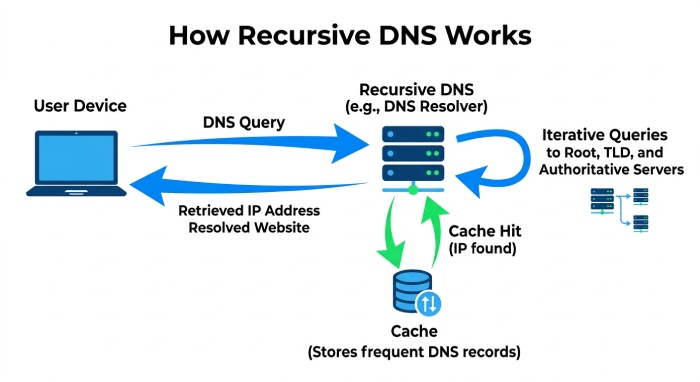 A recursive DNS server acts as a resolver on behalf of the user. Its primary responsibility is to locate the requested DNS information and return an answer as quickly as possible.
Rather than storing authoritative records for every domain on the internet, recursive servers gather information from other DNS servers when needed.
Key Functions of Recursive DNS
- Receives DNS requests from users and applications.
- Searches for the correct DNS records when they are not already known.
- Communicates with other DNS servers to resolve queries.
- Returns the final IP address to the requesting device.
- Stores previous lookup results in cache to improve speed.
The Importance of DNS Caching
Caching is one of the most valuable features of recursive DNS servers. After resolving a domain, the server temporarily stores the result for future requests.
This reduces lookup times, decreases network traffic, and improves browsing performance for frequently visited websites.
What Is Authoritative DNS?
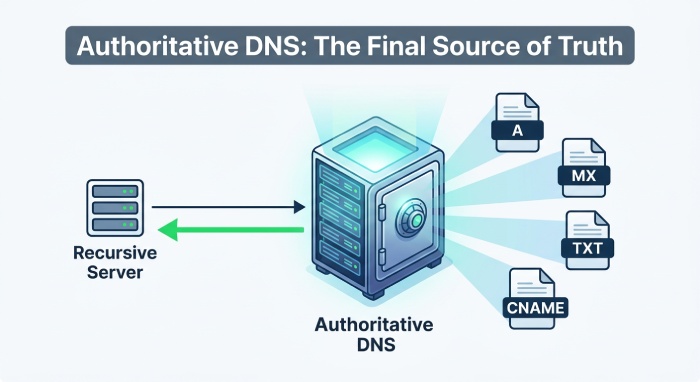
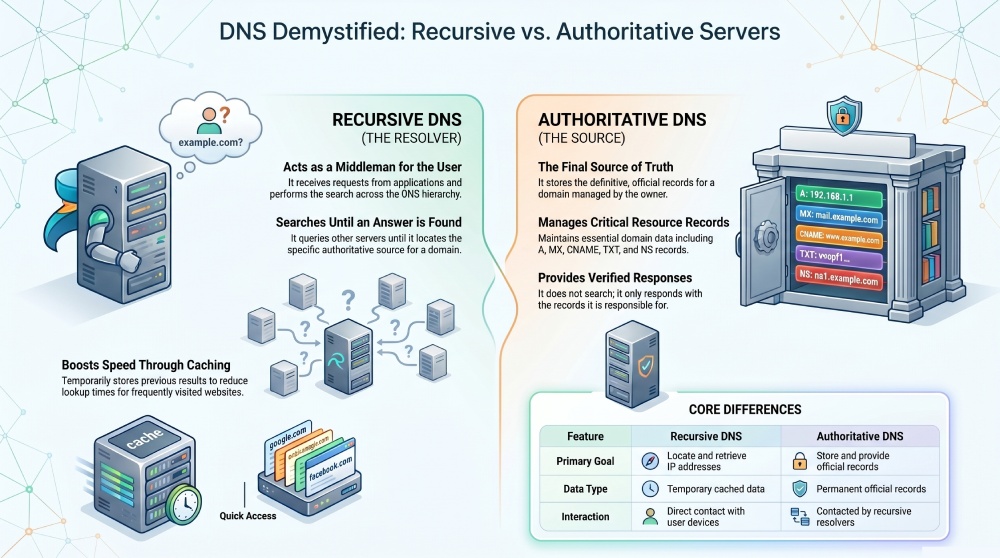
Authoritative DNS servers contain the official DNS records for a domain. They are considered the definitive source of information for that domain and provide answers when recursive servers request data.
Unlike recursive resolvers, authoritative servers do not search for information elsewhere. Instead, they respond using the records they maintain.
Key Functions of Authoritative DNS
- Stores official DNS records for domains.
- Responds to DNS queries with verified information.
- Maintains records such as A, AAAA, MX, CNAME, TXT, and NS records.
- Serves as the final source of truth for domain-related data.
Why Authoritative DNS Matters
Without authoritative DNS servers, there would be no reliable source for domain information. These servers ensure that users receive accurate DNS records and reach the correct destinations online.
The Relationship Between Recursive and Authoritative DNS
Recursive and authoritative DNS servers work together to complete the DNS lookup process.
When a user requests a website:
- The request is sent to a recursive DNS server.
- The recursive server checks its cache for an existing answer.
- If no cached record exists, it searches the DNS hierarchy.
- The recursive server contacts the authoritative server responsible for the domain.
- The authoritative server provides the requested DNS record.
- The recursive server returns the result to the user and may cache it for future use.
This collaboration allows DNS queries to be resolved efficiently while maintaining accuracy.
Authoritative DNS vs. Recursive DNS: Key Differences
Purpose
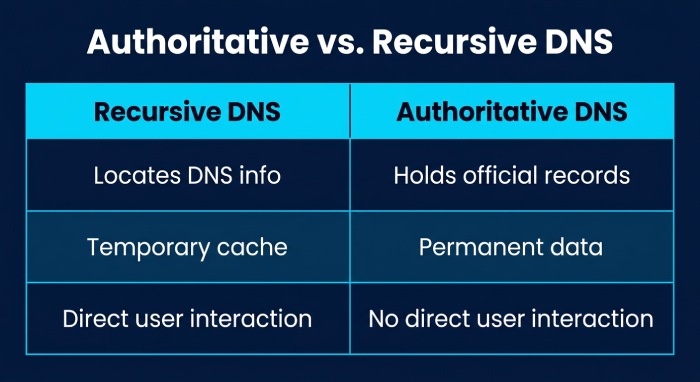
- Recursive DNS servers locate and retrieve DNS information for users.
- Authoritative DNS servers store and provide official DNS records for specific domains.
Data Storage
- Recursive servers primarily store temporary cached data.
- Authoritative servers store permanent DNS records managed by domain owners.
User Interaction
- Users interact directly with recursive DNS resolvers through browsers, applications, and operating systems.
- Users do not directly communicate with authoritative servers during normal browsing.
Query Handling
- Recursive servers perform the work required to find DNS information.
- Authoritative servers answer requests with the records they manage.
Performance Impact
- Recursive servers improve speed through caching.
- Authoritative servers focus on delivering accurate and up-to-date domain information.
Security Role
- Recursive resolvers can validate DNS responses and help protect users from tampered records.
- Authoritative servers maintain trusted domain data and support DNS security mechanisms such as DNSSEC.
Who Uses Recursive DNS?
Recursive DNS is used by virtually every internet-connected device. Internet service providers, public DNS services, businesses, and organizations operate recursive resolvers to process DNS requests for users.
Examples include home internet users, corporate networks, and cloud environments.
Who Uses Authoritative DNS?
Authoritative DNS is used by anyone who owns or manages a domain name. Website operators, businesses, organizations, and cloud service providers rely on authoritative DNS servers to publish and maintain their domain records.
These servers ensure that users can find websites, email services, and other online resources associated with a domain.
Best Practices for DNS Management
To maintain a reliable DNS environment:
- Use reputable authoritative DNS providers.
- Enable DNSSEC where supported.
- Monitor DNS performance and availability.
- Configure appropriate TTL values.
- Maintain redundancy with multiple DNS servers.
- Regularly review and update DNS records.
Strengthen DNS reliability and email security by combining Authoritative DNS management with AutoSPF, SPF, DKIM, and DMARC to ensure trusted domain communication. For domains with many authorized senders, an SPF flattening service keeps your record under the 10-lookup limit and avoids PermErrors. Compare plans on our SPF flattening pricing page. New to these terms? Our SPF glossary defines them all.
Conclusion
Authoritative and recursive DNS servers perform distinct but complementary functions within the DNS ecosystem. Recursive servers handle the process of finding answers for users, while authoritative servers provide the official records that define a domain’s online presence.
Together, they form the foundation of modern internet communication, enabling fast, accurate, and reliable access to websites and online services around the world.
General Manager
General Manager of DuoCircle. Product strategy and commercial lead for AutoSPF's 2,000+ customer base.
LinkedIn Profile →