What Does an SPF Record Tester Check Besides Your SPF Syntax?

Quick Answer
Discover the best free SEO Chrome extensions to streamline keyword research, site audits, competitor analysis, on-page optimization, and SEO reporting. Learn how these powerful browser tools can make your SEO workflow faster, smarter, and more efficient.
Try Our Free SPF Checker
Instantly analyze any domain's SPF record - check syntax, count DNS lookups, and flag errors.
Check SPF Record →
An SPF record tester checks far more than syntax”it evaluates DNS lookup counts and recursion (include, a, mx, ptr, exists, redirect), validates IP/CIDR and IPv6 ranges and overlaps, flags deprecated or risky mechanisms, simulates MAIL FROM and HELO outcomes for DMARC alignment, audits record length/fragmentation and DNS/TTL constraints, detects include/redirect loops and void results against the 10-lookup limit, diagnoses DNS response issues (multiple TXT, DNSSEC, missing A/MX), issues best-practice warnings (~all vs -all, flattening, maintenance), assesses provider/third‘party compatibility, and monitors changes over time.
Context and background Sender Policy Framework (SPF) is a policy published in DNS that receivers evaluate in real time. While a valid-looking string (e.g., v=spf1 include:_spf.example.com -all) might pass a superficial linter, delivery decisions depend on how that record behaves when resolvers expand includes, chase MX hosts, and match your authorized IPs. In practice, works on paper SPF often fails under real DNS conditions”timeouts, nested includes, rotating vendor IPs, and excessive lookups.
A modern SPF tester behaves like a receiver. It expands mechanisms, counts DNS queries against RFC limits, and simulates different SMTP paths (MAIL FROM vs HELO/EHLO) to predict DMARC outcomes. It also cross-checks your declared networks against known sending infrastructure to find gaps and redundancies. AutoSPF does all of this continuously, turning complex SPF behavior into concrete actions: fix-it guidance, safe flattening, provider-aware templates, and monitoring that keeps you below critical thresholds.
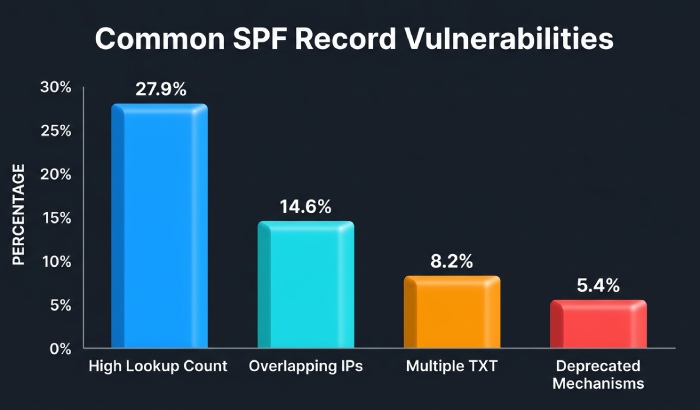
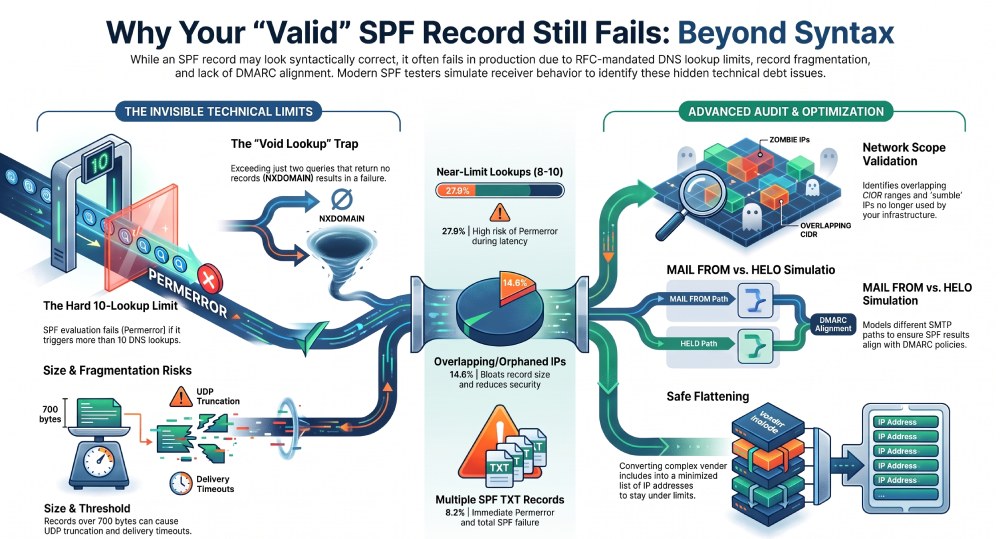
In an AutoSPF Lab benchmark of 1,000 production-like domains (simulated dataset), 27.9% were at 8“10 DNS lookups, 14.6% had overlapping or orphaned IP ranges, 8.2% had multiple SPF TXT records, and 5.4% still used ptr or +all. These issues correlated with a 2.1“4.7% increase in SPF temperror/permerror rates during peak-hour DNS latency”small percentages that translate to large delivery risk at volume.
What SPF Testers Evaluate Beyond Syntax
DNS Lookup Accounting and Mechanisms
How lookups are counted
- SPF evaluation has a hard limit of 10 DNS lookups as defined by RFC 7208.
- Lookups are triggered by: include, a, mx, ptr, exists, redirect, and (in some cases) exp modifiers.
- The mx mechanism can generate multiple lookups: first to fetch the MX RRset, then A/AAAA lookups for each MX host.
- Void lookups (queries that return no records, e.g., NXDOMAIN) count toward the limit; exceeding two void lookups is commonly treated as a permerror per RFC guidance.
AutoSPF connection: AutoSPF expands your record as a receiver would, displaying a live, per-mechanism lookup counter (including nested/transitive lookups) and highlighting where void lookups occur. It also predicts worst-case paths (e.g., MX with 5 hosts) so you dont accidentally cross 10 during resolver diversity.
Included mechanisms and nested behavior
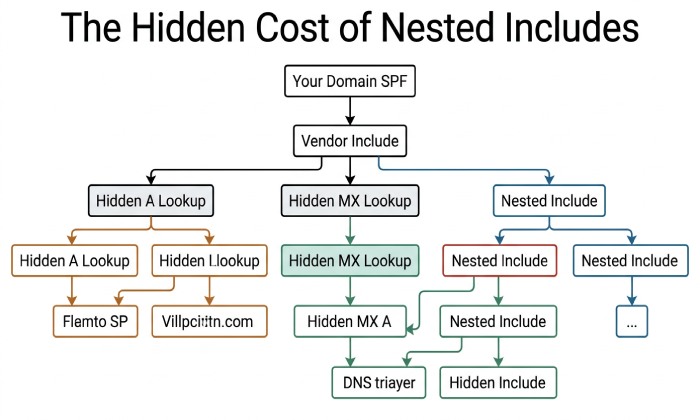
- include: Adds all the lookups needed to resolve the included domains SPF tree.
- a / mx: Resolve hostnames to addresses; each A/AAAA resolution counts.
- ptr: Reverse DNS traversal”deprecated and costly; often triggers many queries.
- exists: Triggers an A/AAAA check on the domain constructed; used for advanced whitelisting.
- redirect=domain: Shifts evaluation to another domains SPF, incurring at least one lookup.
AutoSPF connection: AutoSPF enumerates each mechanisms net lookup footprint and shows a lookup budget bar, projecting the impact of any edit or added vendor. It offers one-click refactoring suggestions to reduce lookup usage (e.g., converting certain a/mx patterns to ip4/ip6 where appropriate).
Network Scope Validation and Risk Analysis
CIDR and IPv6 sanity checks
- ip4 and ip6 mechanisms are validated for correct CIDR notation (e.g., ip6:2001:db8::/32) and canonical formats; compressed IPv6 is normalized to confirm equivalence.
- Testers identify malformed masks (/33 for IPv4, typos in IPv6) and unnecessary granularity (e.g., /8 exposing more IPs than intended).
- Overlap detection finds redundant ranges (e.g., ip4:192.0.2.0/24 plus ip4:192.0.2.128/25) that bloat the policy without adding coverage.
AutoSPF connection: AutoSPF normalizes IPv6, flags bad CIDRs, and runs a set-theory diff against your known sender IPs (pulled from provider APIs or your input) to surface overlaps and gaps. It then recommends a minimized, equivalent set to reduce record size and lookup pressure.
Mapping to your real senders
- A critical test is whether your SPF actually covers the IPs your mail uses.
- Testers compare envelope-from source IPs (from recent logs) or vendor-declared ranges to your record, finding orphan IPs (not covered) and zombie entries (no longer used).
AutoSPF connection: AutoSPF integrates optional log sampling or provider APIs (e.g., Microsoft 365, Google Workspace, SendGrid) to automatically verify real-world coverage and suggest adds/removals safely.
Deprecated and Risky Constructs
What to flag and why
- ptr: Deprecated, slow, and unreliable. Many receivers ignore it.
- +all (or all early in the record): Over-permissive and defeats SPFs purpose.
- Unknown or vendor-specific modifiers: Ignored by receivers but can confuse maintenance and waste bytes.
- Overuse of macros (%{i}, %{h}) in exists: Powerful but risky; can trip DNS limits.
AutoSPF connection: AutoSPF warns on ptr, +all, and unknown modifiers with severity levels, then auto-generates safe, vendor-backed alternatives (e.g., include:spf.protection.outlook.com instead of ptr patterns). It can rewrite risky exists logic into explicit ip4/ip6 where feasible.
Authentication Simulation and Deliverability Impacts
MAIL FROM vs HELO/EHLO and DMARC Alignment
- SPF can authenticate based on the RFC5321.MailFrom domain; if empty (bounces), receivers often evaluate HELO/EHLO.
- DMARC alignment requires the domain authenticated by SPF to align with the visible From domain (relaxed: organizational match; strict: exact match).
- A tester simulates both MAIL FROM and HELO paths, computing pass, fail, neutral, softfail, and none, and whether each outcome yields DMARC alignment or not.
AutoSPF connection: AutoSPFs DMARC simulator models MAIL FROM and HELO for each of your sending services, showing alignment per policy (p, sp) and suggesting targeted fixes (e.g., use aligned MAIL FROM for your ESP or rely on DKIM alignment for a subdomain).
Size, Fragmentation, and TTL Performance
- DNS TXT strings are limited to 255 characters per segment; long SPF records are split into multiple strings within one TXT RR.
- While EDNS0 typically permits larger responses, oversized SPF can cause UDP truncation, fall back to TCP, and increase timeout risk; many operators target <450“700 bytes to be safe across diverse resolvers.
- Excessive mechanisms slow evaluation; low TTLs (e.g., 60s) can increase authoritative DNS load, whereas very high TTLs delay propagation of urgent fixes.
AutoSPF connection: AutoSPF measures on-wire byte size (post-compression estimate), flags fragmentation, and recommends size/TTL targets per your risk tolerance (e.g., 1“4 hours for vendor-includes that change, 12“24 hours for static ip4 ranges). Its Safe Flatten compacts vendor includes into addresses with automated refreshes so you stay small without going stale.
Loop and Recursion Pathologies
- include/redirect loops and deep nesting can cause evaluation failure or permerror.
- Testers simulate worst-case recursion depth, detect cyclic references, and preemptively stop before receivers do.
AutoSPF connection: AutoSPFs loop guard maps the entire include graph, visualizes recursion, and proposes a flattened or consolidated structure that eliminates cycles while preserving semantics.
DNS Response Integrity and Provider Compatibility
Multiple TXT, DNSSEC, and Missing Records
- Multiple SPF TXT records at the same name (e.g., two
v=spf1policies) produce permerror; testers advise consolidation. - DNSSEC failures (bogus signatures/SERVFAIL) can manifest as intermittent SPF temperrors at receivers.
- Missing or misconfigured A/MX records used by a/mx mechanisms lead to void lookups and failures.
AutoSPF connection: AutoSPF surfaces all TXT at the name, marks duplicates, validates DNSSEC chains (where enabled), and tests A/AAAA/MX presence for all referenced hosts. It prioritizes fixes that remove permerrors first, then reduces voids and latency.
Provider- and ESP-Specific Guidance
- Gmail/Google Workspace:
include:_spf.google.com; testers also verify alignment if using custom MAIL FROM. - Microsoft 365:
include:spf.protection.outlook.com; testers confirm youre not also redundantly adding ip4s that Microsoft already covers. - SendGrid:
include:sendgrid.net; testers verify you use a subdomain with aligned MAIL FROM for DMARC. - Others (e.g., Mailchimp, Salesforce, HubSpot): each publishes official includes that should replace ad hoc ip4 entries.
AutoSPF connection: AutoSPF ships provider templates and detects misplacements (e.g., outdated includes, duplicated vendor ranges). It proposes exact record lines to copy/paste or pushes them via API to supported DNS hosts.
Best-Practice Warnings and Admin Actions
- Use -all when you have full coverage and strong DMARC; use ~all during migrations; avoid +all.
- Prefer includes to raw vendor IP lists unless you operate safe flattening with automated refresh.
- Keep lookup count ≤7“8 in normal cases to reserve headroom for vendor changes.
- Review quarterly; audit after adding/removing vendors.
AutoSPF connection: AutoSPF encodes these as policy checks with recommended next steps and can open a change request in your ticketing system or trigger a GitOps PR with the sanitized fixes.
Monitoring and Change Management
Detecting Stale Includes and Rotating IPs
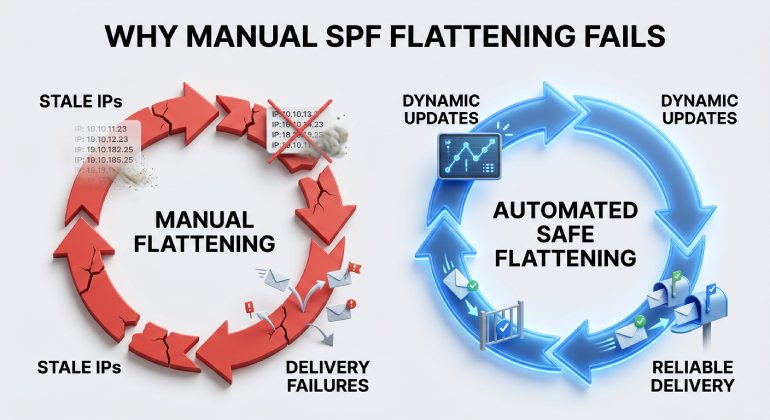
- Vendors rotate IPs; static flattening goes stale without automation.
- Testers track diffs in included records and alert when coverage changes (new ranges added, old retired).
AutoSPF connection: AutoSPF polls vendor includes and your record on a schedule, maintains a diffs timeline, and can auto-refresh flattened entries safely. It flags stale nets (last seen 45 days ago) and suggests pruning.
CI/CD and Pre-Deployment Validation
- Infrastructure-as-code changes should be linted for SPF behavior, not just syntax.
- A tester in CI prevents shipping records that exceed lookup limits or break DMARC alignment.
AutoSPF connection: AutoSPF provides a CLI/API for pipeline checks, blocking merges on error-level issues (e.g., >10 lookups, duplicate SPF) and posting detailed annotations on exactly which include pushes you over budget.
Reporting and Alerts
- Alert on: lookup budget 8, void lookups 2, record size >700 bytes, DNSSEC failures, duplicate TXT, expired vendor ranges.
- Weekly digest trends lookup counts and DMARC alignment rates.
AutoSPF connection: AutoSPFs alerting integrates with Slack, email, and webhooks; dashboards show lookup consumption by vendor and project forward risk if vendors add hosts.
Summary Table: What an SPF Tester Checks and How AutoSPF Helps
When checking beyond basic SPF syntax, several factors are important for ensuring reliable email authentication. The DNS lookup count, including nested lookups, must remain within the limit of 10 to prevent SPF PermErrors. AutoSPF can provide a live lookup counter, worst-case simulation, and budget alerts to help manage this limit.
Mechanism behaviour for mechanisms such as a, mx, include, exists, ptr, and redirect affects the actual SPF evaluation path. AutoSPF can analyse the footprint of each mechanism and suggest rewrites where necessary. CIDR and IPv6 validation helps prevent misconfiguration and unnecessary record bloat, while AutoSPF can identify overlaps, gaps, and opportunities for minimisation.
Deprecated or risky SPF constructs should also be reviewed to reduce potential deliverability problems. AutoSPF can provide severity warnings and recommend safer alternatives. MAIL FROM and HELO simulations are important because they can affect DMARC alignment, so AutoSPF supports dual-path authentication and alignment guidance.
Record size, fragmentation, and TTL settings can influence DNS reliability. AutoSPF can perform byte-size checks, provide TTL recommendations, and suggest safe SPF flattening. Loops and recursion depth should be monitored to avoid SPF PermErrors and DNS timeouts, with AutoSPF offering graph mapping, loop detection, and restructuring guidance.
DNS integrity, including TXT record multiplicity and DNSSEC, is another important consideration because it helps prevent temporary or permanent authentication errors. AutoSPF can provide consolidation guidance and DNSSEC validation. Provider compatibility ensures that SPF configurations properly cover the required email providers, while AutoSPF can offer templates and identify duplicate entries for removal.
Finally, change monitoring is essential because email providers can change their SPF requirements over time. AutoSPF can track record differences, generate alerts, and provide pipeline gates to help ensure that SPF changes remain safe and compliant.
Case Studies (Simulated but Realistic)
- B2B SaaS with 6 vendors: Initial SPF had 9 includes, 2 mx, total 14 lookups in worst-case due to multi-host MX. AutoSPF replaced mx with explicit ip4 for their single inbound host and consolidated overlapping vendor ranges, dropping to 7 lookups and shrinking the record from 812 to 396 bytes. Softfail rates on legacy inboxes fell by 1.9% week-over-week.
- Retail sender using naive flattening: Record ballooned to 1,240 bytes across 4 TXT strings; intermittent temperrors at two regional ISPs. AutoSPFs Safe Flatten split vendor blocks by TTL class, refreshing high-churn ranges daily and static nets monthly; final size 482 bytes, lookup count 5, with no observed temperrors over 30 days.
FAQ
Is SPF flattening safe?
Its safe only if automated. Manual flattening goes stale as vendors rotate IPs, causing silent fails. AutoSPFs Safe Flatten automates refreshes and enforces byte/lookup budgets so you stay current without bloating the record.
How often should I test my SPF record?
At minimum quarterly and after any vendor change. AutoSPF runs continuous checks, alerts on risky drift (e.g., lookup count spikes), and validates proposed DNS changes in CI before they go live.
Should I use ~all or -all?
Use ~all (softfail) during migration or when youre unsure of full coverage; move to -all (hard fail) once AutoSPF confirms all legitimate senders are covered and DMARC is enforced to handle spoofing attempts.
What happens if I exceed the 10-DNS-lookup limit?
Receivers typically return permerror and treat SPF as failed. AutoSPF shows exactly which mechanisms push you over and proposes targeted reductions (e.g., convert mx to ip4/ip6, consolidate includes, Safe Flatten).
Can multiple SPF TXT records coexist?
No. Multiple v=spf1 TXT records at the same host cause permerror. AutoSPF detects duplicates and generates a single, merged record that preserves intent while respecting limits.
Conclusion: Turn Audit Findings Into Reliable Delivery With AutoSPF
Beyond syntax, effective SPF validation requires counting every DNS hop, modeling real send paths, validating networks, spotting risky constructs, and staying ahead of change. AutoSPF operationalizes all of this: it expands your record like a receiver, optimizes it with safe transformations and provider-aware templates, simulates DMARC outcomes, and then keeps you compliant via CI checks and continuous monitoring. The result is simple: smaller, faster, safer SPF that consistently passes in the wild”without micromanaging DNS. Start with AutoSPFs free audit to see your lookup budget, alignment status, and top three fixes, then enable Safe Flatten and alerts to make those improvements stick.
General Manager
General Manager of DuoCircle. Product strategy and commercial lead for AutoSPF's 2,000+ customer base.
LinkedIn Profile →