
Email ecosystems these days are no longer limited to only a couple of email servers. Most organizations now rely on external tools and services, such as email platforms, marketing tools, security gateways, and authentication solutions, to manage and protect their email communications.
The problem with such a complex ecosystem is integrating all these platforms with your domain, so that the receiving servers can correctly identify which services are authorized to send, process, or secure emails on your behalf. To make this happen, you first need to publish certain configurations in your domain’s DNS records, which act as publicly accessible instructions that other systems on the internet can refer to.
In most cases, these integrations require your domain to point to another hostname instead of an IP address. That’s when DNS records like CNAME and ALIAS come into play. Both allow your domain to reference another hostname, helping connect it with external platforms and services.
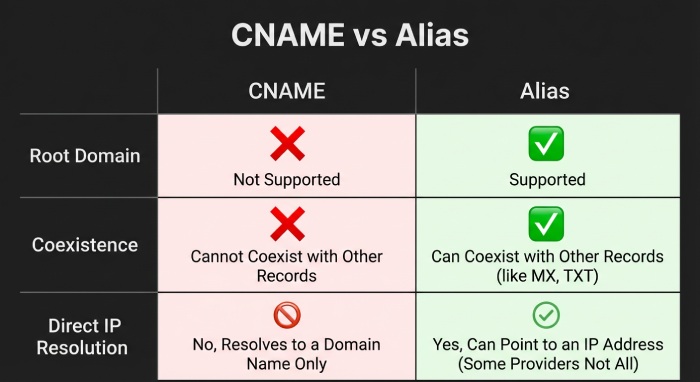
While the two records might seem similar, they are very different and serve different purposes. Let us understand the differences between the two.
What is a CNAME record?
CNAME or Canonical Name records are a type of DNS record that points one domain to another, instead of an IP address. When someone tries to access your domain via a CNAME record, the DNS checks the hostname in the record and resolves that domain to the server’s final IP address. This means that the domain is indirectly connected to the server through another domain that acts as the actual destination.
Because of this, CNAME records are used to connect domains or subdomains to external platforms or services. So instead of pointing your domain to an external server’s IP address, it points to a hostname provided by the service.
This makes integration easier, especially when you are working with external platforms like marketing tools, CRM, or cloud services. Since the underlying infrastructure of these platforms is in the hands of the service provider, they can change it anytime. In such a case, if you use a CNAME record, you don’t have to worry about updating your DNS records every time the infrastructure changes. After all, your domain points to their hostname instead of a fixed IP address, so DNS automatically resolves it to the correct server.
But there are some limitations to CNAME records. They cannot be used for your root domain (yourcompany.com); they are mostly used for subdomains like blog.yourcompany.com. Moreover, you cannot even have other DNS records associated with the same hostname with a CNAME record.
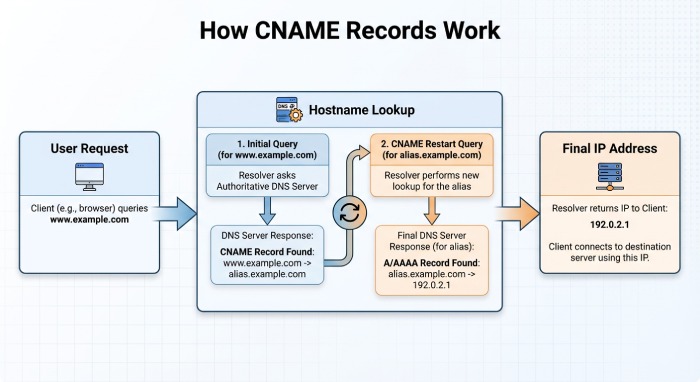
These restrictions have made DNS providers introduce alternative record types such as Alias records.
What is an Alias record?
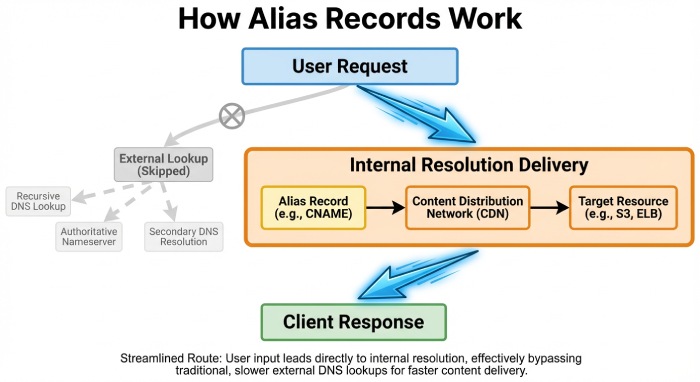
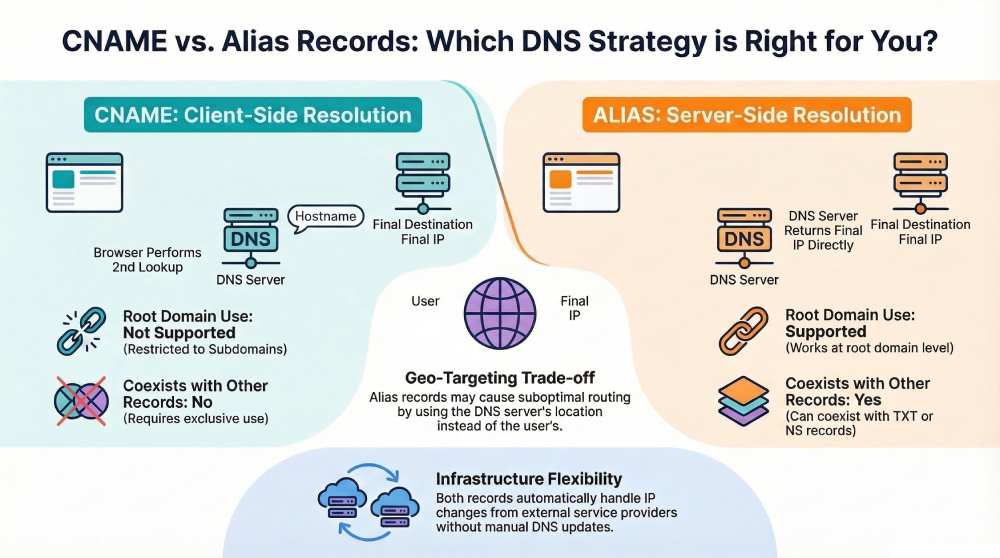
An Alias record is similar to a CNAME record, with the major difference being how the DNS resolution happens. While a CNAME record simply points one domain to another hostname, an Alias record resolves that hostname internally and returns the final IP address to the user.
So, when someone tries to access your domain with an Alias record, the DNS will first look up the hostname, identify the IP behind it, and then return the final IP to the user. These records are useful when you want your root domain, yourcompany.com, to point to an external service and then return the final IP to the user. This resolution makes it behave similarly to a standard A record, while allowing you to seamlessly connect your root domain to modern cloud infrastructure.
How is a CNAME record different than an Alias record?
Here are a few differences between CNAME records and Alias records:
DNS resolution process
CNAME and Alias records perform DNS resolution very differently. While a CNAME record simply points one domain to another hostname, the DNS server returns that hostname to the user. In this case, the user’s browser has to perform another lookup to resolve the second hostname and obtain the final IP address. But in the case of Alias records, the DNS server performs this second lookup itself and directly returns the final IP address to the user.
Ability to coexist with other records
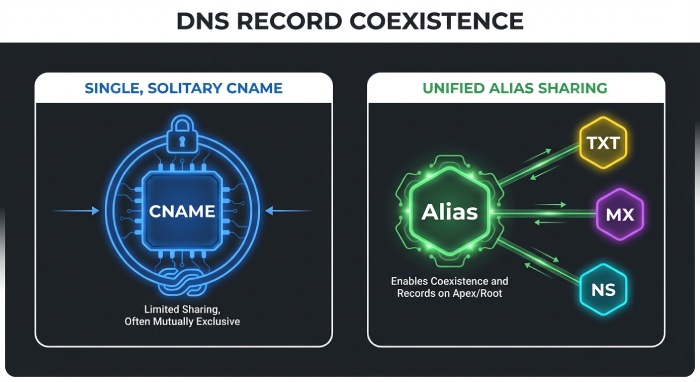
If you have configured a domain with a CNAME record, you cannot create additional records such as TXT, NS, or SOA for that same hostname, or else it may cause a conflict. But this is not the case with Alias records, which can coexist with other DNS record types.
Use at the root domain
Another major limitation of CNAME records is that they cannot be used at the root domain and are only used for subdomains. ALIAS records, however, can be used at the root domain because they ultimately return an IP address, similar to an A record.
Geo-targeting considerations
Even though Alias records give you more flexibility, they may lose some geo-targeting information during the resolution process. Since the authoritative DNS server resolves hostnames internally, routing decisions may sometimes be based on the server’s location rather than the user’s actual location, leading to suboptimal routing in some cases.
Understanding the differences between CNAME vs Alias records helps optimize domain configuration while supporting tools like Autospf and authentication methods such as SPF, DKIM, and DMARC to strengthen overall email security and improve reliable email delivery.
Need help configuring your domain with the right records? Get in touch with our team today!