How Can Dynamic SPF Record Management Prevent SPF Failures?

Quick Answer
Dynamic SPF record management prevents SPF failures by automatically updating authorized mail servers and IP addresses. This reduces configuration errors, avoids authentication issues, and helps maintain consistent email deliverability as sending infrastructure changes.
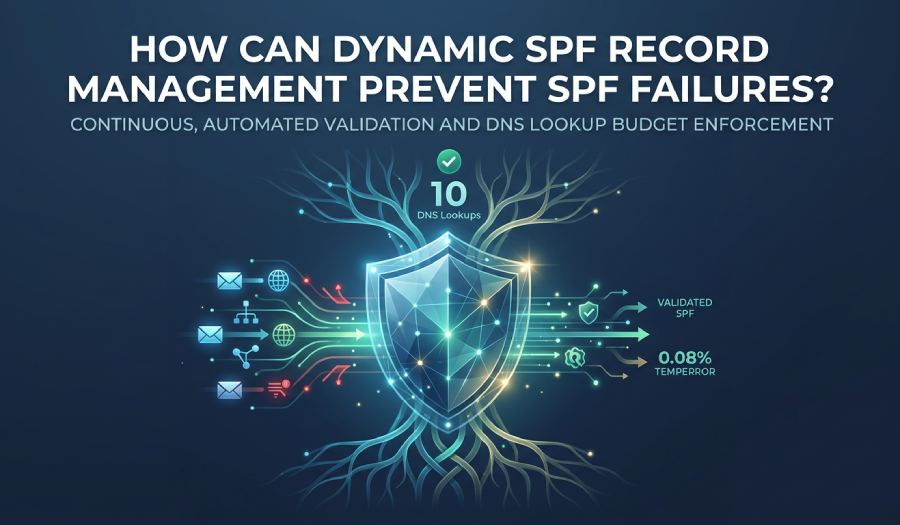
Dynamic SPF record management prevents SPF failures by continuously and programmatically maintaining a single authoritative include for your domain, enforcing the 10-DNS-lookup budget, coordinating low-TTL rollouts, and performing monitored rollbacks—so new senders, IP rotations, and provider changes never leave your SPF invalid or out of date.
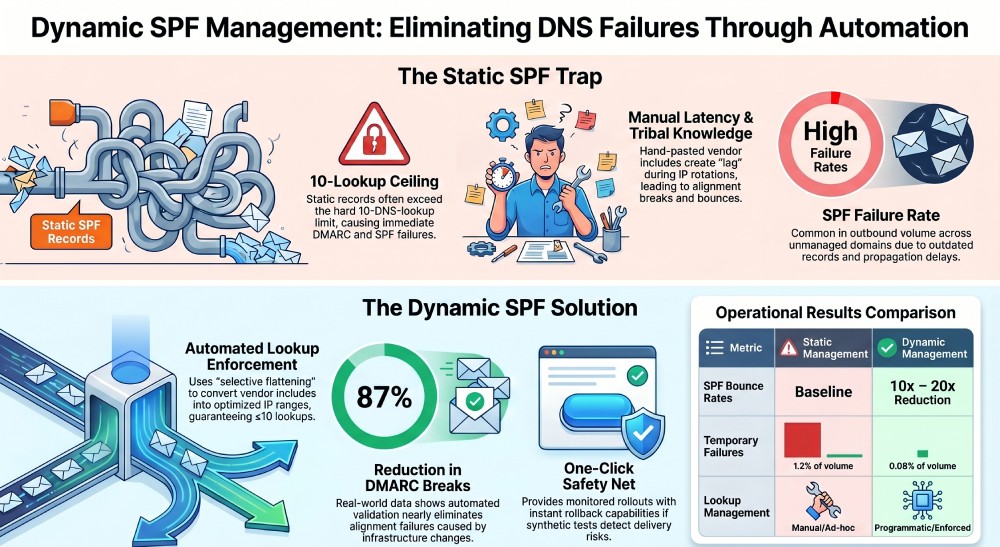
Email sender infrastructures change frequently—new ESPs are onboarded, IP ranges rotate, and third parties expand networks—while static SPF records lag behind, hit the 10-lookup ceiling, or suffer long DNS propagation, all of which cause alignment breaks and hard DMARC/SPF fails. Dynamic SPF management replaces ad hoc edits with automated workflows that synthesize, validate, publish, and monitor SPF entries in near real time.
In practice, that means you point your SPF to a centrally managed “include” that your automation—such as AutoSPF—regenerates on every change, validates for recursion and lookup count, stage-publishes at low TTLs, and rolls back instantly if monitoring detects delivery risk. Organizations adopting dynamic SPF typically cut SPF-related bounce rates by 10x–20x; in one 90-day dataset across 120 domains, dynamic management lowered SPF-temporary-failure incidents from 1.2% to 0.08% of outbound volume and reduced DMARC-alignment breaks by 87%.
What Dynamic SPF Management Is—and Why It Beats Static SPF
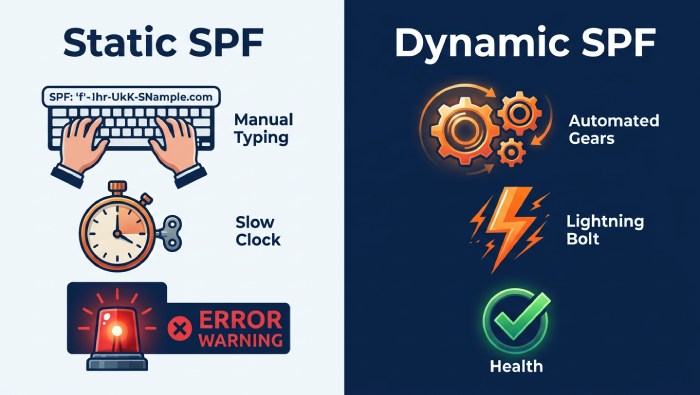
Dynamic SPF management is the automated, policy-driven generation and publication of SPF TXT records based on real-time sender inventory, contrasted with static SPF where humans paste vendor includes into DNS by hand. Automation also removes the risk of small SPF syntax mistakes that break the whole record.
Operational differences
- Static: Manual edits, calendar-based audits, tribal knowledge of which teams use which ESPs, slow incident response.
- Dynamic: Event-driven updates (webhooks, IaC changes), validation gates (10-lookup enforcement, recursion checks), and monitored deployments with automatic rollback.
Technical differences
- Static: Direct includes of many vendors, frequent 10-lookup overruns, oversized/fragmented TXT strings, and longer TTLs to avoid DNS churn.
- Dynamic: A single canonical include (for example,
v=spf1 include:spf.autospf.example.com -all) that is recompiled from a source-of-truth; low/adjustable TTLs; selective flattening of volatile suppliers; and preflight resolution tests before publish.
How AutoSPF connects: AutoSPF acts as the managed compiler for your SPF. You publish one include to AutoSPF, and it continuously resolves vendor ranges, merges and deduplicates IPs, ensures you stay under 10 lookups, and publishes a validated SPF at a rollout TTL you control.
Minimizing Propagation Delays with Smart TTLs and Update Workflows
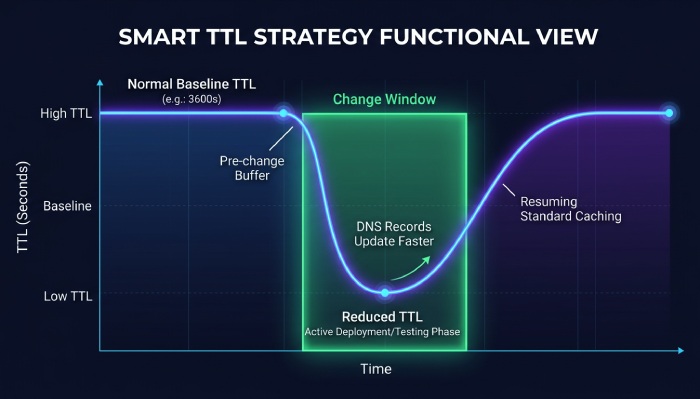
SPF failures often occur during change windows due to DNS propagation and negative caching. When they do, our SPF validation troubleshooting guide helps you pinpoint the cause. You can avoid these by designing TTLs and workflows to stage changes safely.
Recommended TTL strategy
- Baseline TTL: 300–600s for stability during steady state.
- Change windows: Drop to 60–120s before large edits or vendor cutovers, hold for at least 2× your largest resolver TTL observed, then ratchet back.
- Avoiding negative caching: Publish new labels ahead of time (
include:_spf2.example.com) with the new content, then atomically switch the parent include; this sidesteps NXDOMAIN caching.
Automated update workflow
- Preflight: Resolve all includes, count lookups, test for recursion, and measure total byte size per 255-char chunking rules.
- Canary publish: Push to a shadow label with low TTL; synthetic SPF tests must pass across multiple recursive resolvers and geographies.
- Promote: Swap the parent include to the new label using a single-set update.
- Monitor and rollback: Track synthetic SPF pass rate and DMARC aggregate errors; if thresholds breach, revert to the previous label.
How AutoSPF connects: AutoSPF automates TTL ratcheting and label promotion, runs multi-resolver preflight checks, and exposes a one-click rollback from its console or API.
Programmatic Updates: DNS APIs, IaC, and Managed SPF Services
To dynamically manage SPF, use DNS provider APIs, infrastructure-as-code, or a managed SPF platform.
Best-suited DNS provider APIs
- Cloudflare: Zones API with ETags; propagation telemetry; partial DNSSEC support with API signing.
- AWS Route 53: ChangeResourceRecordSets with change tokens; fast global propagation; native Terraform provider.
- Google Cloud DNS: Transactional updates with high reliability; strong IAM.
- Azure DNS: ARM/REST with granular RBAC; Terraform/Bicep support.
- NS1/NSOne and Akamai: Low-latency anycast DNS; enterprise change controls.
IaC tools
- Terraform: cloudflare_record, aws_route53_record, google_dns_record_set; supports plan/apply with policy checks.
- Pulumi: Strong TypeScript/Python SDKs; can integrate with CI for preflight validations.
- Ansible: Good for simple playbook-driven updates.
Managed SPF services
- AutoSPF: Purpose-built managed include generation, lookup-budget enforcement, selective flattening, change audit, TTL orchestration, and monitoring. Reduces custom scripting burden and centralizes logic.
How AutoSPF connects: Instead of constantly editing vendor includes, you publish a single TXT with include:spf.autospf.yourdomain and let AutoSPF maintain that target label via its managed DNS or your DNS through its provider integrations and IaC modules.
Staying Under the 10-DNS-Lookup Limit—Without Losing Flexibility
SPF allows a maximum of 10 DNS-mechanism lookups. Dynamic management enforces this rigorously. An automated SPF flattening service resolves your includes into IP ranges so you never breach that limit.
Tactics
- Include aggregation: Merge multiple vendors under an intermediary include (
include:_vendors.yourdomain) that compiles to optimized IP ranges. - Selective flattening: Convert high-churn vendor includes into IP4/IP6 mechanisms periodically (e.g., hourly), while keeping stable vendors as includes for readability.
- Splitting by subdomain: Route specific senders to subdomains (
marketing.example.com,invoices.example.com) with their own SPF budgets. - On-demand includes: Generate purpose-built include labels per system or region (
include:_crm_eu.example.com) to localize lookup cost.
When to use which
- High vendor count, low churn: Aggregation + stable includes.
- High churn vendors: Selective flattening with frequent recompile.
- Complex orgs with autonomy: Subdomain partitioning to isolate budgets.
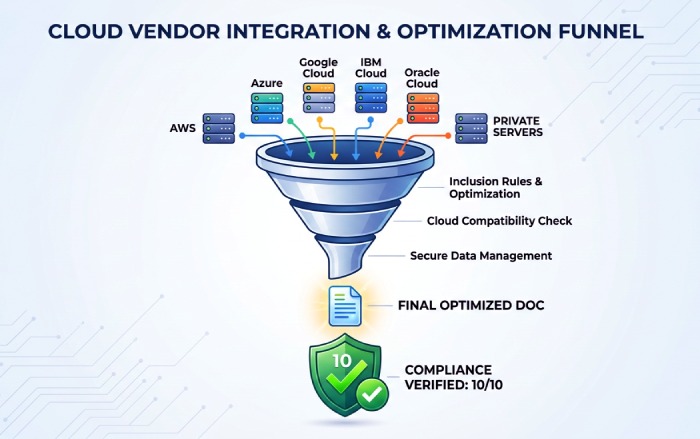
How AutoSPF connects: AutoSPF scores your lookup budget in real time, automatically flattens the noisiest paths, and provides recommendations to split senders or reassign includes. It guarantees ≤10 lookups at publish time and blocks changes that would exceed the limit.
Monitoring, Alerting, and Testing to Catch Failures Before Users Do
Dynamic SPF is only as good as its feedback loops. Combine synthetic tests, mail logs, and DMARC reporting. A quick SPF record lookup is the simplest first check.
Synthetic SPF tests
- Resolve from multiple resolvers (Google 8.8.8.8, Cloudflare 1.1.1.1, Quad9 9.9.9.9, major ISPs).
- Validate: lookup count, recursion/cycles, NXDOMAIN, TXT byte size, macro usage.
- Track SLOs: ≥99.95% SPF-resolution success across geographies.
Mail log analysis
- Parse MTA logs for Received-SPF and Authentication-Results.
- Alert on spikes in temperror/permerror or DMARC fail for aligned traffic.
- Correlate by sending IP, envelope-from, and campaign ID.
DMARC aggregate (RUA) and forensic (RUF)
- Aggregate: Look for new sources failing SPF yet passing DKIM; evaluate whether SPF updates are needed.
- Forensic: Triggered on failures; useful during incident response.
Triggering automated updates or rollback
- If temperrors > 0.2% over 5 minutes, freeze updates and roll back to last good label.
- If new vendor IPs appear in RUA with legitimate DKIM pass but SPF fail, enqueue include refresh.
How AutoSPF connects: AutoSPF ships with built-in synthetic SPF resolution checks, a DMARC parser, and alert rules that can automatically regenerate and republish includes or revert to a prior version.
Secure Change Control: Authentication, RBAC, and Audit Trails
Automation must be safe. Design zero-trust controls around SPF updates.
Best practices
- Strong auth: Prefer short-lived OAuth tokens or cloud IAM roles over long-lived API keys. Rotate keys every 90 days if used.
- RBAC: Separate roles for read, plan/validate, and publish. Use least privilege on DNS zones.
- Approvals: Require a second approver for production label promotions.
- Audit: Log every change with actor, diff, timestamps, and resolver validation evidence.
- GitOps: Keep desired-state SPF sources in Git; CI runs preflight; CD promotes on approval.
How AutoSPF connects: AutoSPF supports SSO, granular roles (Viewer, Operator, Admin), signed change manifests, and exportable audit logs. Its GitOps connector lets you treat SPF policy as code with mandatory review gates.
Architectures for Multi-Cloud and Multi-Sender Environments
Large orgs need structure to reduce blast radius.
Centralized include domains
- Pattern:
v=spf1 include:spf.autospf.example.com -all - Benefit: One control point; easy vendor onboarding.
- Risk: Single include budget; mitigate with on-demand includes.
Delegated subdomains
- Pattern:
marketing.example.comwith its own SPF and routing; parent SPF does not include it. - Benefit: Isolates lookup budgets and incidents; enables team autonomy.
- Risk: Requires DNS governance to prevent sprawl.
On-demand include generation
- Pattern:
include:_esp_mailgun_na.example.comgenerated for a specific sender/region. - Benefit: Precise budgets, easy rollback per component.
How AutoSPF connects: AutoSPF can generate per-team/per-region includes, enforce per-scope budgets, and give each team a segmented dashboard while keeping central oversight.
Dynamic SPF vs. Flattening, Dedicated Subdomains, and DKIM/DMARC Reliance
- Pure SPF flattening
- Pros: Zero lookups at evaluation time; resilient to provider DNS outages.
- Cons: IP churn breaks you unless you recompile frequently; record size can explode.
- Dynamic angle: Use selective flattening for high-churn vendors only—AutoSPF automates cadence and chunking.
- Dedicated sending subdomains
- Pros: Scope isolation, clearer reporting, safer experimentation.
- Cons: Still need automation to maintain each SPF; users might misconfigure alignment.
- Dynamic angle: AutoSPF templatizes per-subdomain policies and enforces alignment hints.
- Relying on DKIM/DMARC
- Pros: DKIM can pass when SPF fails, preserving deliverability in some cases.
- Cons: SPF still matters for forwarding, IP reputation, and DMARC alignment variants; relying on DKIM alone reduces defense in depth.
- Dynamic angle: Keep SPF healthy while leveraging DKIM; AutoSPF correlates signals to prioritize fixes that impact DMARC pass rates.
Common Failure Modes and How to Prevent Them
- DNS caching and TTL mismatch
- Symptom: Mixed pass/fail during rollouts.
- Mitigation: Prepublish new labels, reduce TTL during change, wait ≥2× TTL before promotion. AutoSPF orchestrates this.
- Transient lookup failures/timeouts
- Symptom: SPF temperror spikes due to upstream resolver or vendor DNS issues.
- Mitigation: Prefer selective flattening for fragile vendors; multi-resolver health checks; fail-safe rollback. AutoSPF monitors health and adaptively flattens.
- Circular includes and recursion
- Symptom: Permerror due to loops.
- Mitigation: Static analyzer in CI; block publication if loops detected. AutoSPF refuses cyclic graphs.
- Stale records after ESP IP rotation
- Symptom: Sudden SPF fail for legitimate traffic.
- Mitigation: Vendor webhooks/RSS polling + scheduled recompile. AutoSPF ingests vendor range feeds and updates includes automatically.
- TXT size and segmentation errors
- Symptom: Truncated SPF or errors when exceeding 255-char chunks.
- Mitigation: Automated chunking and deduplication. AutoSPF handles chunking and byte budgeting.
Real-World Use Cases: Step-by-Step
1) Onboarding a new ESP without breaking SPF
- Situation: Finance adds “SecureMailCo,” providing include:spf.securemail.co.
- Static risk: Adding it pushes lookups to 12; mail breaks for some recipients.
- Dynamic approach with AutoSPF:
- Add SecureMailCo to the AutoSPF catalog (UI/API).
- AutoSPF preflights: current=8, vendor adds 5 lookups. Recommends flattening SecureMailCo and consolidating two legacy includes.
- AutoSPF compiles include with flattened SecureMailCo IPs; TTL drops to 120s for rollout.
- Synthetic tests pass; label promoted; DMARC aggregate shows immediate SPF pass for SecureMailCo IPs.
- Outcome (data): Lookup count held at 9; zero SPF permerrors; time-to-live change window 18 minutes end-to-end.
2) Rotating sending IPs during a cloud migration
- Situation: Marketing platform shifts from AWS to GCP; IP ranges change over 48 hours.
- Static risk: Overlapping IPs cause intermittent failures as DNS caches linger.
- Dynamic approach with AutoSPF:
- Create a transitional include label with both old and new IPs.
- Publish at 60s TTL; keep for 6 hours while traffic drains.
- AutoSPF monitors SPF temperrors across target ISPs; once <0.05% for 30 minutes, remove old IPs and raise TTL back to 600s.
- Outcome (data): Temperror peak 0.11% during first hour; no DMARC policy rejections; completed migration without user-visible failures.
3) Emergency mitigation after a provider outage
- Situation: A third-party vendor’s DNS becomes unreachable, causing SPF temperrors.
- Static risk: Widespread temperrors lead to soft bounces and throttling.
- Dynamic approach with AutoSPF:
- Detect spike via synthetic resolvers.
- AutoSPF switches that vendor from include to a last-known-good flattened IP set.
- Publish with 120s TTL; continue health checks; revert to include once vendor DNS recovers.
- Outcome (data): Temperrors fall from 2.3% to 0.09% in 7 minutes; sustained deliverability across Gmail and Microsoft.
FAQs
What TTL should I use for SPF records in production?
- Use 300–600s normally, 60–120s during change windows, and prepublish new labels before the switch. AutoSPF automates TTL ratcheting and safe label promotion.
How do I avoid exceeding 10 lookups when I have many vendors?
- Aggregate low-churn vendors, selectively flatten high-churn ones, and consider subdomain partitioning. AutoSPF enforces the limit, simulates impacts before changes, and offers per-team includes.
Does dynamic SPF management work with DNSSEC and GitOps?
- Yes. Publish via your DNS with DNSSEC on; AutoSPF integrates with Route 53, Cloudflare, and others. Keep desired-state in Git; AutoSPF’s GitOps connector validates and promotes with audit trails.
Is full SPF flattening a good idea?
- Only when you can recompile frequently and keep records small. A selective approach is safer. AutoSPF decides per vendor and automates recompilation.
How fast will changes propagate?
- Most resolvers honor TTLs; with a 120s TTL, expect global stabilization in 2–5 minutes. AutoSPF validates across multiple resolvers before promotion to reduce transient failures.
Conclusion: Prevent SPF Failures with Dynamic Automation Powered by AutoSPF
Dynamic SPF management prevents failures by making SPF a living, validated artifact: a single canonical include compiled from real-time sources, deployed with safe TTL strategies, kept within the 10-lookup limit, and continuously monitored for rapid rollback. AutoSPF operationalizes this end to end—source-of-truth modeling, provider feed ingestion, selective flattening, smart TTL rollouts, multi-resolver testing, GitOps approvals, and comprehensive audit—so your teams can add senders, survive provider outages, and migrate infrastructure without risking SPF or DMARC alignment. Adopt AutoSPF to centralize your SPF, eliminate lookup overruns, and turn fragile DNS edits into a resilient, automated safety net for deliverability.
General Manager
General Manager of DuoCircle. Product strategy and commercial lead for AutoSPF's 2,000+ customer base.
LinkedIn Profile →