How Do DMARC Vendors Help Monitor Email Authentication?

Quick Answer
DMARC vendors help organizations monitor SPF, DKIM, and DMARC authentication, identify legitimate and unauthorized senders, analyze reports, detect suspicious activity, and safely move from monitoring to enforcement while supporting email deliverability.
Try Our Free DMARC Checker
Validate your DMARC policy, check alignment settings, and verify reporting configuration.
Check DMARC Record →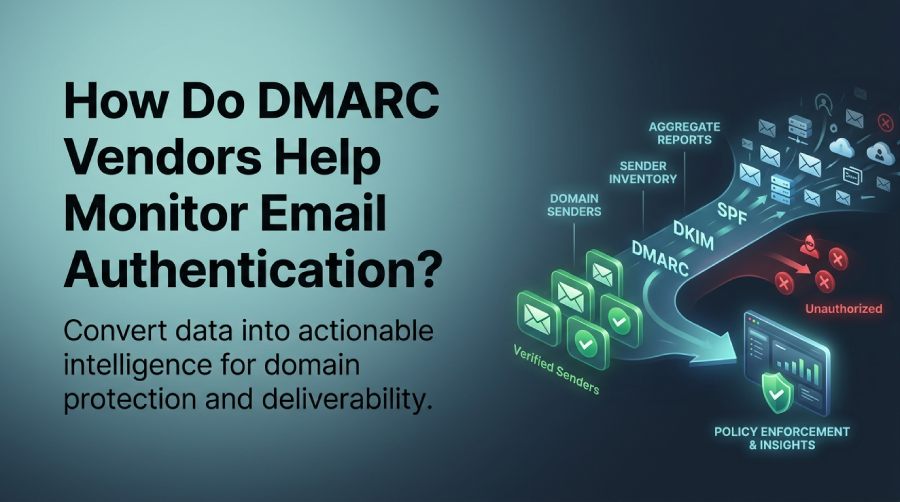
What a DMARC Vendor Does in Email Authentication
A DMARC vendor helps organizations monitor, analyze, and manage email authentication across their sending domains. At its core, DMARC works with SPF and DKIM to evaluate authentication and alignment for messages claiming to come from a domain. While these DNS-based standards can be configured manually, a DMARC vendor can turn authentication data into actionable insights for email security, domain protection, and email deliverability.
For most organizations, especially enterprise organizations with complex email infrastructure, the challenge is not simply publishing a DMARC record. The bigger challenge is understanding every legitimate sender, identifying unauthorized mail sources, and moving safely from monitoring to policy enforcement.
Why DMARC Monitoring Requires Specialized Expertise
A capable DMARC vendor provides reporting capabilities, DNS record management guidance, and technical capabilities that help security and IT teams understand who is sending on behalf of the business. This is particularly important for organizations in financial services, healthcare, and regulated sectors where compliance requirements and regulatory compliance influence email security decisions.
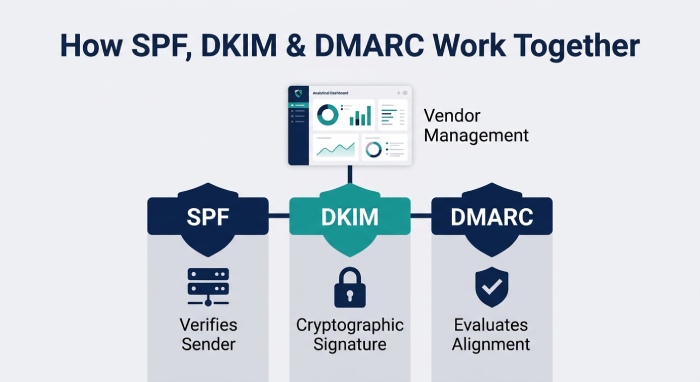
SPF, DKIM, and DMARC Working Together
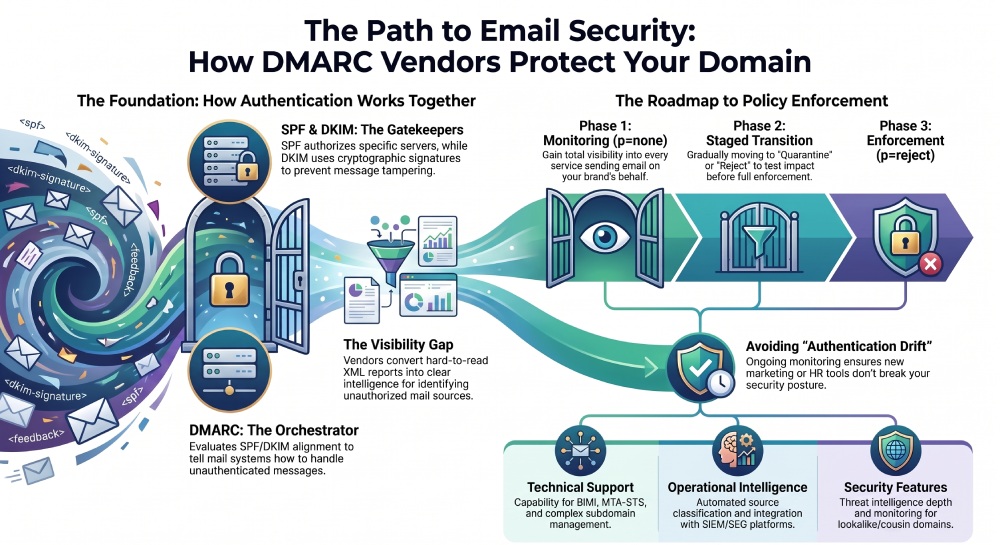
SPF verifies whether a sending server is authorized to send mail for a domain. DKIM confirms that the message was cryptographically signed and has not been modified in transit. DMARC evaluates SPF and DKIM alignment and tells receiving mail systems how to handle unauthenticated messages. Together, these standards help organizations interpret authentication results, reduce false positives, support email deliverability, and strengthen overall email authentication.
Tools such as AutoSPF can also support SPF management when organizations have many senders and face DNS lookup limits.
Preparing Domains Before DMARC Enforcement
Before an organization moves toward quarantine or reject, it needs a clear understanding of its domain portfolio and current authentication state. Many companies own dozens or hundreds of domains, including parked domains, campaign domains, regional domains, and domains inherited through mergers or acquisitions. A DMARC vendor can help discover these assets, identify which domains actively send mail, and separate business-critical domains from domains that should not send email at all.
This preparation reduces the likelihood of accidental disruption. For example, a forgotten payroll platform, invoice system, or customer notification tool may send a small volume of legitimate mail that still matters to employees or customers. If that source is not authenticated before policy enforcement, messages may be sent to spam or rejected by receivers.
Creating an Accurate Sender Inventory
A sender inventory is one of the most important foundations of implementation success. It documents each sending service, the business owner, the domain or subdomain used, the required SPF include, the DKIM selector, and whether alignment is passing. A DMARC vendor helps build and maintain this inventory by matching aggregate reports to known email service providers and flagging unknown sources for review.
This process also supports governance. When marketing, sales, HR, and customer support teams want to add new platforms, they should follow an approved authentication workflow. That workflow may include creating a dedicated subdomain, configuring DKIM, updating SPF, reviewing DNS records, and confirming that DMARC alignment passes before production sending begins.
How DMARC Vendors Collect and Interpret Aggregate Reports
DMARC aggregate reports are XML files sent by mailbox providers and receivers. These reports show which IP addresses sent mail using a domain, whether SPF passed, whether DKIM passed, whether alignment succeeded, and how many messages were observed. Without DMARC solutions, teams often struggle to read these files manually or connect them to real business systems.
A DMARC vendor collects aggregate reports from receivers, normalizes the data, and presents it in a clear user interface. This allows administrators to perform email volume analysis, identify legitimate senders, and detect configuration gaps in SPF, DKIM, and DNS. For large environments, multi-domain management and subdomain management are essential because authentication issues often appear in forgotten subdomains, regional brands, or acquired domains.
Turning XML Data Into Operational Intelligence
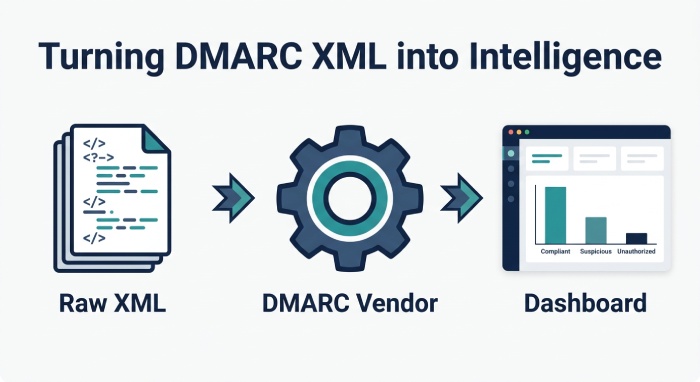 Good DMARC solutions convert report data into meaningful categories: compliant sources, partially authenticated sources, unauthorized senders, forwarding flows, and suspicious activity. This supports implementation success because teams can prioritize fixes based on sending volume, business importance, and security risk.
A mature DMARC vendor may enrich aggregate data with threat intelligence, vendor reputation signals, geolocation, and known infrastructure patterns. For example, a B2B intelligence platform, marketing automation tool, or customer support system may legitimately send mail, but each sender must be authenticated with SPF and DKIM to maintain domain protection and email deliverability.
The Role of Automation Quality
Automation can accelerate classification, but automation quality matters. Poor automation can mislabel valid sources or overlook risky activity. Strong DMARC solutions combine automated source detection with analyst review, API access, and customer support so teams can validate findings before taking action.
Managing Third-Party Senders and DNS Changes
Third-party senders are often the most difficult part of a DMARC project. Modern organizations rely on many external systems for marketing campaigns, transactional notifications, billing, recruiting, support, surveys, and executive communications. Each platform may have different authentication requirements, and some vendors support stronger DKIM alignment than others.
A DMARC vendor helps teams coordinate these changes without losing control of the domain. Instead of adding every requested SPF include to the organizational root domain, security teams can use dedicated subdomains, documented approval processes, and regular reviews. This keeps DNS cleaner, reduces risk, and makes it easier to remove access when a vendor is no longer used.
Avoiding SPF Flattening Pitfalls
Because SPF has a 10-lookup limit, organizations sometimes use SPF flattening to reduce nested lookups. While flattening can solve one problem, it can create another if IP ranges change and records are not updated quickly. A DMARC vendor, often alongside a specialized SPF management tool, can help monitor lookup limits, detect stale entries, and recommend safer configurations.
Strong DNS record management also includes checking for duplicate records, invalid syntax, missing DKIM keys, overly broad mechanisms, and misaligned return-path domains. These details may seem minor, but they directly affect email deliverability and the success of policy enforcement.
Detecting Spoofing, Phishing, and Unauthorized Senders
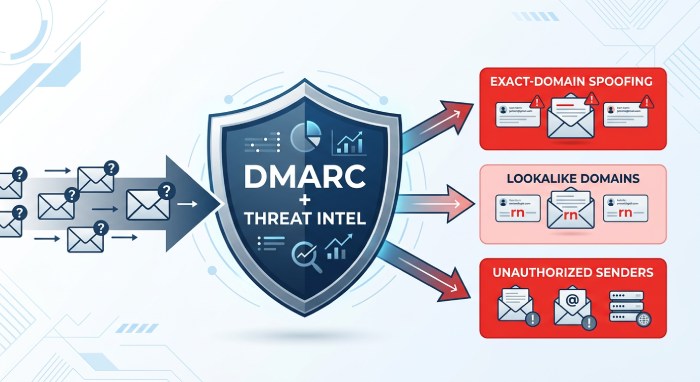 One of the important functions of a DMARC vendor is helping organizations identify potential domain spoofing, phishing activity, and unauthorized sending sources. Attackers may impersonate trusted brands to support credential theft, invoice fraud, malware delivery, and business email compromise. DMARC provides visibility into sending sources and authentication results, helping organizations identify messages that fail SPF or DKIM authentication or alignment and investigate potentially unauthorized use of their domains.
A DMARC vendor strengthens email security by identifying patterns that individual aggregate reports may not reveal. For example, repeated unauthorized traffic from unfamiliar networks may indicate phishing attacks. Sudden spikes from a new geography may suggest compromised infrastructure. Messages failing SPF and DKIM alignment at scale may show active domain spoofing.
Combining DMARC With Threat Intelligence
Threat intelligence helps determine whether a suspicious sender is simply misconfigured or potentially malicious. Some DMARC solutions can integrate with SIEM platforms, secure email gateways, and broader email security systems to correlate authentication failures with phishing attempts, malware campaigns, and account compromise events.
Organizations should evaluate DMARC solutions based on their threat intelligence capabilities, authentication monitoring, brand protection features, technical compatibility, and operational requirements. Industry reviews and analyst research can provide useful context about market maturity, but teams should also assess integration options, reporting quality, automation, scalability, and support before selecting a solution.
Beyond Exact-Domain Spoofing
DMARC primarily protects domains that an organization controls, but many DMARC vendor platforms include advanced features such as lookalike domain monitoring. This helps identify typo domains, cousin domains, and deceptive registrations used in phishing attacks. When combined with security audits and takedown workflows, lookalike domain monitoring becomes an important part of broader domain protection and brand protection.
Dashboards, Alerts, and Ongoing Domain Monitoring
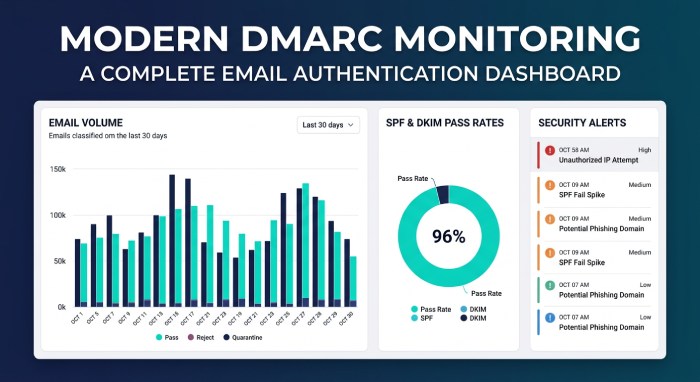
Modern DMARC solutions rely heavily on dashboards, alerts, and continuous domain monitoring. A well-designed dashboard should show authentication status, top senders, SPF and DKIM pass rates, domain policy, subdomain activity, email volume analysis, and progress toward enforcement. The user interface matters because email authentication programs often involve security teams, DNS administrators, marketing operations, legal teams, and external email service providers.
A DMARC vendor may provide alerts when new senders appear, authentication failures increase, DNS records change, or suspicious sending activity is identified.
Reporting for Security, Compliance, and Operations
Strong reporting capabilities support compliance requirements, board-level visibility, and operational planning. In financial services and healthcare, teams may need evidence for regulatory compliance, security audits, and internal risk reviews. A DMARC vendor can provide historical reporting, forensic reports where available, and executive summaries that demonstrate progress in domain protection, email security, and brand protection.
Some platforms also support BIMI readiness checks, MTA-STS configuration monitoring, and DNS record management recommendations. BIMI and Brand Indicators for Message Identification can display verified brand logos in supported inboxes, but they require a strong DMARC enforcement posture. MTA-STS and MTA-STS records add transport-layer protection, helping strengthen the organization’s overall security posture.
Measuring Time-to-Enforcement and Program Success
A successful DMARC project is not measured only by whether a record exists. It is measured by how quickly and safely the organization can move from monitoring to enforcement while preserving email deliverability. Time-to-enforcement depends on sender complexity, internal ownership, vendor responsiveness, and the quality of authentication data. A DMARC vendor helps shorten that timeline by showing which issues matter most and which domains are ready for stronger policy.
Many organizations begin with a p=none policy to collect visibility, then move to p=quarantine, and eventually to p=reject. The same approach may be applied gradually using percentage-based enforcement, allowing teams to test impact before applying a stricter policy to all mail. This staged process is especially valuable for enterprise organizations with multiple business units and complex approval paths.
Metrics That Show Authentication Maturity
Useful metrics include the percentage of authenticated mail, the percentage of aligned mail, the number of unknown senders, the volume of rejected spoofed messages, and the number of domains at enforcement. Teams should also track how long it takes to classify new senders and resolve authentication failures.
These metrics help security leaders communicate progress to executives and auditors. They also support cost analysis because teams can compare the operational time saved by automation, managed service assistance, and improved reporting capabilities against the price of the DMARC vendor.
Choosing the Right DMARC Vendor for Compliance and Deliverability
Selecting a DMARC vendor requires a structured evaluation of its capabilities and fit with an organization’s requirements. Organizations can assess DMARC solutions based on technical capabilities, integration requirements, customer support, deployment options, pricing, and scalability. Relevant considerations may include the complexity of the email infrastructure, the number of domains, enforcement requirements, and the internal team’s technical expertise.
Key Selection Criteria
Important evaluation areas include:
- Support for SPF, DKIM, DMARC, BIMI, and MTA-STS
- Multi-domain management and subdomain management
- SIEM integration, API access, and SEG compatibility
- Quality of dashboards, alerts, and reporting capabilities
- Threat intelligence depth and phishing attacks detection
- Managed service option for teams needing hands-on assistance
- Customer support quality and onboarding process
- Time-to-enforcement expectations and gradual policy enforcement workflows
A feature comparison should also examine how each DMARC vendor handles the monitoring to enforcement transition. Moving too quickly to quarantine or reject can create false positives and disrupt legitimate mail. Moving too slowly leaves the organization exposed to phishing attacks and domain spoofing.
Comparing Notable DMARC Solutions
DMARC solutions are often evaluated based on usability, reporting capabilities, email authentication visibility, automation, managed services, and threat intelligence. Organizations should choose a solution that aligns with their security requirements, technical resources, and email infrastructure.
A practical solution comparison should go beyond industry recognition. Reviews, analyst research, and peer feedback can provide useful insights, but buyers should also validate integration requirements, DNS workflows, email service providers, API access, automation capabilities, and customer support responsiveness. The goal is not simply to adopt a tool, but to achieve successful implementation, strengthen email security, protect brand reputation, and move toward DMARC enforcement without negatively affecting email deliverability.
Building a Long-Term Email Authentication Roadmap
DMARC is most effective when it becomes part of an ongoing email authentication roadmap rather than a one-time project. After reaching enforcement, organizations should continue monitoring domains, reviewing third-party senders, maintaining DNS records, and validating that new systems are authenticated before they send. Business systems change constantly, so continuous monitoring helps prevent authentication drift.
A long-term roadmap may also include expanding enforcement to parked domains, applying stricter subdomain policies, enabling BIMI, reviewing MTA-STS adoption, and improving integrations with SIEM or SEG platforms. These steps strengthen email security while supporting trust with customers, partners, and mailbox providers.
A DMARC vendor can provide more than reporting by helping organizations interpret authentication data, identify legitimate and unauthorized sending sources, and manage the transition toward DMARC enforcement. Ongoing monitoring can help organizations maintain accurate authentication records, protect their domains from unauthorized use, and support email deliverability as their sending infrastructure evolves.
General Manager
General Manager of DuoCircle. Product strategy and commercial lead for AutoSPF's 2,000+ customer base.
LinkedIn Profile →