How Does SPF Handle Emails Sent With a Null Return-Path?

Quick Answer
SPF authenticates emails with a null return-path by checking the sending server’s HELO/EHLO domain instead of the empty envelope sender. The HELO hostname must have a valid SPF record that authorizes the sending IP address.
Short Answer: SPF Falls Back to the HELO/EHLO Identity
When an email is sent with a null return-path, the SMTP envelope sender is empty: MAIL FROM:<>. SPF still performs authentication, but it cannot evaluate the missing envelope sender domain. Instead, SPF validation uses the client HELO domain supplied during the SMTP session, such as smtp.example.com or mx1.example.com.
In practical terms, if a bounce message, delivery status notification, or automated postmaster message arrives with an empty return path, the receiving mail server performs an SPF check against the HELO/EHLO name. That means the HELO hostname must have a valid SPF record in DNS, and that SPF record must authorize the sending IP.
This behavior matters because a null return-path is common and legitimate, but it is also frequently misunderstood during SPF troubleshooting, especially in environments using Postfix, Gmail routing, a mail relay, or mail forwarding.
What a Null Return-Path Means in Email Delivery
MAIL FROM:<> and Envelope Semantics
A null return-path means the SMTP envelope sender is empty. At the protocol level, the sending host issues:
MAIL FROM:<>This is known as an empty return path. It is not the same as a missing From: header. The envelope sender is used for bounce handling, while the visible header From: is what users see in their mail client.
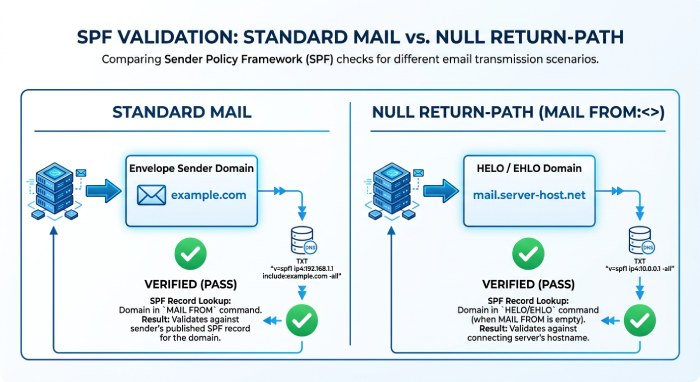
The purpose of a null return-path is to prevent mail loops. If a bounce message itself cannot be delivered, it should not generate another bounce. For example, if example.com sends a delivery failure notice, it should use a null return-path so that a failed bounce does not create an endless chain of delivery status notifications.
Difference Between Header From and Envelope Sender
SPF authenticates the SMTP identity, not the human-visible author identity. With ordinary mail, SPF validation typically checks the domain in the envelope sender address. With a null return-path, there is no sender address domain to check, so SPF validation uses the client HELO domain instead.
DKIM and DMARC behave differently. DKIM authenticates an email using a cryptographic signature covering selected message headers and the message body, while DMARC checks whether the authenticated SPF or DKIM domain aligns with the visible From: domain. A null return-path can still pass SPF because the receiving server uses the HELO/EHLO domain to construct the MAIL FROM identity. However, an SPF pass does not automatically guarantee a DMARC pass. The HELO-derived domain must also align with the visible From: domain for SPF to contribute to DMARC authentication.
How SPF Chooses the Domain to Check When Return-Path Is Empty
HELO Identity Becomes the SPF Identity
For an empty return path, SPF uses the client HELO domain from the SMTP HELO or EHLO command. If a server connects and says:
EHLO smtp.example.com
MAIL FROM:<>
then the receiver evaluates the SPF record for smtp.example.com. This is why a properly configured helo hostname is important. A vague, local, or nonexistent HELO name can cause SPF validation problems.
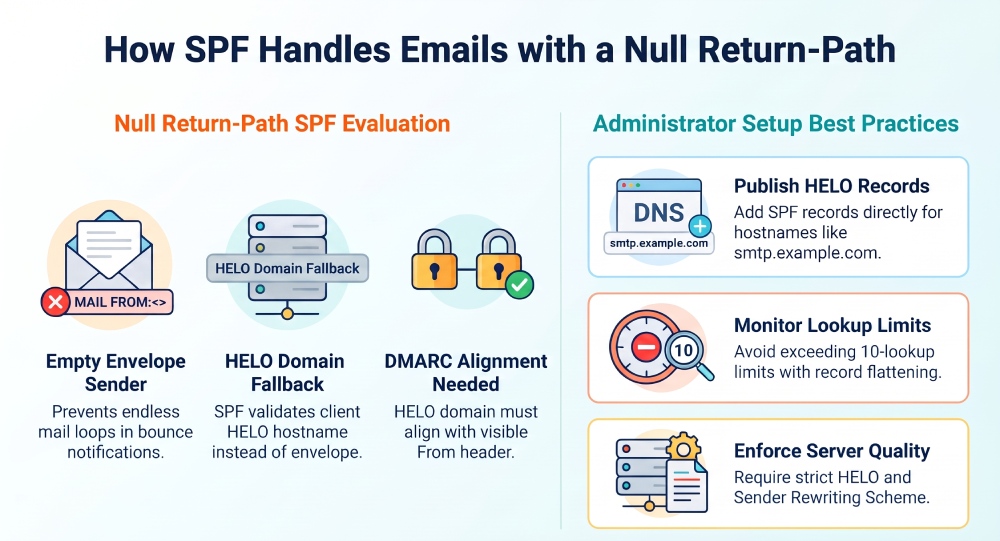
In Postfix, administrators often enforce HELO quality with smtpdhelorequired = yes. This is useful because the client HELO domain becomes security-relevant when the message has a null return-path.
DNS Records Involved in the Lookup
The receiving server performs a DNS query for a TXT record containing an SPF policy, usually beginning with v=spf1. For example:
smtp.example.com. TXT "v=spf1 ip4:203.0.113.10 -all"The receiver may also evaluate an A record, AAAA record, MX-based authorization for an MX domain, or includes in the SPF mechanism set. A CNAME can complicate the lookup path, and excessive includes can trigger the SPF 10-lookup limit.
When an SPF policy contains multiple nested includes or DNS-dependent mechanisms, administrators should monitor the complete lookup chain to avoid exceeding the SPF DNS lookup limit. Reviewing SPF dependencies and simplifying unnecessary DNS references can help maintain reliable authentication. SPF flattening is one approach that can reduce DNS lookup dependencies when implemented and maintained carefully.
Example SPF syntax for a HELO hostname
smtp.example.com. TXT "v=spf1 a mx ip4:203.0.113.10 ip6:2001:db8::10 -all"That SPF syntax authorizes the host’s A record, MX hosts, IPv4 address, and IPv6 address. For a null return-path bounce, this SPF record is checked against the client HELO domain, not against a normal envelope sender domain.
SPF Evaluation for Bounce Messages and Delivery Status Notifications
Bounce Mail, DSNs, and Postmaster Messages
Bounce messages, delivery notifications, and postmaster emails commonly use a null return-path. Receiving servers validate SPF against the HELO hostname, so administrators should publish a valid SPF record and configure proper Postfix authentication and relay restrictions.
Interactions With Mailing Lists and Forwarders
Forwarding servers and mailing lists can cause SPF failures when their IP addresses are not authorized by the original sender’s SPF policy. Sender Rewriting Scheme (SRS) helps address this problem by rewriting the envelope sender during forwarding so that SPF can authenticate the forwarding domain. However, SRS does not replace HELO-based SPF evaluation for messages with a null return-path. Those messages still require SPF validation using the HELO/EHLO identity.
Common Authentication Outcomes, Risks, and Misconfigurations
Pass, Neutral, Softfail, Fail, TempError, and PermError
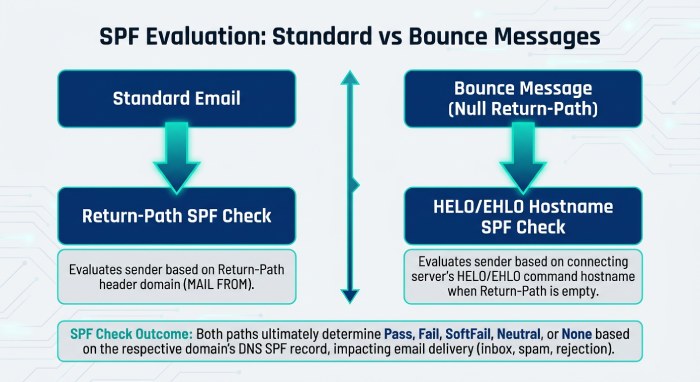
For a null return-path, SPF checks the client HELO domain and returns results such as pass, fail, softfail, or neutral. DNS issues may cause temperror, while invalid records or lookup limits can result in permerror.
Misconfigurations in Postfix and DNS
Postfix may fail SPF authentication if its HELO hostname lacks a valid SPF record. Administrators should verify DNS settings, main.cf, sender rewriting, and relay permissions to ensure proper email authentication and routing.
Abuse Risks and Backscatter Controls
Attackers may forge sender addresses to trigger unwanted bounce messages, creating backscatter. Administrators can reduce this risk through SPF, DKIM, DMARC, rate limits, recipient validation, and proper relay restrictions.
Best Practices for Sending and Receiving Null Return-Path Emails
Sending Side Practices
Use a stable HELO hostname, such as smtp.example.com, with a valid SPF record. Authorize all sending IPs, simplify SPF records, and regularly test emails with both normal and null return-paths.
Receiving Side Practices
Configure SPF checks to validate the HELO identity when the return-path is empty. Apply proper relay restrictions, allow legitimate bounce messages, reject unauthorized senders, and monitor SPF logs for authentication issues.
General Manager
General Manager of DuoCircle. Product strategy and commercial lead for AutoSPF's 2,000+ customer base.
LinkedIn Profile →