Java4Shell Exploit, Optimizely Malware and VMware Attacks

Quick Answer
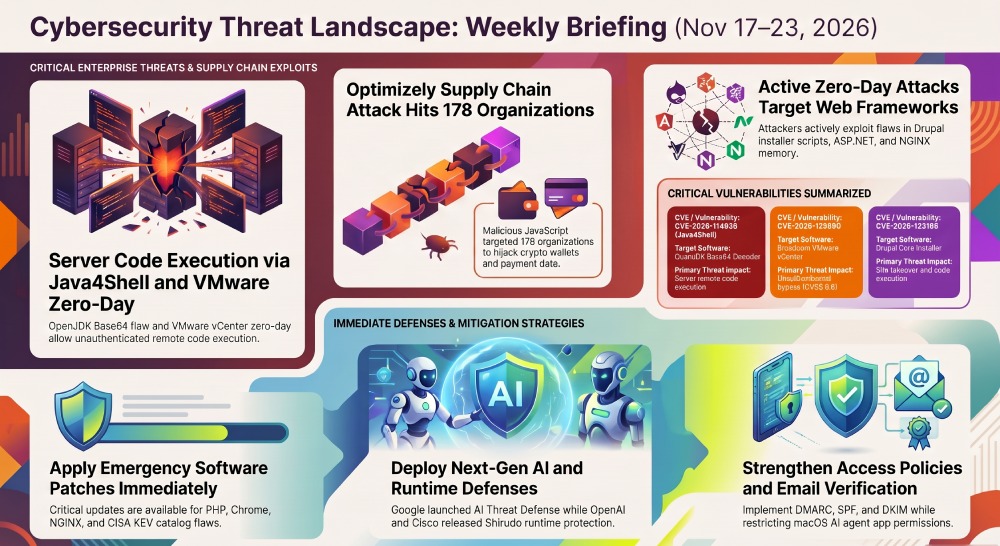
This weekly cybersecurity roundup covers major threats, including Java4Shell, VMware zero-day exploits, Optimizely malware attacks, data breaches, critical vulnerabilities and security updates from November 17–23, 2026.

This week brought a mix of supply-chain attacks, actively exploited enterprise flaws, email security concerns and a wave of data breaches.. A critical Java bug leaked early, a website testing platform was used to push crypto-stealing code to 178 organisations, and a China-linked group quietly exploited a VMware zero-day for months.
Java4Shell: a Base64 string can run code on servers!
Researchers at Calif disclosed CVE-2026-114938, a memory-corruption flaw in OpenJDK’s Base64 decoder. It can be triggered without logging in and may let an attacker run code on servers using AVX-512 processors, including Jira and Jenkins. Oracle and OpenJDK released fixes on 17 November, and the details leaked before the planned release, so teams should patch right away. Help Net Security
Optimizely attack pushes malware to 178 organisations!
Attackers planted malicious JavaScript in Optimizely snippets that were served to visitors of 178 organisations, including Zoom, CNN, IKEA and Ledger. The code swapped cryptocurrency wallet addresses and could capture card details typed into forms. Optimizely has since fixed the flaw and removed the injected code. Help Net Security
VMware vCenter zero-day exploited for months!
Broadcom patched CVE-2026-123890, a critical vCenter authentication bypass with a CVSS score of 9.8, on 19 November. Google’s threat intelligence team says a China-linked espionage group, tracked as ARMORY CASTLE, had been exploiting it since early September. Any organisation running vCenter should apply the update without delay. Google Threat Intelligence
Drupal installer flaw is now being exploited!
Drupal’s security team patched CVE-2026-132165, a critical flaw in the core installer that can let an unauthenticated attacker reinstall a site and gain code execution. Early reports said no exploitation had been seen, but later coverage says attacks on live sites began on 19 November. Admins should update and block access to /core/install.php. BleepingComputer

Critical ASP.NET anti-CSRF library flaw exploited in the wild!
Researchers urged developers to stop using the legacy Idunno. AntiCsrf library after a critical flaw that allows unauthenticated remote code execution was found being exploited. Separately, malicious versions of the package were published on 17 November and were built to run a credential stealer whenever Python starts. Western Illinois University Cybersecurity Centre
Microsoft Entra Connect Health flaw used to steal tenant data!
Attackers have exploited a flaw in Microsoft Entra Connect Health to steal data from Microsoft 365 tenants. Organisations that use Entra Connect should check their environments and apply the vendor’s guidance. Weekly roundup, The Parker Nathan
NGINX2Root memory-corruption flaws patched!
The NGINX project released fixes on 18 November for several memory-safety bugs, two of them in HTTP/2 support that were found independently by several research teams. Related flaws in HTTP/3 proxying, DNS resolution and the mail proxy were fixed in the same release. Anyone running affected NGINX versions should update. Heart Internet weekly summary
PHP releases fix 18 vulnerabilities!

The PHP project released versions 8.5.13, 8.4.28, 8.3.37 and 8.2.36 on 19 November, fixing 18 vulnerabilities across the core engine and session handling. Sites on older branches should move to a patched release as soon as possible. Heart Internet weekly summary
Google Chrome patches six critical flaws, two found with AI!
Google fixed six critical vulnerabilities in Chrome, and two of them were found with help from AI tools. Users should make sure their browser has restarted onto the latest version. Weekly roundup, The Parker Nathan
Cleverbridge data breach exposes card numbers and CVVs!
Cleverbridge, a software sales and payments provider, warned that hackers stole credit card numbers and security codes in a data breach. Customers who bought software through its platforms should watch their card statements closely. Weekly roundup, The Parker Nathan
Google launches AI Threat Defense!
Google introduced a new service that combines its Gemini model, Wiz context, CodeMender patching and Mandiant expertise to find and fix vulnerabilities. It is aimed at countering autonomous exploits, which are becoming more common. Silicon Report
US seeks over $1 billion in stolen Binance crypto!
The US Department of Justice has filed for forfeiture of more than $1 billion in cryptocurrency linked to a $6.3 billion heist attributed to North Korean cybercriminals. The filing aims to recover assets tied to that theft. Silicon Report
GeoVision camera servers used for cryptomining!
Huntress observed malicious activity tied to GeoVision camera-management software across 13 organisations. A sample of the affected hosts was running version GV-VMS 17.4.8.0, and the attackers were using the foothold to mine cryptocurrency. Security Boulevard
FBI warns about Gootloader malware spread through Google Search!
The FBI warned that hackers are abusing Google Search results to distribute Gootloader malware, which can lead to ransomware attacks. Users searching for common documents should be careful about which results they click. The Parker Nathan
Apple tightens macOS app permissions!

Apple has tightened how macOS apps can access data, in response to growing security risks from AI agents that act on a user’s behalf. The change limits the data an app can reach without clear permission. The Parker Nathan
Copycat OpenAI and Cisco tool protects running Linux systems!
OpenAI and Cisco launched Shirudo, an open-source eBPF runtime tool that adds targeted protections to live Linux systems against active exploits. It is designed to buy time while teams prepare permanent patches. Silicon Report
CISA adds more known exploited vulnerabilities to its catalogue!
CISA added several flaws to its Known Exploited Vulnerabilities catalogue over the week, including ones tied to the Drupal and Java issues above. Federal agencies must patch these within set deadlines, and private organisations should treat the list as a priority. CISA
Across all of these stories, the common thread is that attackers are getting into trusted systems, whether that’s a website script, a third-party AI vendor or a server’s installer. Keeping software patched and checking who is allowed to send email on your behalf are still two of the most useful steps you can take. DMARC, SPF and DKIM help stop spoofed messages from reaching your customers, and that is worth reviewing alongside the patch list. CISA
General Manager
General Manager of DuoCircle. Product strategy and commercial lead for AutoSPF's 2,000+ customer base.
LinkedIn Profile →