One-Click Unsubscribe Explained: Meeting Gmail and Yahoo’s RFC 8058 Rule

Quick Answer
RFC 8058 defines how email senders implement one-click unsubscribe using List-Unsubscribe and List-Unsubscribe-Post headers. Gmail and Yahoo require qualifying bulk senders to support this feature for marketing emails, helping reduce spam complaints and protect sender reputation.
One-Click Unsubscribe Explained: Meeting Gmail and Yahoo’s RFC 8058 Rule
What RFC 8058 One-Click Unsubscribe Means and Why It Matters
RFC 8058 is an Internet Engineering Task Force (IETF) standard that explains how email senders can support one-click unsubscribe through specific email header fields. It provides a standardized method for making the unsubscribe process simple, secure, and reliable.
The standard builds on RFC 2369 by introducing the List-Unsubscribe-Post header field. This allows a receiving mail system to send an automated POST request to the unsubscribe endpoint without requiring users to visit a website, log in, or complete additional steps.
RFC 8058 improves the email experience by making subscription removal faster and easier. It also helps reduce spam complaints, protect sender reputation, and maintain better email deliverability. For email senders, implementing one-click unsubscribe supports a more reliable and user-friendly mailing process.
Gmail and Yahoo’s Sender Requirements: Who Must Comply and What’s Required
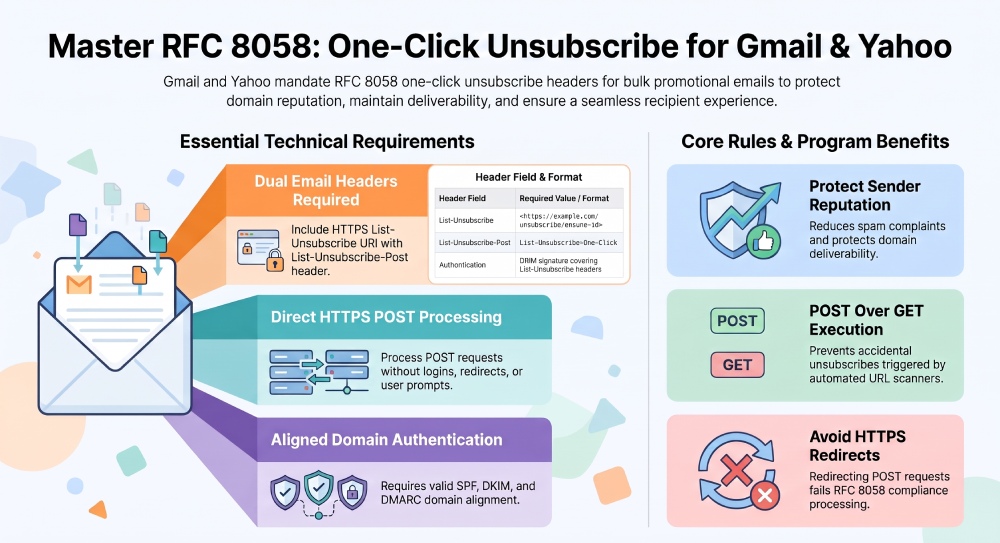
Gmail and Yahoo require qualifying bulk senders to provide one-click unsubscribe functionality for marketing and promotional emails. Both providers recognize the RFC 8058 approach, although their sender policies and eligibility requirements are not identical. Transactional emails, such as password resets and order confirmations, are generally excluded from this specific one-click unsubscribe requirement.
A compliant mail sender should provide:
- A functioning List-Unsubscribe email header
- A List-Unsubscribe-Post email header with the value
List-Unsubscribe=One-Click - An HTTPS URI that accepts an unsubscribe request
- No login, password, preference center requirement, or confirmation step
- Timely subscription removal after the unsubscribe request
- Proper domain authentication through SPF, DKIM, and DMARC alignment
Mail receivers can use these headers, together with authentication and other sender eligibility signals, to offer a native unsubscribe option in the recipient’s mailbox. However, displaying the button depends on the provider’s additional eligibility checks.
Bulk Sender Scope and Practical Impact
The rule is most relevant to any mailing list operator sending newsletters, promotions, product updates, or automated marketing campaigns. A transactional message such as a password reset may not need the same unsubscribe mechanism, but a broadcast marketing list generally does.
Gmail and Yahoo require automated unsubscribe requests to work reliably, as delays or failures can increase spam complaints and damage sender reputation.
Tools such as Autospf.com can support broader domain authentication hygiene, which matters because Gmail and Yahoo evaluate authentication alongside RFC 8058 compliance.
How List-Unsubscribe and List-Unsubscribe-Post Headers Work
The two critical headers are List-Unsubscribe and List-Unsubscribe-Post. Together, they make one-click unsubscribe possible.
A simplified example looks like this:
List-Unsubscribe:
List-Unsubscribe-Post: List-Unsubscribe=One-Click
The List-Unsubscribe header provides the HTTPS URI for sending unsubscribe requests, while List-Unsubscribe-Post indicates that the URI supports RFC 8058-compliant POST requests. Without this header, the mail receiver may display an unsubscribe option but cannot ensure one-click processing. The HTTPS URI should use an opaque identifier to validate the subscriber or mailing list without exposing private information, such as a raw email address.
Header Syntax, DKIM, and Trust
The email headers must follow valid syntax under RFC 5322 to ensure proper recognition by the mail receiver. Malformed headers may be ignored. DKIM authentication is also important, as a valid signature under RFC 6376 helps verify that the List-Unsubscribe and List-Unsubscribe-Post headers were added by an authorized mail sender and remained unchanged during transit.
Why Mail Receivers Prefer POST Over GET
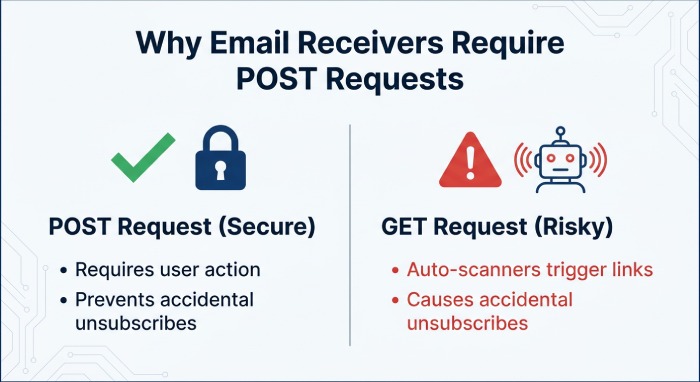
RFC 8058 uses POST requests instead of GET actions to prevent accidental unsubscriptions. Since web browsers and automated security systems may scan or prefetch URLs, using GET could unintentionally remove subscribers from mailing lists. Requiring List-Unsubscribe-Post with a specific POST request body allows trusted mail receivers to process unsubscribe requests safely.
Implementation Checklist: Technical Setup, Testing, and Common Mistakes
A solid RFC 8058 implementation requires coordination between marketing platforms, mail software, DNS authentication, and the unsubscription server.
Technical Setup Steps
Start with the email header. Every eligible marketing message should include a List-Unsubscribe header containing an HTTPS URI. The same message should include:
List-Unsubscribe-Post: List-Unsubscribe=One-ClickThe unsubscribe endpoint must accept HTTPS POST requests using the request body specified by RFC 8058. The receiving mail system should send the request as multipart/form-data or may use application/x-www-form-urlencoded. The endpoint must process the request without relying on cookies, HTTP authorization, or other session context.
Testing Before Production
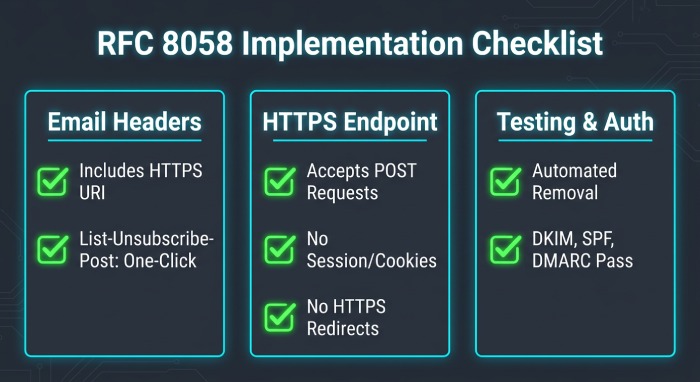
Testing should confirm that:
- The List-Unsubscribe header is present and contains an HTTPS URI
- The List-Unsubscribe-Post header is present and correctly formatted
- The POST request triggers subscription removal
- The unsubscribe process does not require manual intervention
- The recipient mailbox receives mail authenticated with DKIM, SPF, and DMARC
- The To header, List-Unsubscribe header, and DKIM-Signature are not corrupted by downstream systems
You should test with real Gmail and Yahoo recipient mailbox accounts and inspect the raw email header. Many teams also use internal QA tools to validate header syntax, ABNF expectations, DKIM results, and domain authentication.
Common Mistakes to Avoid
Another important implementation mistake is returning an HTTPS redirect from the unsubscribe endpoint. RFC 8058 specifies that the endpoint must not return an HTTPS redirect because redirected POST requests may not work reliably. The original HTTPS endpoint should process the unsubscribe request directly.
Compliance Benefits: Deliverability, User Trust, and Long-Term Email Program Health
Proper RFC 8058 support improves email deliverability by giving recipients an easy way to unsubscribe instead of reporting messages as spam. A reliable one-click unsubscribe process helps reduce spam complaints, protect sender reputation, build user trust, and maintain a positive email experience.
It also improves mailing list quality by removing uninterested subscribers, increasing engagement, and keeping marketing data accurate. Following RFC 8058 requirements helps email senders maintain compliance, respect user preferences, and support long-term email program health.
General Manager
General Manager of DuoCircle. Product strategy and commercial lead for AutoSPF's 2,000+ customer base.
LinkedIn Profile →