Protect Your Brand Online: Why Every Business Needs Protected Domain Services

Quick Answer
Protected domain services help businesses secure valuable domains, monitor DNS changes, prevent cybersquatting and phishing, and protect brand reputation. Combining domain security with SPF, DKIM, and DMARC strengthens protection against spoofing and online impersonation.

What Protected Domain Services Are and How They Work
Protected domain services are a structured set of domain protection, domain registration, monitoring, DNS, and enforcement capabilities designed to prevent misuse of your brand online. Instead of simply buying one primary domain and hoping no one abuses similar names, businesses use domain protection services to identify risky variations, secure important domain names, monitor abuse, and respond quickly when attackers launch phishing, spoofing, or impersonation campaigns.
For modern organizations, domain security is not separate from cloud security, email security, DDoS protection, API security, and application security. A domain is often the front door to websites, customer portals, APIs, email systems, and cloud-hosted applications. If that front door is compromised, attackers can redirect traffic, steal credentials, distribute malware, or damage customer trust.
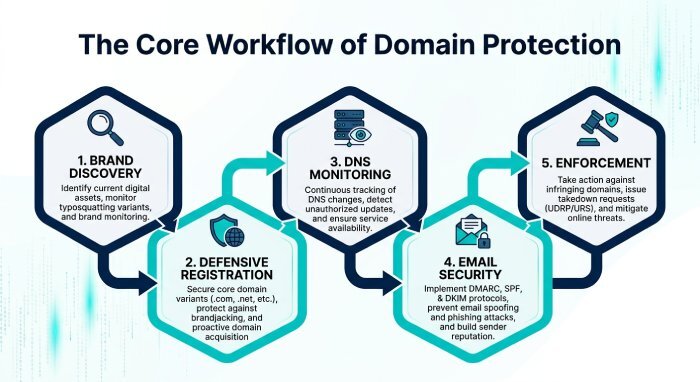
The Core Workflow
A strong domain protection program usually includes:
- Brand and keyword discovery across domain registration databases
- Defensive domain registration for key names, misspellings, and regional extensions
- DNS monitoring to detect unauthorized changes
- Email security controls to reduce spoofing and impersonation
- Enforcement workflows for takedowns, registrar complaints, and abuse reporting
- Integration with SPF, DKIM, DMARC, and email security controls
Domain protection should work alongside email authentication controls such as SPF, DKIM, and DMARC. SPF identifies authorised email senders, while DKIM and DMARC add further layers of authentication and domain alignment. Tools such as AutoSPF can help businesses manage and monitor SPF records, making it easier to maintain accurate sender authorisation as email infrastructure changes.
Inventory, Registration, and Resolution
The first step is knowing what you own and what attackers might target. A domain registrar handles domain registration, but domain protection goes further by mapping brand names, product names, executive names, campaign terms, and high-risk typos. Once identified, important domains can be secured through defensive domain registration and connected to trusted DNS infrastructure.
Registrar Controls and Whois Privacy
Look for private domain protection, whois privacy, account security features, registry lock options, and multi-factor authentication. These levels of protection reduce the chance of unauthorized transfers, hijacking, or malicious DNS updates.
Where Domain Protection Fits in Modern Security
Domain protection services should connect with cloud security, web application firewall rules, DDoS protection, API security, email security, bot management, and network protection. For example, a suspicious lookalike domain may be connected to a phishing site, while a compromised legitimate domain may be used to attack an API endpoint or bypass customer trust.
Connecting Domain Security to Email Authentication
DNS security is an important part of protecting a business domain because DNS records determine where domain-related services are directed. Unauthorised DNS changes can disrupt websites or email services and may expose users to malicious destinations. Businesses should therefore secure their DNS management while also implementing email authentication controls such as SPF, DKIM, and DMARC.
SPF helps identify authorised email-sending sources, while DKIM verifies that messages have not been altered and DMARC helps domain owners define how receiving servers should handle authentication failures. Together, these controls provide a stronger foundation for protecting business domains against email spoofing and impersonation.
Email Authentication and Domain Protection
Domain protection is closely connected to email authentication. Attackers can abuse lookalike domains or spoof legitimate domains to send phishing emails, fraudulent invoices, and credential-harvesting messages. Implementing SPF, DKIM, and DMARC helps organisations establish which systems can send email on behalf of their domains and provides greater visibility into authentication failures.
SPF is particularly important because it identifies authorised sending servers and helps receiving mail systems detect unauthorised sources. However, managing SPF records can become difficult as businesses add marketing platforms, CRM systems, customer-support tools, and other third-party senders. Regular SPF monitoring and record management can help prevent configuration errors and maintain reliable email authentication.
The Business Risks of Unprotected Domains: Cybersquatting, Phishing, and Brand Impersonation
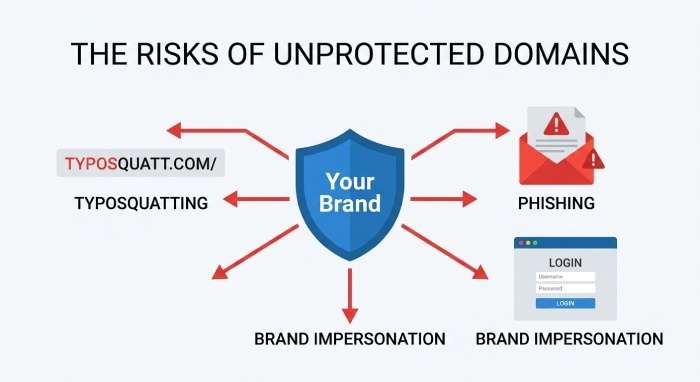
Unprotected domains create avoidable exposure. Attackers register confusingly similar names, use them in email fraud, clone login pages, or redirect users to malicious applications. Without domain protection services, a business may not discover the abuse until customers report fraud or search engines index the fake site.
Cybersquatting and Typosquatting
Cybersquatting occurs when someone registers a domain using your brand name or a similar phrase, often to sell it back, divert traffic, or host harmful content. Typosquatting targets common misspellings, such as missing letters, swapped characters, plural versions, or alternate top-level domains.
For a small business, a compromised or lookalike domain can result in lost leads, customer confusion, and reputational damage. For larger organisations, domain abuse can increase the risk of email spoofing, phishing, and fraudulent messages sent in the company’s name, making SPF, DKIM, and DMARC important components of domain protection.
Attack Paths: Email, DNS, and Applications
Attackers often combine fake domain registration with weak email security. They may send fraudulent invoices, credential-harvesting messages, or malware links from lookalike domains. Tools such as AutoSPF can support email security operations by helping organizations manage SPF records more effectively as part of a broader domain protection and phishing protection strategy.
Sector-Specific Exposure
Financial Services firms face account takeover and wire fraud risk. Healthcare organizations must protect patient portals and data compliance obligations. Retailers must secure checkout flows, CDN delivery, and website optimization. Gaming companies must defend against DDoS protection challenges, bot management abuse, and credential stuffing.
Phishing and Brand Impersonation
Phishing is one of the most damaging outcomes of poor domain security. When customers receive emails from convincing lookalike domains, they may not realize they are interacting with an attacker. Brand impersonation can also appear in paid ads, social media profiles, fake support portals, and malicious mobile app pages.
Email security, DNS authentication, web application firewall policies, API security, and DDoS protection work best when supported by domain protection services that detect and disrupt impersonation early.
How Protected Domain Services Strengthen Brand Trust and Customer Security
Customers expect secure, reliable digital experiences. If your brand appears in a phishing campaign or fake domain, the customer may blame your business—even if the domain was never yours. Domain protection helps preserve trust by reducing confusion, preventing misuse, and keeping users connected to legitimate services.
Trust Signals Customers Actually Notice
Customers may not understand DNSSEC, SSL/TLS, post-quantum cryptography, or firewall-as-a-service, but they do notice secure URLs, consistent branding, fast pages, and reliable access. Domain security supports these trust signals by ensuring users reach the correct destination.
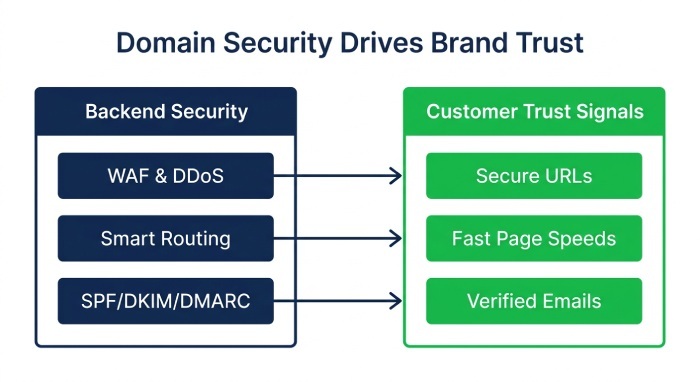 A strong domain protection plan also supports digital transformation. As businesses launch new portals, APIs, mobile apps, and cloud workloads, domain registration and domain management must keep pace. Otherwise, innovation creates new attack surfaces faster than security teams can govern them.
From Attack Mitigation to Digital Experience
Protected domain services improve risk minimization and customer experience by connecting domain protection with performance services. CDN acceleration, smart routing, load balancing, DDoS protection, and web application firewall policies help preserve application performance during attacks. API security and cloud security controls also protect the back-end services powering modern digital experience.
Organizations can strengthen domain security by combining domain monitoring with email authentication controls such as SPF, DKIM, and DMARC. These technologies help businesses identify authorised senders, detect authentication failures, and reduce the risk of domain spoofing and phishing.
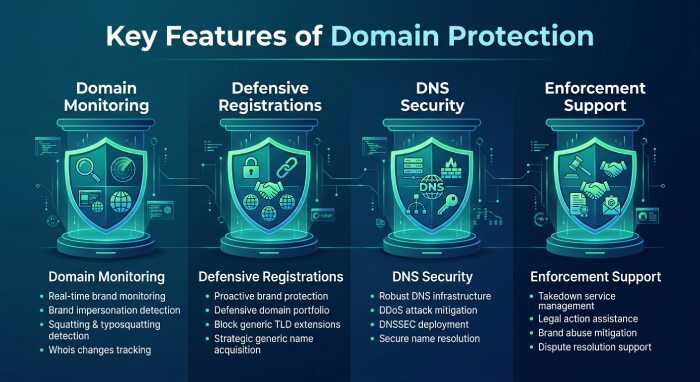
Key Features to Look For: Domain Monitoring, Defensive Registrations, DNS Security, and Enforcement Support
The best domain protection services combine visibility, prevention, and response. Buying extra domains is useful, but it is not enough. Businesses need monitoring, policy, enforcement, and integration with their broader security stack.
Monitoring and Defensive Registrations
Effective monitoring should identify new domain registration activity that resembles your brand. It should also prioritize risk so teams can distinguish harmless registrations from likely fraud. Defensive registrations should cover core brand names, product names, high-risk typos, country-code domains, and campaign-specific names.
Important features include:
- Continuous domain monitoring
- Similarity detection for typos and homoglyphs
- DNS record monitoring
- Brand abuse reporting
- Integration with email security and phishing protection tools
- Account security controls for owned domains
DNS Security and Enforcement Support
DNS security should include resilient authoritative DNS, secure record management, DNSSEC where appropriate, and alerting for unauthorized changes. Enforcement support is equally important. If an attacker launches a fake site, your provider should help with takedown notices, registrar escalation, hosting provider complaints, and evidence collection.
A mature domain protection strategy should also connect domain monitoring with email authentication. Monitoring SPF, DKIM, and DMARC results can help organisations identify unauthorised email activity, authentication failures, and potential spoofing attempts. Keeping an accurate inventory of legitimate email senders and regularly reviewing SPF records can further reduce the risk of email delivery problems and domain abuse
Choosing the Right Protected Domain Strategy for Your Business
The right strategy depends on your risk profile, brand footprint, regulatory environment, and digital roadmap. A Small Business may begin with core domain registration, whois privacy, DNS security, and email security. An Enterprise organization may need global services, defensive registrations across many markets, advanced enforcement, bot management, API security, and integrated cloud security.
Matching Levels of Protection to Business Size
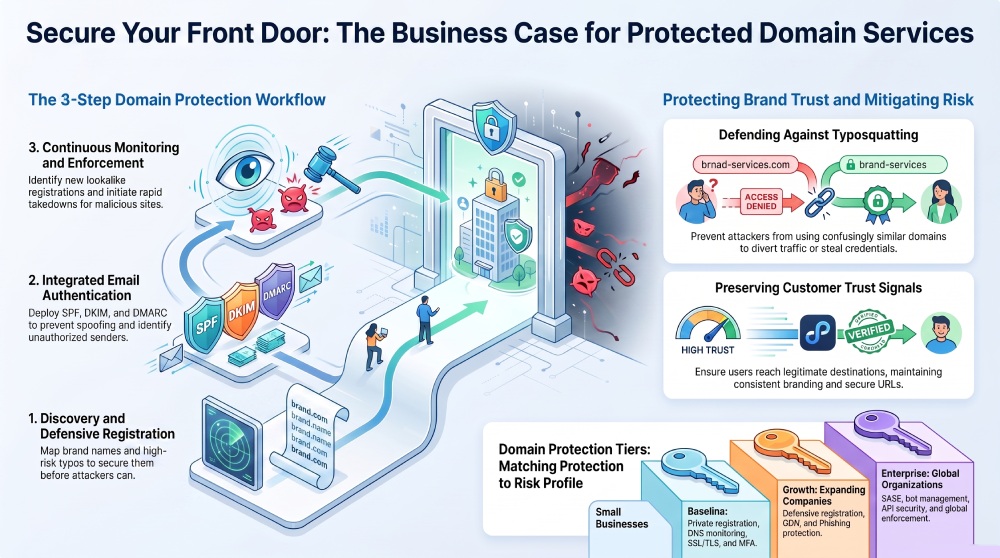 Choose levels of protection based on exposure:
- Baseline: Secure domain registrar, private domain protection, DNS monitoring, SSL/TLS, and account security.
- Growth: Defensive domain registration, email security, phishing protection, web application firewall, CDN, and DDoS protection.
- Advanced: API security, cloud security, bot management, network firewall, firewall-as-a-service, zero trust network access, and secure web gateway.
- Enterprise: SASE, Magic Transit, network-as-a-service, SD-WAN, global enforcement, compliance standards support, and post-quantum cryptography planning.
Operating Model and Partner Support
A successful domain protection strategy requires clear ownership across security, IT, marketing, legal, and domain management teams. These teams should establish who approves domain registrations, monitors suspicious activity, reviews email authentication failures, and responds to phishing or brand impersonation incidents.
Regular monitoring of SPF, DKIM, and DMARC results can help security teams identify unauthorised email activity and respond before it causes significant damage. Organisations should also maintain an inventory of legitimate email-sending services and update their SPF records whenever email infrastructure changes.
General Manager
General Manager of DuoCircle. Product strategy and commercial lead for AutoSPF's 2,000+ customer base.
LinkedIn Profile →