SSL and TLS Compared: What's Changed and Why It Matters

Quick Answer
SSL is an outdated security protocol, while TLS is its modern, more secure replacement. TLS provides stronger encryption, faster handshakes, better authentication, and improved data integrity for HTTPS and email communications.
What SSL and TLS Are: Core Purpose and How They Secure Data
SSL and TLS are cryptographic protocols that protect data in transit across networks. While they secure websites through HTTPS, they also play a critical role in encrypting SMTP connections between mail servers. For organizations using SPF, DKIM, and DMARC, TLS provides an additional layer of protection by securing email during transmission. Managing multiple SPF includes keeps that authentication reliable.
In email systems, TLS encrypts SMTP sessions between sending and receiving mail servers, helping protect emails from interception while they travel across the internet.
Secure Socket Layer and Transport Layer Security Explained
Secure Socket Layer was originally developed by Netscape, with important contributions associated with Taher Elgamal. SSL became the foundation for protecting early web traffic. Transport Layer Security later replaced SSL as the modern, stronger protocol for secure communication.
Although people still say “SSL certificate”, most modern deployments actually use a TLS certificate. The term SSL remains common in marketing and administration, but the underlying communication protocol is almost always TLS.
Encryption, Authentication, and Data Integrity
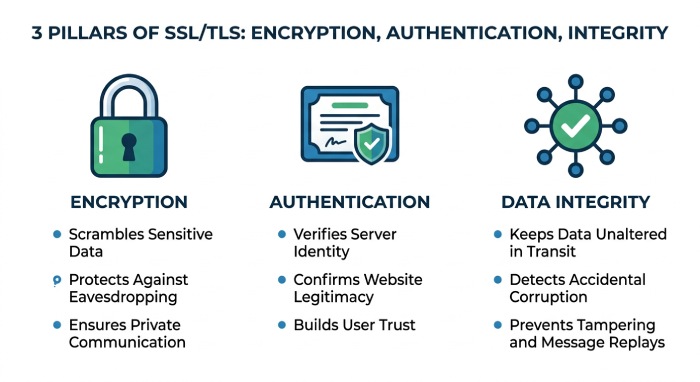
SSL and TLS provide three core protections:
Encryption for Confidentiality
Encryption prevents attackers from reading data in transit. A TLS cipher suite defines the bulk encryption algorithm, key exchange algorithm, and validation algorithm used to protect the session.
Authentication with Certificates
Authentication verifies that the server is who it claims to be. A digital certificate binds a domain name to a public key and is issued by a trusted certificate authority. During the handshake, the server proves possession of the matching private key.
Data Integrity Checks
Data integrity ensures that transmitted information has not been modified. TLS uses mechanisms such as a message authentication code, MAC, or hash-based message authentication code, commonly written as HMAC, to detect tampering.
How SSL/TLS Creates a Secure Channel
SSL/TLS establishes a secure channel before application data is exchanged. The client and server negotiate protocol versions, select a cipher suite, perform key exchange, validate the certificate, and derive shared secrets used for encryption and authentication.
The Role of the Handshake
The handshake is the setup phase where the browser and server agree on security parameters. In an SSL handshake or TLS handshake, the client sends supported versions and cipher suites, while the server responds with its chosen protocol, certificate, and key exchange details.
From Master Secret to Session Keys
Older TLS versions use a pseudo-random function to derive a master secret from exchanged values. That master secret is then expanded into encryption keys and authentication keys used to secure the session.
The Evolution from SSL to TLS: Key Milestones and Deprecation of SSL
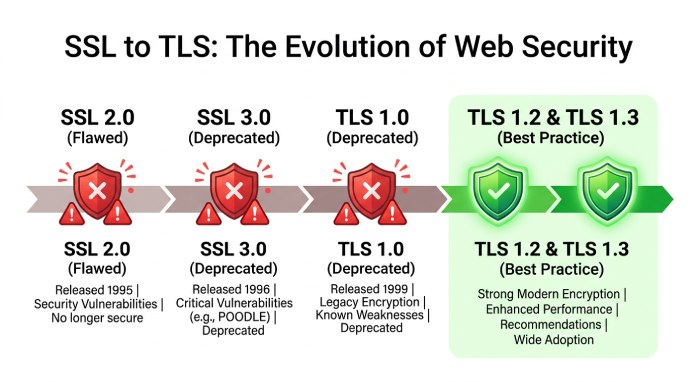
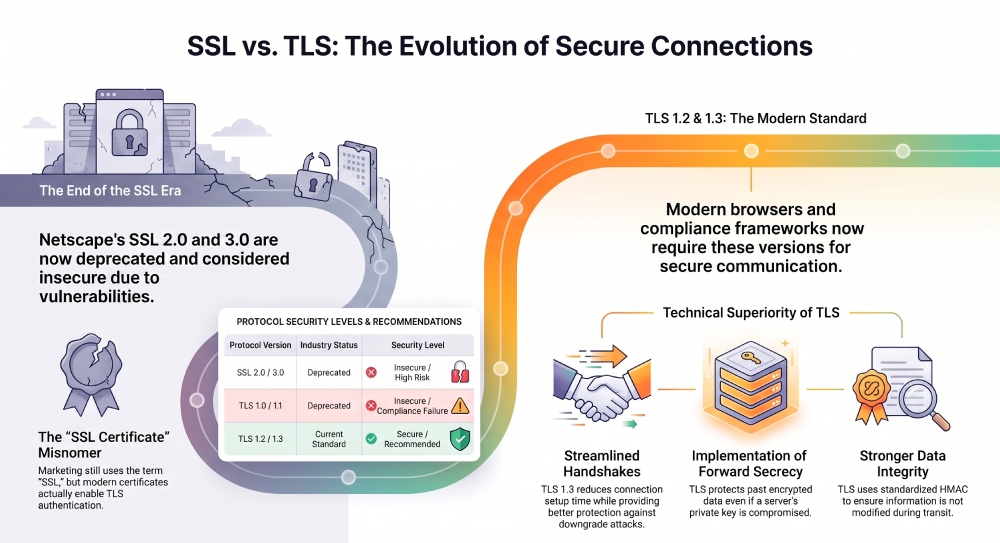
SSL has a long history, but it is no longer considered safe. SSL 2.0 had serious vulnerabilities and design weaknesses. SSL 3.0 improved the design but still became insecure over time. TLS 1.0, introduced by Tim Dierks and Christopher Allen, was based on SSL 3.0 but strengthened the protocol.
Netscape, SSL 2.0, and SSL 3.0
Netscape introduced SSL to make the early World Wide Web safer for commerce and login systems. SSL 2.0 was quickly found to be flawed. SSL 3.0 added improvements, including better handshake protection and broader algorithm support, such as the historical Fortezza algorithm, but SSL 3.0 is now deprecated.
TLS 1.0 and the Move to Transport Layer Security
TLS 1.0 formalized Transport Layer Security as an internet standard. While TLS 1.0 was stronger than Secure Socket Layer, it too is now deprecated by modern browsers, cloud providers, and compliance frameworks. Current best practice is to use TLS 1.2 or TLS 1.3.
Why SSL Was Deprecated
SSL was deprecated because attackers discovered weaknesses in the protocol, encryption options, padding behavior, and message digest methods. Older systems often relied on algorithms such as MD5, which no longer provide acceptable cryptographic strength.
Protocol Vulnerabilities
SSL and early TLS versions suffered from vulnerabilities that weakened confidentiality, authentication, and data integrity. Attackers could exploit downgrade behavior, weak cipher suites, and outdated message authentication designs.
Browser and Server Enforcement
Modern browser vendors reject deprecated SSL versions. A server still supporting SSL 3.0 or weak TLS settings may trigger security warnings, break HTTPS, or fail compliance scans from platforms such as AWS security tools.
SSL vs. TLS: Technical Differences in Encryption, Handshakes, and Authentication
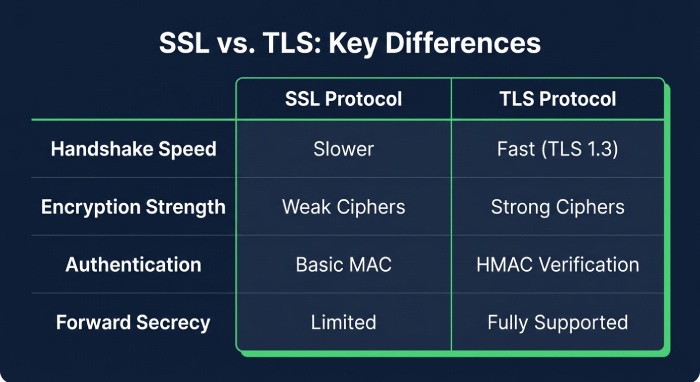
While SSL and TLS serve the same broad purpose, TLS improves the security model in several technical areas. Transport Layer Security refined the handshake, strengthened authentication, improved encryption negotiation, and added more reliable data integrity protections.
1. Handshake Improvements
The TLS handshake is more structured and secure than the SSL handshake. It improves version negotiation, session key derivation, and protection against downgrade attacks. TLS 1.3 simplifies the handshake further, reducing round trips and improving performance.
Explicit Connection Behavior
Older protocols sometimes used an explicit connection upgrade, such as STARTTLS-style negotiation on a port that began in plaintext. Modern HTTPS typically uses TLS directly on port 443, creating a secure connection immediately.
2. Encryption and Cipher Suite Changes
SSL supported weaker cipher suites and older cryptography. TLS supports stronger encryption, modern key exchange, and forward secrecy. With forward secrecy, even if a private key is compromised later, past encrypted communication remains protected.
3. Message Authentication and Integrity
SSL used earlier MAC constructions, while TLS standardized stronger message authentication. TLS commonly relies on Hash-Based Message Authentication Code, or HMAC, which combines a secret key with a secure hash to create an authentication code.
Message Digest and Integrity Check
A message digest summarizes transmitted content. TLS combines the digest with a message authentication code to perform an integrity check, confirming that data integrity has not been compromised.
Authentication: Certificates, Keys, and Trust
Authentication depends heavily on certificates and public key infrastructure. A certificate contains identity information, a public key, issuer details, and validity dates. The client validates the certificate chain before trusting the server.
SSL Certificate vs. TLS Certificate
An SSL certificate and a TLS certificate are often the same product in commercial language. Technically, the certificate supports TLS authentication today. The phrase “SSL certificate” persists because it is familiar, but a properly configured certificate enables Transport Layer Security.
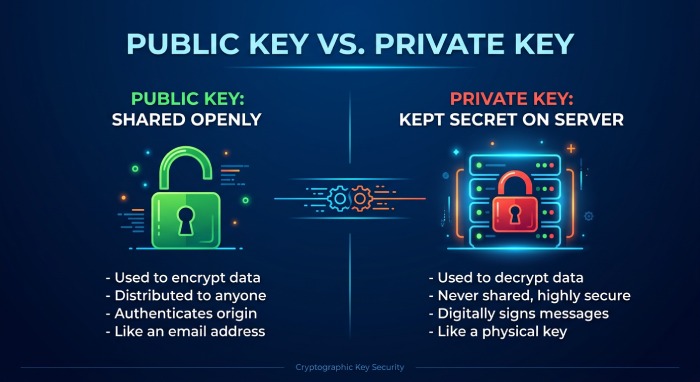
Public Key and Private Key Roles
The public key is included in the digital certificate and can be shared openly. The private key must remain secret on the server. During the handshake, cryptographic proof links the certificate to the server’s private key.
Alert Messages and Error Handling
TLS defines alert messages that help endpoints signal problems. These alerts improve reliability by making failures explicit instead of ambiguous.
Warning Alert, Fatal Alert, and Close Notify
A warning alert may indicate a non-critical condition. A fatal alert terminates the secure channel because the protocol cannot continue safely. The close notify alert signals that one side is intentionally closing the encrypted communication session.
Why TLS Matters Today: Security, Compliance, SEO, and User Trust
TLS matters because modern digital services depend on secure, authenticated, and tamper-resistant communication. Without TLS, data can be intercepted, modified, or impersonated in transit.
- Security and Compliance: Security standards increasingly require TLS 1.2 or TLS 1.3. Organizations using AWS, payment processors, healthcare platforms, or identity providers must avoid deprecated SSL and early TLS versions. Web security also complements broader controls such as email security, endpoint protection, and identity management.
- SEO and Browser Trust: Search engines favor HTTPS, and browsers visibly warn users when a secure connection is missing. A valid certificate improves user trust, while expired or misconfigured certificates damage credibility.
Performance and Reliability Benefits of Modern TLS
Modern TLS is not just more secure; it is faster and more reliable. TLS 1.3 reduces handshake overhead, removes obsolete cryptography, and supports efficient session resumption.
- Faster Secure Connections: A shorter handshake improves performance, especially on mobile networks. Strong TLS configuration can reduce latency while maintaining encryption, authentication, and data integrity.
- Better Operational Reliability: Clear alert messages, standardized certificate validation, and mature tooling make TLS more reliable than legacy SSL. Resources such as GeeksforGeeks and cloud documentation often summarize these operational differences for administrators.
Best Practices for Modern TLS Implementation and Migration from Legacy SSL
Organizations should disable SSL entirely and remove TLS 1.0 and TLS 1.1 unless a tightly controlled legacy dependency exists. The preferred baseline is TLS 1.2 with strong cipher suites, with TLS 1.3 enabled wherever possible.
Configuration Priorities
Use trusted certificates, protect the private key, automate renewal, and monitor certificate expiration. Configure HTTPS on the correct port, usually 443, and redirect HTTP traffic to HTTPS.
Cryptographic Recommendations
Select cipher suites that support forward secrecy, authenticated encryption, and strong key exchange. Avoid MD5, RC4, export-grade cryptography, and obsolete bulk encryption algorithm choices.
Migration Checklist
To migrate from legacy SSL/TLS, inventory all servers, identify deprecated protocol support, update libraries, test client compatibility, deploy a valid TLS certificate, and scan for vulnerabilities. Confirm that every secure channel provides encryption, authentication, confidentiality, and data integrity without relying on Secure Socket Layer or weak Transport Layer Security settings.
TLS protects email while it travels between mail servers, but encryption alone doesn’t verify who sent the message. That’s why organizations should combine TLS with SPF, DKIM, and DMARC. Together, these technologies improve email security, protect against spoofing, and help ensure legitimate messages reach recipients safely. Keeping SPF within its 10-lookup limit is easier with an SPF flattening service. Before you start, it helps to separate the SPF flattening myths from fact.
General Manager
General Manager of DuoCircle. Product strategy and commercial lead for AutoSPF's 2,000+ customer base.
LinkedIn Profile →