What Is DTLS Protocol? How It Differs From TLS in Secure Communication

Quick Answer
DTLS (Datagram Transport Layer Security) secures low-latency, datagram-based communication with encryption, authentication, integrity, and replay protection. Unlike TLS, DTLS supports unreliable transports such as UDP, making it ideal for WebRTC, VPNs, IoT, gaming, and real-time applications.
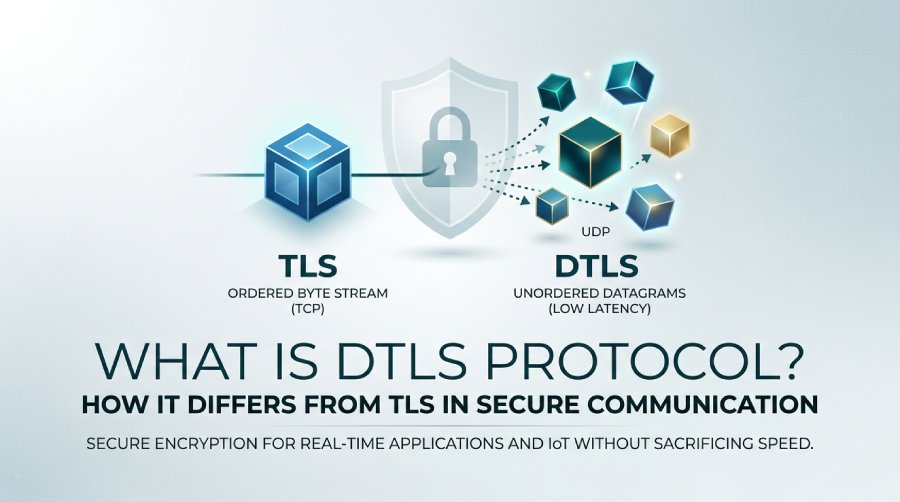
Secure communication is not limited to web browsing, file transfers, and API requests. Many modern applications rely on fast, packet-based communication where low latency is important. This is where DTLS (Datagram Transport Layer Security) comes in. It provides TLS-like encryption, authentication, and integrity protection for applications that use datagram-based transports such as UDP, while preserving their low-latency behavior.
In simple terms, DTLS is designed for situations where network packets may be lost, duplicated, or delivered out of order. Unlike TLS, which is typically used with reliable, ordered connections, DTLS protects datagram-based communication without turning it into a traditional byte stream. This makes it useful for real-time applications such as video conferencing, WebRTC, gaming, VPNs, and IoT communication.
What Is DTLS Protocol? Definition and Core Purpose
The DTLS protocol, or Datagram Transport Layer Security, is a secure communication protocol designed to protect applications that use datagram-based transports, especially UDP. It provides encryption, authentication, integrity, and replay protection while preserving the low-latency, packet-oriented nature of datagram communication. Unlike TLS, which typically runs over reliable, ordered connections, DTLS is designed for environments where packets may be lost, duplicated, or delivered out of order.
Unlike classic Transport Layer Security, which is commonly layered over TCP, the DTLS protocol is built for environments where packets may be lost, duplicated, or delivered out of order. This makes DTLS especially useful for voice, video, gaming, IoT telemetry, VPN acceleration, and real-time browser communications.
A useful way to think about DTLS is that it preserves the application behavior expected from datagrams while adding the cryptographic assurances associated with TLS. Applications still send messages as discrete packets rather than as a continuous byte stream, but those packets can be encrypted and authenticated. This is especially valuable when the application needs to react immediately to current information rather than wait for older data to be retransmitted and placed in order.
Core purpose for datagram-based applications
The core purpose of Datagram Transport Layer Security is to secure datagram-based applications without forcing them into a stream-oriented model. Datagram transport does not guarantee reliable transmission, ordering, or retransmission. This behavior is often desirable for real-time systems, where a late voice packet or game-state update may be less useful than no packet at all.
The DTLS protocol therefore provides encryption, authentication, integrity, replay protection, and defenses against message forgery, eavesdropping, and tampering while preserving the low-latency advantages of datagram-based communication, particularly over UDP.
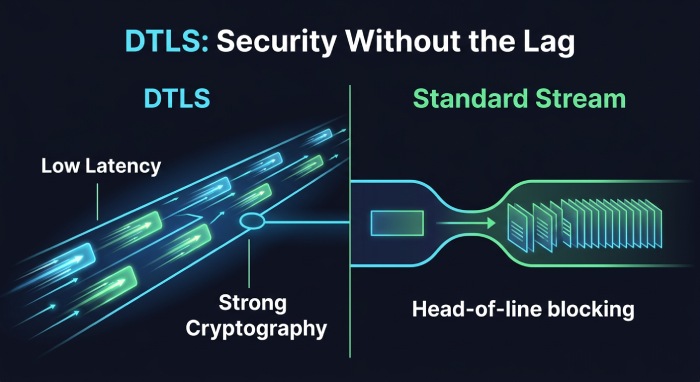
This design is important because security controls should not change the fundamental performance profile of an application more than necessary. If a conferencing platform, industrial sensor, or remote desktop session is designed around rapid updates, forcing it through a reliable stream may create delay, head-of-line blocking, and user-visible performance issues. DTLS gives developers and network architects a way to apply strong cryptography while still allowing the application to make intelligent decisions about dropped or late packets.
Why DTLS Exists
Traditional TLS is excellent for reliable streams. A browser loading a web page, a client submitting an API request, or an application downloading a software update usually needs every byte to arrive correctly and in order. TCP provides that foundation, and TLS protects the data flowing through it.
However, not every application benefits from strict ordering. In a live video call, receiving packet 500 before packet 499 is not necessarily a failure. The application may still use packet 500 and discard packet 499 if it arrives too late. In a multiplayer game, the most recent position update is usually more useful than an old update that was delayed in transit. In IoT telemetry, a later sensor reading may supersede a previous one.
DTLS exists to serve those scenarios. It keeps the security model close to TLS while adjusting the transport assumptions. It adds mechanisms for handshake retransmission, message fragmentation, anti-replay protection, and sequence handling because the transport layer underneath it does not provide the same guarantees as TCP.
Standards, Versions, and Protocol Lineage
DTLS is closely related to TLS, or Transport Layer Security, but it is adapted for unreliable datagram delivery. The major versions are tied to formal RFCs and corresponding TLS generations.
From DTLS 1.0 to DTLS 1.3
DTLS 1.0 was based on TLS 1.1 concepts. DTLS 1.2, standardized in RFC 6347, aligns with TLS 1.2 and remains widely deployed. DTLS 1.3, defined in RFC 9147, tracks TLS 1.3 and improves handshake efficiency, cryptographic agility, and resistance to legacy weaknesses.
Where TLS assumes an ordered byte stream, DTLS assumes a packetized network where a network packet can disappear, arrive late, or arrive out of sequence. This distinction shapes nearly every part of the DTLS implementation.
Version selection and compatibility
Version selection matters in production environments. DTLS 1.2 is still common because many libraries, embedded systems, VPN clients, and communication stacks adopted it over a long period. It can be secure when configured with modern cipher suites, strong certificates, and proper validation. However, DTLS 1.3 is preferable for new deployments when both endpoints support it because it inherits many of the improvements introduced by TLS 1.3.
The move from older versions to DTLS 1.3 also reduces the need for legacy negotiation patterns and older cryptographic options. This is important for compliance-driven environments where obsolete algorithms, weak key exchange methods, or outdated protocol versions may violate internal security baselines.
Organizations should treat DTLS version management as part of their broader TLS governance program. The same questions apply: which protocol versions are allowed, which certificate authorities are trusted, how are keys rotated, how are weak ciphers disabled, and how quickly can vulnerable libraries be patched?
How DTLS Works: Handshake, Encryption, and Datagram Transport
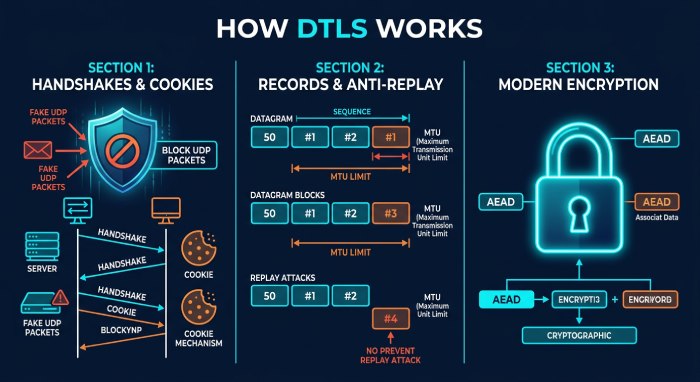 The DTLS protocol works by adapting the TLS handshake and record layer to unreliable transports. It still negotiates cipher suites, authenticates endpoints, derives session keys, and protects application data, but it must also handle loss of datagram, duplication, and packet reordering.
Handshake and cookies
In TLS, the handshake runs over TCP, so message ordering and retransmission are handled by the transport. In Datagram Transport Layer Security, handshake messages may be fragmented, retransmitted, and reassembled by DTLS itself. A stateless cookie exchange is often used to reduce denial-of-service risk before expensive cryptographic operations occur.
This makes DTLS suitable for UDP and User Datagram Protocol deployments where spoofed source addresses are possible. It also matters for SCTP, or Stream Control Transmission Protocol, where DTLS can secure message-oriented traffic while preserving multi-streaming behavior.
The cookie exchange is especially useful because UDP does not require a connection to be established before packets are sent. An attacker can forge source addresses and send many handshake initiation messages to a server. Without protections, the server might spend CPU and memory performing expensive cryptographic work for clients that do not actually exist. With cookies, the server can first require proof that the client can receive traffic at the claimed address.
Records, encryption, replay controls
After the handshake, DTLS protects application data using a record layer similar to Transport Layer Security. Each protected record can include sequence numbers and authentication tags that provide integrity and order protection where appropriate. DTLS also uses anti-replay mechanisms to help detect and reject replayed records.
A record in DTLS is designed to fit into the packet-oriented nature of the transport. Because datagrams have size limits, implementations must pay attention to maximum transmission unit, or MTU, behavior. If a record is too large, IP fragmentation may occur, and fragmented packets can be more fragile across real networks. For this reason, many DTLS applications tune record sizes carefully, especially on mobile networks, VPN tunnels, and paths that cross NAT devices or firewalls.
Modern Encryption and Security
Older TLS and DTLS implementations could use Cipher Block Chaining (CBC) cipher suites that were affected by various padding and timing attack techniques. Modern TLS 1.3 and DTLS 1.3 use authenticated encryption with associated data (AEAD), which provides confidentiality and integrity together and avoids many weaknesses associated with older encryption modes.
However, using a modern protocol version alone does not guarantee secure communication. Proper certificate validation, secure key management, strong cryptographic settings, reliable random-number generation, and regularly updated libraries are also important for a secure DTLS deployment.
Datagram Transports: UDP, User Datagram Protocol, SCTP, and DCCP
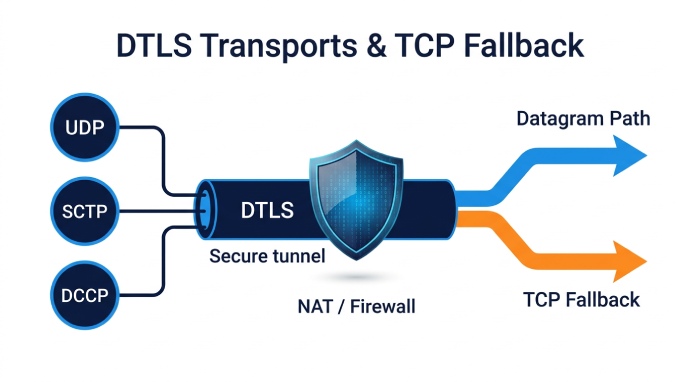 Most people associate the DTLS protocol with UDP, and that is the most common deployment model. UDP, or User Datagram Protocol, provides low overhead and low latency, which is why Datagram Transport Layer Security is popular in media, VPN, and real-time systems.
However, DTLS is not limited to UDP. It can also be used with SCTP, where Stream Control Transmission Protocol provides message-oriented transport with features such as multistreaming. SCTP is important in telecom and signaling environments, and DTLS over SCTP can protect those exchanges without converting them into a TCP-like stream protocol.
DTLS can also be relevant to other datagram transports, including Datagram Congestion Control Protocol (DCCP), where secure communication is required.
NAT, firewalls, and real-world packet paths
In real networks, datagram traffic often has to pass through NAT gateways, stateful firewalls, load balancers, carrier-grade NAT, and security inspection devices. These middleboxes can affect DTLS behavior. Some networks allow outbound TCP but restrict or shape UDP. Others allow UDP only for specific ports or time out idle mappings quickly.
This is one reason many products that use DTLS also provide fallback to TLS over TCP. The DTLS path is preferred for performance, but a TCP-based path may be needed for restrictive networks such as hotels, airports, mobile carriers, or corporate guest Wi-Fi. From an operational perspective, teams should test both the preferred path and the fallback path so users do not experience unexplained connectivity failures.
Keepalive traffic can also be important. Because NAT mappings for UDP may expire quickly, a client may need to send periodic traffic to keep the path open. The correct interval depends on the network environment, battery constraints, and application requirements.
DTLS vs. TLS: Key Differences in Reliability, Latency, and Use Cases
The key difference between DTLS and TLS is the transport assumption. TLS, or Transport Layer Security, expects a reliable, ordered stream. DTLS, or Datagram Transport Layer Security, expects unreliable datagrams.
Reliable streams vs. datagrams
TLS typically runs over TCP. TCP provides reliable transmission, ordering, congestion control, and retransmission. That is excellent for web pages, APIs, file transfers, and transactions where every byte must arrive in order.
DTLS usually runs over UDP or User Datagram Protocol. It tolerates dropped packets and packet reordering, which is better for datagram-based applications where latency is critical. For example, a video conference should not freeze while waiting for an old packet. A multiplayer game should prioritize current state over stale updates.
This distinction also helps avoid the TCP meltdown problem in some tunneling designs. Running TCP inside TCP can cause competing retransmission logic and poor performance. A VPN tunnel using DTLS over UDP can avoid some of those effects while still maintaining strong security.
Practical comparison of DTLS and TLS
| Area | TLS | DTLS |
|---|---|---|
| Typical transport | TCP | UDP, User Datagram Protocol, or SCTP |
| Delivery model | Reliable, ordered stream | Unreliable, packet-oriented datagrams |
| Best fit | Web, APIs, email submission, file transfer | Voice, video, gaming, VPN acceleration, IoT telemetry |
| Packet loss handling | Handled by TCP | Handled by the application and DTLS handshake logic |
| Latency behavior | Can suffer from head-of-line blocking | Better suited for real-time traffic |
| Common fallback role | Primary secure transport for TCP applications | Often preferred path for performance, with TLS fallback |
The choice is not about one protocol being universally better. It is about matching the security protocol to the transport and application behavior. If an application needs exact byte ordering and reliable delivery, TLS over TCP is usually the correct model. If an application needs secure low-latency datagrams, DTLS is often the better fit.
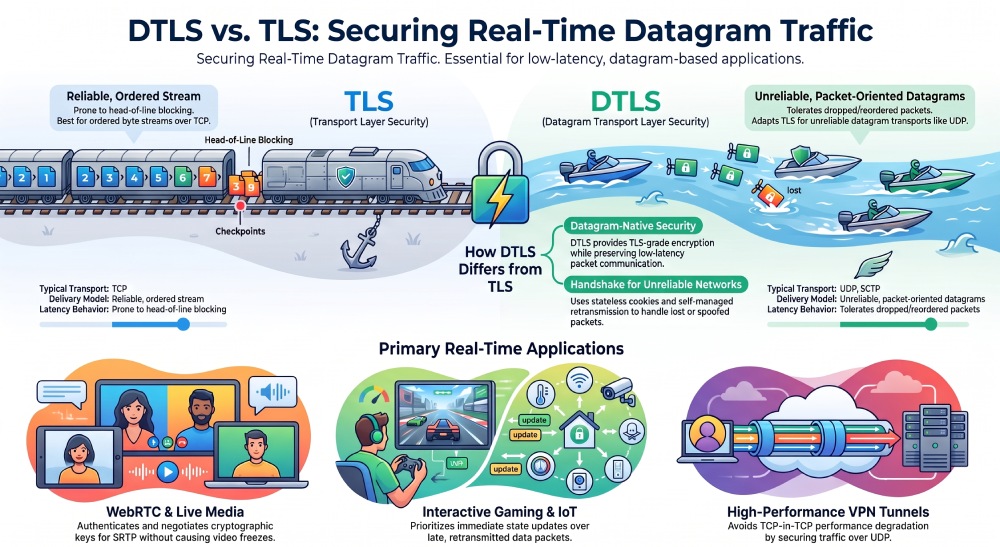
Common DTLS Applications: VoIP, VPNs, IoT, Gaming, and WebRTC
The DTLS protocol is common wherever real-time behavior and security must coexist. It protects datagram-based applications without sacrificing the performance benefits of UDP, SCTP, or related transports.
Real-time media, browsers, and DTLS-SRTP
DTLS is also found in VoIP, conferencing, remote-control traffic, IoT messaging, online gaming, and some Remote Desktop Protocol scenarios where UDP acceleration improves responsiveness.
DTLS plays a specific role in establishing secure keys for media protection. The media itself is typically carried by SRTP, while DTLS helps authenticate and negotiate the cryptographic material used for that media flow. This separation allows browsers and communication systems to maintain strong security while preserving the real-time performance users expect from video calls and screen sharing.
IoT and embedded device communication
IoT environments often use constrained devices, intermittent connectivity, and low-power communication patterns. In these cases, DTLS can secure device-to-cloud or device-to-gateway traffic without requiring TCP. Sensors, meters, industrial controllers, and building automation systems may send small datagrams where low overhead is valuable.
However, IoT deployments require careful planning. Embedded devices may have limited CPU, memory, entropy sources, and update mechanisms. Certificate validation, key storage, firmware patching, and secure random number generation are just as important as protocol selection. A device that supports DTLS but cannot be updated or cannot validate identities correctly may still create risk.
Gaming and interactive applications
Online games and interactive simulations often prefer UDP because the latest state matters most. A delayed movement update or world-state packet may no longer be useful by the time it arrives. DTLS can protect sensitive session data, authentication-related exchanges, or gameplay traffic where confidentiality and integrity are required.
Not every game encrypts every datagram with DTLS, and architectures vary. Some systems use separate channels for authentication, matchmaking, state updates, and voice chat. Still, the underlying design principle is similar: real-time applications need security controls that do not impose unnecessary ordering delays.
DTLS Security Considerations, Benefits, and Limitations
The benefits of Datagram Transport Layer Security are clear: low latency, strong encryption, endpoint authentication, replay resistance, and compatibility with datagram-based applications. The DTLS protocol is especially valuable when TCP-based TLS would introduce delay, head-of-line blocking, or tunneling inefficiency.
However, DTLS also has limitations. Because UDP and User Datagram Protocol do not guarantee delivery, the implementation must handle retransmission, fragmentation, packet reordering, and loss of datagram correctly. Middleboxes may block UDP. Firewalls and NAT devices can behave differently with DTLS than with conventional TLS. Poor implementation choices can also weaken security, especially if obsolete cipher suites, weak certificates, or legacy DTLS 1.0 settings remain enabled.
Common risks in DTLS deployments
Several issues appear repeatedly in poorly managed DTLS deployments:
- Use of outdated protocol versions, especially DTLS 1.0.
- Weak or legacy cipher suites left enabled for compatibility.
- Incomplete certificate validation or weak private key protection.
- Lack of anti-replay enforcement.
- Oversized datagrams that cause fragmentation and packet loss.
- Insufficient rate limiting for unauthenticated handshake attempts.
- No monitoring of fallback from DTLS to TLS, making performance problems hard to diagnose.
- Inconsistent behavior across mobile networks, roaming users, and restrictive firewalls.
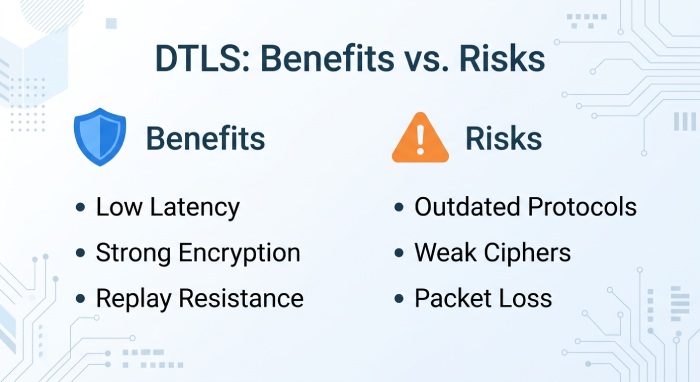 These risks do not mean DTLS is unsafe. They mean it must be implemented and operated with the same discipline applied to TLS. The protocol provides strong building blocks, but deployment choices determine the real-world security outcome.
Best Practices for Deploying DTLS Securely
For new deployments, prefer DTLS 1.3 where supported and use DTLS 1.2 only with strong cipher suites and modern authentication. Disable obsolete versions such as DTLS 1.0 where possible. Align DTLS configuration with current TLS policy, especially around certificate validation, key exchange, and authenticated encryption.
Use replay protection, validate peer identities, monitor failed handshakes, and rate-limit unauthenticated traffic. Test behavior across NAT, firewalls, roaming networks, and mobile connections. For VPN tunnel and SSL VPN use cases, verify fallback behavior between DTLS over UDP and TLS over TCP, and watch for performance issues linked to tunneling design.
Finally, choose well-maintained library support and keep the implementation updated. Whether DTLS secures real-time communication, signaling, IoT telemetry, or enterprise network traffic, the goal is the same: provide Transport Layer Security-grade protection for modern datagram-based applications without sacrificing the speed and responsiveness that make these communication methods effective.
Deployment checklist
A practical DTLS deployment checklist should include both security and network operations:
- Confirm which DTLS versions are enabled.
- Prefer DTLS 1.3 where possible.
- Use strong AEAD cipher suites.
- Disable weak, deprecated, or export-grade cryptography.
- Require proper certificate validation and hostname or identity checks.
- Configure anti-replay protection.
- Test retransmission behavior during packet loss.
- Validate MTU and fragmentation behavior.
- Confirm NAT traversal and keepalive settings.
- Monitor handshake failures and downgrade or fallback events.
- Rate-limit unauthenticated requests.
These practices help ensure that DTLS delivers both the performance benefit and the security assurance it is meant to provide.
Troubleshooting DTLS Performance and Connectivity
When DTLS does not work as expected, the problem is often related to the network path rather than the cryptography itself. A client may support DTLS, and a server may be configured correctly, but a firewall, proxy, or NAT device may interfere with UDP traffic.
Common symptoms include successful connection over TLS but poor or failed connection over DTLS, frequent tunnel fallback, media quality issues, or intermittent session drops. Packet captures can help confirm whether handshake messages are being exchanged, whether retransmissions are occurring, and whether datagrams are being fragmented or blocked.
For VPN and secure access deployments, administrators should compare user experience across multiple networks. A tunnel that performs well on a corporate LAN may behave differently on home broadband, public Wi-Fi, mobile hotspots, or international carrier networks. Monitoring should distinguish between authentication failures, policy denials, packet loss, and transport fallback so teams do not misdiagnose performance problems as identity or application issues.
Final Takeaway
DTLS is best understood as the datagram-oriented counterpart to TLS. It provides encryption, authentication, integrity, and replay protection for applications that require secure, low-latency communication over datagram transports, especially UDP (User Datagram Protocol). DTLS is used in real-time communications, WebRTC, IoT, gaming, VPNs, and other applications where preserving the packet-based behavior of the underlying transport is important.
While DTLS secures real-time network communications, email security relies on standards such as SPF, DKIM, and DMARC to authenticate sending domains and help prevent email spoofing and phishing.
The most important distinction is that TLS secures reliable streams, while DTLS secures unreliable datagrams. That single difference affects handshake design, retransmission, record handling, anti-replay controls, NAT traversal, and operational troubleshooting.
General Manager
General Manager of DuoCircle. Product strategy and commercial lead for AutoSPF's 2,000+ customer base.
LinkedIn Profile →