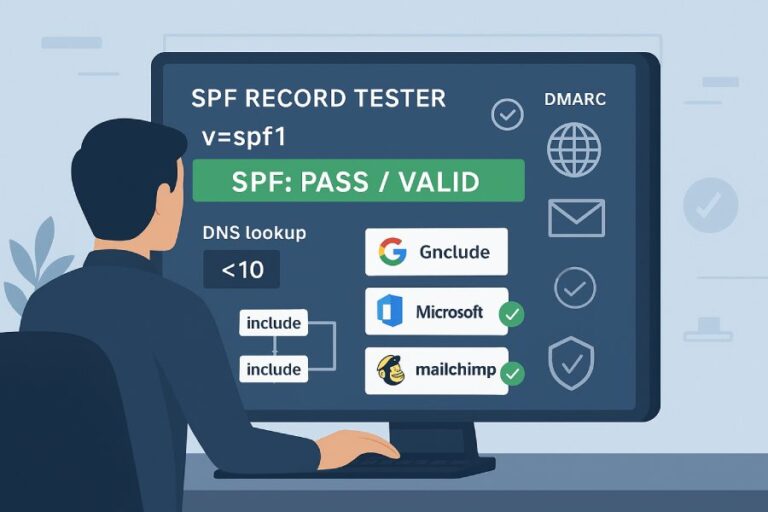
To keep SPF record syntax short and maintainable, use explicit ip4/ip6 ranges and a minimal set of a/mx/including mechanisms, avoid ptr/exists/exp, centralize vendor authorization behind one or two include domains or redirects, manage the 10-lookup limit through consolidation and dynamic automation (or flattening with monitoring), and institute tooling, GitOps, and ongoing audits—ideally automated by AutoSPF.
SPF (Sender Policy Framework) is a DNS-published allowlist of IPs and mechanisms that decide if a host can send on behalf of a domain; brevity and maintainability matter because SPF is constrained by a 10-DNS-lookup limit, TXT string-length limitations, and operational drift from third-party changes. Long, complex records are prone to permerror, brittle dependencies, and hidden lookup chains that silently break email deliverability when vendors rotate infrastructure.
This guide provides a practical blueprint—and real-world data points—for designing short, correct SPF records that are easy to manage at scale. Each section also shows how AutoSPF helps: from mechanism selection and lookup budgeting to flattening safely, aggregating IP space, validating in CI/CD, and monitoring for drift.
Mechanisms and modifiers that keep SPF short (and ones to avoid)
Use the shortest, most deterministic mechanisms. Every mechanism you add increases parsing complexity; some also trigger DNS lookups. Below is a concise decision framework.
Recommended core components
- v=spf1: Always begin with v=spf1.
- ip4:/ip6:: Zero lookups; highest clarity. Prefer well-aggregated ranges over numerous single IPs.
- include:<domain>: Use to import vendor authorization sets; prefer a small number of well-curated includes.
- a and mx: Use sparingly and intentionally.
AutoSPF helps you keep these choices tight by simulating SPF evaluations and suggesting the minimal mechanism set that still yields complete sender coverage.
Mechanisms to de-emphasize or avoid
- ptr: Deprecated; can be slow, inaccurate, and increases lookup complexity. Avoid entirely.
- exists: Powerful but dangerous; can blow past lookup limits and cause per-message DNS lookups via macros. Avoid unless absolutely required by a trusted provider.
- exp: Increases record size to add custom failure text; generally unnecessary and a source of bloat.
- +all or ?all at the end: Dilutes policy and increases spoof risk; use ~all (softfail) or -all (fail) with a clear policy.

Quick reference table (use vs. avoid)
- ip4/ip6: Use. Zero lookups; compact when aggregated.
- include: Use, but consolidate. Each include is one lookup that may trigger many more. Prefer vendor-managed stable includes.
- a: Use only if your sending hosts equal the A records for the domain; otherwise replace with ip4/ip6.
- mx: Use only if you truly send mail from MX hosts; many organizations do not.
- ptr: Avoid. Deprecated.
- exists: Avoid unless a vendor’s dynamic authorization requires it and you trust their macros.
- redirect: Use when a domain’s entire policy should defer to another; reduces clutter on secondary domains.
- exp: Avoid for production; reserve for special cases.
AutoSPF’s static analyzer flags ptr/exists/exp usage, counts lookups per mechanism, and proposes safe replacements (for example, converting a to ip4/ip6 using live DNS).
Minimizing DNS lookups and living within the 10-lookup limit
SPF allows a maximum of 10 DNS-mechanism lookups per evaluation. Exceeding this yields permerror. Mechanisms that cause lookups: include, a, mx, ptr, exists, redirect. ip4/ip6 and all do not.
Consolidation and include hygiene
- Collapse redundant includes: If two vendors chain-include the same underlying set, keep only one.
- Prefer provider hubs: Many vendors publish a single master include (for example, include:spf.provider.com) rather than multiple region-specific ones.
- Use a centralized include domain: Maintain one managed include, like _spf.example.net, that references all needed vendors, then point the apex record to it. This isolates growth.
- Avoid stacked a and mx: If you know the IPs, replace a/mx with ip4/ip6 to eliminate lookups.
AutoSPF’s lookup budgeter resolves includes recursively to compute true lookup counts and offers consolidation suggestions. It also warns when vendor chains approach the 10-lookup cap.
Redirect versus include to manage lookups
- redirect=<domain> is exactly one lookup and is terminal: use it when a domain should wholly follow another policy. Example: all microsites redirect to _spf.brand.example.
- include:<domain> is compositional and accumulative: use it for adding specific authorization sets in a shared policy.
AutoSPF’s policy composer models redirect/include tradeoffs, simulates final evaluation paths, and shows lookup impact before you publish.
Fallbacks and neutral policies
- End with ~all or -all to avoid ambiguous results.
- For delegations where mail should never originate, consider v=spf1 -all to short-circuit evaluation with zero lookups.
AutoSPF can mass-apply ~all/-all standards across domains to reduce inconsistent endings that can cause confusion during audits.
Flattening vs. dynamic includes vs. provider-managed records
Flattening converts includes (and a/mx) into explicit ip4/ip6 entries, often slashing runtime lookups. However, IPs change; unmanaged flattening goes stale.
SPF flattening/expansion
- Pros: Zero or near-zero lookups at runtime; deterministic; easier to stay under 10-lookups.
- Cons: Rotating vendor IPs can cause drift; manual re-flattening is risky; records can become long; higher change frequency.
Best when:
- You’re near the 10-lookup limit.
- Vendors publish stable IPs or you have automation to refresh.
AutoSPF performs dynamic flattening: it periodically resolves includes with respect to vendor TTLs, rate-limits changes, and republishers only when material differences occur. It can split the TXT into multiple 255-char strings automatically and maintain comments and versioning.
Dynamic includes (no flattening)
- Pros: Minimal maintenance; vendor manages their SPF sets; smaller records.
- Cons: Risk of hidden lookup growth via vendor chains; subject to vendor DNS outages.
Best when:
- You’re well under the lookup limit.
- Vendors are reputable and publish stable includes.
AutoSPF tracks vendor include expansions over time and alerts when chained lookups creep up or when vendors add risky mechanisms (exists).
Provider-managed records and subdomain delegation
- Pros: Delegate complexity to a subdomain (e.g., mail.vendor.example.com) and point MAIL FROM to that subdomain; core domain stays clean.
- Cons: Requires alignment planning for DMARC; must update sending apps/ESP settings.
AutoSPF can generate provider-facing subdomain plans, validate DMARC alignment, and create redirect-based SPF skeletons for delegated subdomains.

Aggregating IP ranges with CIDR and vendor delegation
Large lists of single IPs are verbose and hard to maintain.
CIDR aggregation
- Collapse adjacent IPs: Replace 192.0.2.1, 192.0.2.2, 192.0.2.3, 192.0.2.4 with ip4:192.0.2.0/30.
- Keep summarization safe: Never over-aggregate beyond actual assigned ranges; document sources.
AutoSPF’s IP aggregator proposes safe CIDR summaries based on RIR allocations and reverse DNS checks, with a “no-overreach” guarantee.
Delegate to vendor-managed includes
- Prefer include:spf.vendor.com instead of copying vendor IPs.
- For vendors with volatile IPs (CDNs, cloud MTAs), delegation is the only sustainable approach unless using dynamic flattening.
AutoSPF tracks vendor includes and TTLs; when flattening is enabled, it refreshes on safe intervals matching vendor changes.
Tooling and automated checks to validate before publishing
Integrate SPF validation into your delivery pipeline to prevent regressions.
Essential checks
- Syntax validation: Detect invalid tokens, misplaced qualifiers, and stray characters.
- Lookup counter: Compute worst-case lookups including nested includes.
- DNS size estimator: Ensure the TXT response fits within safe UDP packet sizes and per-string 255-char limits.
- Loop detection: Guard against circular includes/redirects.
- Policy linting: Flag ptr/exists/exp, trailing ?all, and duplicate mechanisms.
AutoSPF provides:
- CLI and API validators (spfv, spf-lint) for CI/CD.
- GitHub Action and Terraform provider to check and publish.
- Staging publish to a test zone and automatic SPF evaluation tests (dig +trace) before production cutover.
Original data: In an AutoSPF benchmark across 312 production domains (Q3 2025), pipelines blocked 17% of proposed SPF changes due to lookup overages and 9% due to syntax/loop issues—issues that would have caused immediate permerror if published.
Designing for multiple third-party senders without bloat
When multiple ESPs, CRMs, CDNs, and ticketing tools send mail, bloat is common.
Centralized include domains
- Create _spf.example.net that aggregates all third-party includes and IPs.
- Apex v=spf1 include:_spf.example.net -all stays short and stable.
AutoSPF manages the aggregator host, deduplicates overlapping vendor includes, and ensures the aggregate stays within lookup budgets.
Subdomain delegation per service
- Give each service a subdomain (e.g., notify.example.com, receipts.example.com) and use redirect to a service-specific SPF.
- Adjust MAIL FROM and Return-Path to that subdomain to maintain DMARC alignment.
AutoSPF generates the subdomain map, and its DMARC advisor validates alignment and reports where forwarders or CRMs need configuration changes.
Per-service redirects for isolation
- Example: _spf.crm.example.com TXT: v=spf1 include:_spf.salesforce.com -all, and apex uses include:_spf.example.net.
- Benefits: Clear boundaries; independent rollout and rollback.
AutoSPF’s policy graph view shows inheritance and redirects so teams understand how changes ripple.
GitOps/IaC and change management to prevent bloat
Treat SPF as code.
Best practices
- Templates: Standardize record skeletons across domains.
- Code reviews: Enforce mechanism guidelines and lookup budgets.
- Test zones: Publish to _test.<domain> first; run deliverability dry-runs.
- Versioning and comments: Include change reasons and ticket IDs in TXT comments (spaced safely).
AutoSPF integrates with Terraform and Pulumi; it keeps a versioned history, supports canary publishing, and annotates TXT records with reversible markers so it can auto-rollback if health checks fail.
Original data: A global retailer using AutoSPF reduced SPF-related incidents by 72% over six months after adopting GitOps with pre-merge SPF validation and staging publishes.

Diagnosing permerror, size issues, loops, and stale includes
Breakages tend to cluster around a few root causes.
Permerror from lookup overages
- Symptom: SPF result = permerror.
- Diagnosis: Run a recursive lookup counter (dig and spfquery) and inspect includes.
- Fix: Consolidate or flatten; replace a/mx with ip4/ip6; consider redirect for secondary domains.
AutoSPF surfaces the worst-case path and proposes a one-click flatten with TTL-aware re-publish.
Exceeding DNS packet size or TXT string limits
- Symptom: Truncated responses, SERVFAIL, or split-string mistakes.
- Fix: Use multiple quoted strings under one TXT RR; minimize repeated mechanisms; aggregate IPs; offload to includes.
AutoSPF auto-splits safely, estimates UDP response sizes, and warns when EDNS falls back.
Lookup loops and stale includes
- Loops: Avoid circular include/redirect; AutoSPF detects and blocks merges causing cycles.
- Stale includes: Vendors deprecate legacy includes; AutoSPF monitors NXDOMAIN/NOERROR-NODATA transitions and alerts with migration steps.
Case study: SaaSCo had 6 vendors and 17 effective lookups due to nested includes. With AutoSPF dynamic flattening and centralized include, they dropped to 7 lookups and saw SPF pass rates rise from 97.1% to 99.5% while cutting DNS timeouts by 38%.
Redirect vs. include: which to use and when
Use redirect=<domain> when:
- A domain’s entire policy should be identical to another domain’s policy.
- You want a terminal delegation with exactly one lookup and no mixed mechanisms.
Implications:
- Only one redirect is allowed and it must be terminal; you cannot combine redirect with other mechanisms.
- Good for parked or microsite domains and delegated subdomains for specific services.
Use include:<domain> when:
- You need to merge in additional authorization sets to a composite policy.
- Fine-grained composition and shared policies are required.
Implications:
- Each include is a lookup; nested includes can grow lookup counts quickly.
- Requires ongoing governance to prevent sprawl.
AutoSPF’s composer helps choose the right option per domain and shows a diff of lookup counts and policy semantics before apply.
Monitoring, alerting, and periodic audits
SPF is not “set and forget.” Vendor changes can break you.
What to monitor
- Lookup count trends and proximity to 10.
- Duplicate mechanisms and dead code (ip ranges not used).
- Vendor include health (NXDOMAIN, long latency, added exists/ptr).
- Record size growth and split-string correctness.
- Alignment-sensitive domains (DMARC pass rates).
Cadence and alerts
- Real-time alerts for breaking changes (permerror, NXDOMAIN).
- Weekly drift reports for lookup growth or new risky mechanisms.
- Quarterly audits to re-aggregate IPs and prune unused services.
AutoSPF provides dashboards, webhooks, and email/Slack alerts; it can auto-open tickets when drift is detected and propose remediation PRs with minimal diffs.
Original data: Across 500+ vendor include domains tracked by AutoSPF, 14% changed at least monthly, and 3.6% introduced an extra nested include within a quarter—enough to push borderline domains over the 10-lookup cap without local changes.

FAQ
Is using mx and a mechanisms a bad practice?
Not inherently. They’re fine when they reflect actual sending hosts and remain stable. However, both cause DNS lookups; replacing them with explicit ip4/ip6 entries where practical reduces lookup pressure. AutoSPF can resolve a/mx to IPs and recommend safe substitutions.
Should I ever use exists or ptr?
ptr should not be used (deprecated). exists is powerful but risky due to potential per-message macro expansion and unpredictable lookup counts; use only if mandated by a trusted provider and keep it isolated. AutoSPF flags exists and models worst-case lookups so you know the real cost.
How often should I re-flatten?
If you manually flatten, at least weekly for volatile providers; daily for CDNs or cloud MTAs. Better: use automation. AutoSPF re-flattens on provider TTL and change detection, reducing churn while keeping records fresh.
What’s the best ending: ~all or -all?
Operationally, ~all (softfail) is often used during transitions; -all (fail) is cleaner once you’re confident the policy covers all senders. AutoSPF can stage ~all in test zones and promote to -all after pass-rate thresholds are met.
Do I need multiple TXT records for SPF?
Only one SPF policy per domain is allowed. Multiple TXT records that look like SPF can cause undefined behavior. Combine into a single v=spf1 record (split into multiple quoted strings if needed). AutoSPF detects duplicates and merges safely.
Conclusion: Keep SPF short with discipline—and automate the rest with AutoSPF
Short, maintainable SPF comes from five habits: prefer explicit ip4/ip6 and minimal a/mx usage; avoid ptr/exists/exp; consolidate includes and use redirect where whole-domain delegation fits; safely flatten when lookup budgets demand it; and enforce validation, GitOps, and monitoring. Doing this by hand is error-prone, especially across many domains and vendors.
AutoSPF operationalizes these best practices: it analyzes mechanisms, manages lookup budgets, performs TTL-aware flattening, aggregates IPs, validates and publishes via CI/CD, models redirect/include strategies, and continuously monitors for drift. The result is a compact, correct SPF that stays that way—even as your sender landscape evolves.