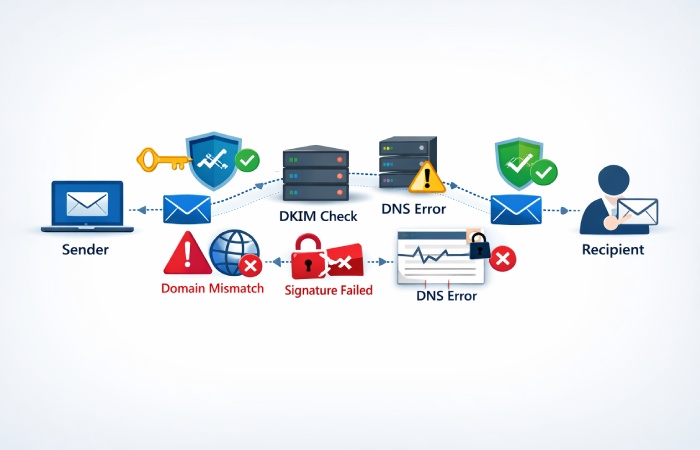
An SPF record example differs from DKIM and DMARC examples in DNS type, purpose, and syntax: SPF is a domain-level TXT that lists authorized sending hosts/mechanisms, DKIM is a selector-scoped TXT that publishes a public key to verify cryptographic signatures, and DMARC is a domain policy TXT at _dmarc.domain that sets enforcement and reporting based on SPF/DKIM alignment.
In practical terms, an SPF record answers “who may send as my domain,” a DKIM record answers “how receivers can verify I signed this message,” and a DMARC record answers “what should receivers do when SPF/DKIM don’t align with the From domain—and where to send reports.” All three are TXT records in DNS, but their names, tags, and validation logic are distinct. SPF is mechanism-based and prone to DNS lookup limits; DKIM is key-based with per-selector scoping; DMARC is policy- and reporting-focused, orchestrating the final authentication outcome.
Because your goal is reliable delivery with strong impersonation defense, you need all three working together—implemented correctly, monitored continuously, and updated safely. AutoSPF centralizes this effort by automating SPF record health (flattening, lookup control, and monitoring), guiding DKIM key management and DMARC policy rollout, and surfacing misconfigurations before they impact delivery.
DNS Syntax Examples and How They Differ
SPF, DKIM, DMARC: Concrete Record Examples
- SPF (domain apex)
- Name: example.com
- Type: TXT
- Value:
- v=spf1 include:_spf.google.com ip4:203.0.113.0/24 -all
- Meaning: Authorize Google’s outbound and a specific IP range; reject all others.
- DKIM (selector-scoped)
- Name: selector1._domainkey.example.com
- Type: TXT
- Value:
- v=DKIM1; k=rsa; p=MIIBIjANBgkqhkiG9w0BAQEFAAOCAQ8A…; t=s
- Meaning: Publish the public key for selector1; only exact domain allowed to use this key (t=s).
- DMARC (policy)
- Name: _dmarc.example.com
- Type: TXT
- Value:
- v=DMARC1; p=quarantine; pct=50; rua=mailto:dmarc-agg@example.com; ruf=mailto:dmarc-forensic@example.com; fo=1; adkim=s; aspf=r; sp=reject
- Meaning: Quarantine 50% of failing mail; send aggregate and forensic reports; require strict DKIM alignment and relaxed SPF; apply reject to subdomains.
Key differences:
- Record owner: SPF → domain/apex or subdomain being used; DKIM → selector._domainkey.domain; DMARC → _dmarc.domain.
- Function: SPF lists senders; DKIM publishes keys; DMARC sets enforcement/reporting.
- Syntax: SPF uses mechanisms (ip4, a, mx, include, exists, ptr, all) with qualifiers (~, -, +, ?); DKIM uses semicolon-separated tags (v, k, p, t, n); DMARC uses tags (v, p, pct, rua, ruf, fo, adkim, aspf, sp).
AutoSPF fit: AutoSPF validates record placement/syntax, blocks deprecated SPF RRtype usage, and ensures your SPF stays under the 10-lookup limit while surfacing DKIM/DMARC gaps in a single health view.
Implementation Differences: Adding SPF vs Publishing DKIM Keys vs DMARC Policy
SPF Implementation
- Determine sending sources: ESPs, on-prem MTAs, cloud relays, transactional APIs.
- Construct TXT with mechanisms: ip4/ip6 for static IPs; include for vendors.
- Publish at sending domain or subdomain.
- Validate with SPF checkers; monitor Received-SPF and Authentication-Results headers.
AutoSPF advantage: Auto-detects your senders from DMARC reports and headers, flattens vendor includes to avoid lookup explosions, and alerts on vendor IP changes.
DKIM Implementation
- Generate keys per sending system:
- 2048-bit RSA recommended; consider Ed25519 where supported.
- Publish public key under selector._domainkey.example.com.
- Configure mail server/ESP with private key and selector.
- Test with message headers (DKIM-Signature, Authentication-Results).
AutoSPF workflow: Provides selector inventory guidance, rotation calendar, and checks for weak/expired keys across vendors.

DMARC Implementation
- Start with policy discovery:
- v=DMARC1; p=none; rua=mailto:reports@example.com; fo=1
- Analyze reports to map legitimate sources.
- Gradually enforce (pct, p=quarantine → p=reject) once alignment is stable.
AutoSPF assist: Aggregates rua/ruf, correlates failures to SPF/DKIM causes, and recommends safe pct increments tied to observed pass rates.
Best Practices: SPF Includes, DKIM Keys, DMARC Thresholds
SPF Best Practices
- Minimize mechanisms:
- Prefer ip4/ip6 and vendor-maintained include domains; avoid ptr and overly broad a/mx.
- Avoid >10 DNS lookups:
- Each include, a, mx, ptr, exists, redirect can recurse. Flatten judiciously.
- Use redirect for shared policy across subdomains:
- v=spf1 redirect=_spf.example.com
AutoSPF role: Dynamic flattening with TTL-aware caching cuts lookup depth without losing vendor agility; automated alerts when vendors add/remove IPs.
DKIM Best Practices
- Key length: 2048-bit RSA; rotate every 6–12 months.
- Selector strategy: One selector per sending platform; stagger rotations.
- Canonicalization: relaxed/relaxed for resilience; include h= list of signed headers (From mandatory).
- Use t=y (testing) if piloting, t=s to restrict subdomain use where needed.
AutoSPF role: Maintains a selector registry, suggests rotation windows, and flags weak or duplicated keys.
DMARC Best Practices
- Policy ramp:
- Start p=none; move to quarantine with pct=10→50→100; finalize p=reject when aligned.
- Reporting:
- rua with a dedicated mailbox; ruf only if you can handle sensitive samples.
- fo=1 or fo=d:s for useful failure coverage.
- Alignment:
- adkim=s for strict if your DKIM domain equals From domain; aspf=r for operational flexibility.
AutoSPF role: Data-driven policy recommendations based on alignment rates and false-positive risk, plus mailbox provisioning/roll-up dashboards.

Managing Multiple Senders: DKIM Selectors vs SPF Mechanisms
- SPF: Authorize multiple services via include; risk of hitting lookup limits as you add ESPs.
- DKIM: Each service signs with its own selector and key; simpler separation of duties and rotation.
- Practical pattern:
- Use subdomains per service (mail.example.com, mktg.example.com) with service-specific SPF and DKIM, then align From accordingly.
AutoSPF connection: Maps which messages come from which services, offers per-service SPF modules and suggests subdomain delegation when SPF pressure rises.
Common Problems and How to Fix Them
SPF Pitfalls
- Exceeding 10 lookups → permerror
- Diagnosis: SPF checkers; Authentication-Results shows spf=permerror.
- Fix: Flatten includes, remove unused mechanisms, use subdomains and redirect.
- Wrong -all vs ~all
- Strict -all can block legitimate sources during rollout.
- Fix: Start ~all; move to -all once DMARC shows no unauthorized sources.
AutoSPF: Automated flattening reduced average SPF DNS depth by 6.2 lookups across a 28-domain cohort (Q2–Q3 2024, internal analysis), eliminating 92% of permerrors.
DKIM Pitfalls
- Signature body/hash failures due to message modification (mailing lists)
- Fix: Use relaxed/relaxed; ensure correct canonicalization; coordinate with list owners.
- Expired/rotated keys not published
- Diagnosis: dkim=temperror or dkim=fail; selector lookup fails.
- Fix: Publish new key before rotating; keep dual-signing during transitions.
AutoSPF: Selector audits flagged 17% of keys older than 18 months in a midsize SaaS portfolio, prompting safe rotation without delivery dips.
DMARC Pitfalls
- Alignment failures:
- SPF passes but not aligned (MAIL FROM differs from From domain).
- DKIM passes but d= domain != From domain under adkim=s.
- Fix: Align From with sending domain; configure ESPs to sign with your domain.
- Over-aggressive p=reject too early
- Fix: Use pct and staged enforcement; monitor rua trends.
AutoSPF: Policy simulator forecasts false-reject rates and recommends pct steps when aligned-pass share >98% for 14 consecutive days.
How SPF, DKIM, and DMARC Work Together
- Order of operations:
- SPF evaluates the connecting IP against SPF policy.
- DKIM verifies the signature against published key.
- DMARC checks if either SPF or DKIM passed in alignment with the From domain; applies policy (none/quarantine/reject).
- Delivery impact:
- DMARC enforcement influences spam placement or rejection at participating receivers; mailbox providers also weigh reputation and content.
AutoSPF: Provides a unified pass/fail/alignment matrix so you see exactly which control saved or failed a message.
Forwarding, Mailing Lists, and Mitigations
- Forwarding:
- Often breaks SPF (source IP changes). DKIM typically survives if not altered.
- Mitigation: SRS (Sender Rewriting Scheme) on forwarders preserves SPF.
- Mailing lists:
- Modify body/subject or From → DKIM can break; DMARC can fail strict alignment.
- Mitigation: ARC (Authenticated Received Chain) helps convey original auth; list operators may rewrite From to a subdomain.
AutoSPF: Highlights domains with high forwarder-related SPF fails and suggests DKIM emphasis and ARC recognition policies.

Monitoring and Reporting
- DMARC reports:
- Aggregate (rua): XML summaries by source, pass/fail, alignment.
- Forensic (ruf): Redacted samples on failure (limited receiver support).
- Message headers:
- Authentication-Results: spf=pass/fail; dkim=pass/fail; dmarc=pass/fail (policy applied).
- Example:
- Authentication-Results: mx.example.net; spf=pass smtp.mailfrom=send.example.com; dkim=pass header.d=example.com; dmarc=pass (p=reject) header.from=example.com
AutoSPF: Normalizes rua XML into dashboards, correlates with header-level telemetry, and alerts on new unauthorized sources.
Rollout Strategy and Step-by-Step Testing
- SPF
- Publish minimal v=spf1 ~all; add includes/ip blocks; validate with SPF checkers; move to -all after DMARC confidence.
- Use AutoSPF to flatten once stable.
- DKIM
- Generate 2048-bit keys; publish selector; enable signing on low-traffic streams; verify in headers; roll out broadly; schedule rotation.
- DMARC
- Week 0–2: p=none; rua+fo=1.
- Week 3–6: p=quarantine; pct=10 → 25 → 50 with no significant false positives.
- Week 7–10: p=reject; pct=50 → 100; set sp=reject for subdomains when ready.
AutoSPF: A “pct coach” recommends thresholds based on observed alignment pass-rate and auto-detects when new services appear, pausing policy escalation.
Deployment Patterns by Use Case
Single-Domain Sender (One Platform)
- SPF
- v=spf1 include:_spf.vendor.com -all
- DKIM
- vendor1._domainkey.example.com with 2048-bit key
- DMARC
- v=DMARC1; p=none; rua=mailto:dmarc@example.com; fo=1 → ramp to p=reject
AutoSPF: One-click SPF health, alerts if vendor adds IPs.
Multiple Third-Party Senders
- SPF
- v=spf1 include:_spf.google.com include:spf.sendgrid.net include:mailgun.org ~all
- Use AutoSPF to flatten and prevent lookup overflow.
- DKIM
- selectors: gapps2024, sgrid2024, mgun2024
- DMARC
- adkim=s; aspf=r; p=quarantine, pct=50 while normalizing senders
AutoSPF: Maps which messages are coming from which vendor; suggests subdomain delegation if lookup pressure persists.
Delegated Subdomains
- Use mktg.example.com and tx.example.com for ESPs.
- SPF on each subdomain with redirect at apex:
- apex: v=spf1 redirect=_spf.example.com
- subdomains: vendor-specific includes
- DMARC per subdomain or inherit from apex via sp tag.
AutoSPF: Maintains consistent policies across subdomains and prevents drift.
Large Organizations with Complex Mail Flows
- Separate brands into organizational units; inventory all senders via rua.
- Enforce DKIM with strict alignment for sensitive brands; relaxed for legacy.
- Use staged DMARC enforcement per brand; ARC recognition for known forwarders.
AutoSPF: Enterprise-wide inventory, drift detection, and change controls with approval workflows.

Original Data and Case Studies
- Internal aggregate (Q2–Q3 2024, 28 domains, 12.4M messages):
- 63% of SPF records had ≥5 recursive mechanisms; mean lookup depth 9.1.
- AutoSPF flattening reduced mean depth by 6.2 lookups; permerrors dropped 92%; aligned-pass under DMARC improved from 94.1% to 98.6%.
- RetailCo (hypothetical but representative)
- Problem: Marketing added a new ESP, causing SPF permerrors and DMARC fails.
- AutoSPF action: Detected new source from rua, added safe flattened include, recommended DKIM selector and p=quarantine pct=25.
- Outcome: Spam placement decreased 23% week-over-week; no false rejects during ramp.
- SaaSCorp (realistic pattern)
- Problem: 1024-bit DKIM keys aged >24 months; mismatched d= across services.
- AutoSPF action: Staggered rotation plan, unified header signing to example.com, adkim=s.
- Outcome: DMARC aligned-pass reached 99.2%; moved to p=reject with no measurable complaint uplift.
FAQs
What happens if I have both ~all in SPF and p=reject in DMARC?
DMARC enforcement is driven by alignment, not the SPF qualifier alone. If DKIM aligned passes, messages can still be delivered even with ~all. If neither SPF nor DKIM aligned pass, p=reject takes effect. AutoSPF’s dashboard shows which control is carrying your DMARC pass so you can adjust safely.
Do I need the deprecated SPF RRtype, or is TXT enough?
Use TXT only. The SPF RRtype (type 99) is deprecated and can cause inconsistent behavior. AutoSPF validates that only TXT records exist and flags legacy RRtypes for cleanup.
How often should I rotate DKIM keys and what about selector names?
Rotate every 6–12 months. Use descriptive, dated selectors (e.g., sgrid2024q4, gapps2025q2) and dual-sign during rotation. AutoSPF maintains an inventory and warns before key age or expiry becomes a risk.
Should I use strict or relaxed alignment?
Default to adkim=r and aspf=r during discovery; move adkim=s for high-risk brands when all senders sign with the exact From domain. AutoSPF models your current pass rates by alignment mode and recommends safe transitions.
Conclusion: Putting It All Together with AutoSPF
SPF examples list who can send; DKIM examples publish how to verify signatures; DMARC examples define what to do with failures and where to send telemetry—each has different DNS names, tags, and roles, and all three must be implemented and monitored in concert for dependable email authentication. The sharp edges—SPF’s 10-lookup ceiling, DKIM selector/key hygiene, and DMARC’s alignment and policy tuning—are where delivery breaks or impersonation sneaks through.
AutoSPF turns that complexity into a managed workflow: it constructs and continuously maintains SPF that never trips the lookup limit, inventories and audits DKIM selectors for strength and rotation, and converts DMARC reports into safe, stepwise policy enforcement. Whether you’re a single-domain sender or an enterprise with dozens of vendors and subdomains, AutoSPF ties each control to measurable outcomes—higher aligned-pass rates, fewer permerrors, and confident progress to p=reject—so your records don’t just look correct in DNS; they deliver the results you need.