Mailhardener: Top Hosted MTA-STS Providers Compared in Detail

Quick Answer
Mailhardener helps organizations strengthen email security with hosted MTA-STS solutions. Compare top MTA-STS providers, explore their features, and learn how to enforce secure SMTP connections, prevent email interception, and improve email transport security.
Try Our Free MTA-STS Checker
Validate the MTA-STS DNS record and policy file for any domain.
Check MTA-STS Policy →
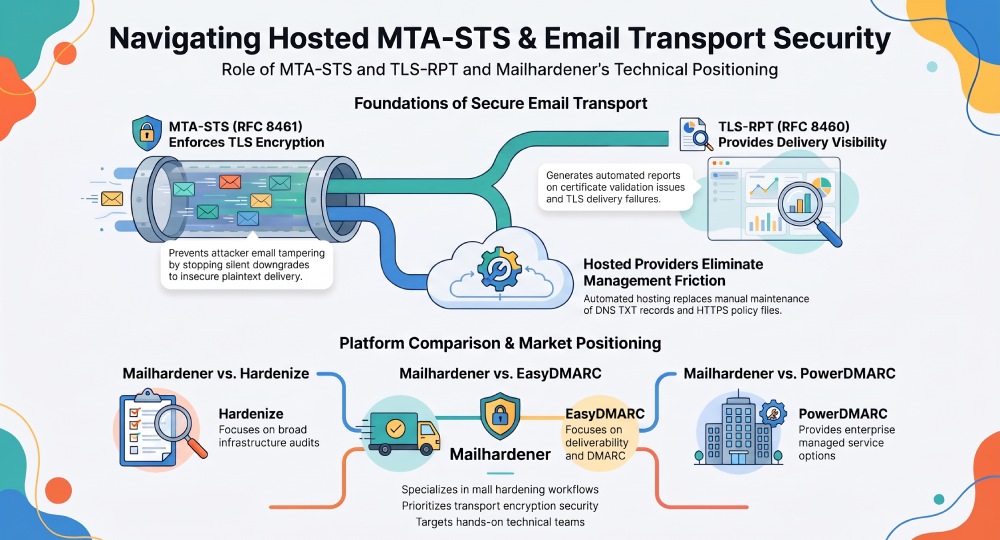
MTA-STS, short for Mail Transfer Agent Strict Transport Security, is an email security standard defined in RFC 8461 that tells sending mail servers to use TLS encryption when delivering mail to a recipient domain. In practical terms, MTA-STS helps enforce secure email transport over SMTP by preventing messages from being silently downgraded to plaintext delivery. It is especially valuable for phishing prevention, fraud prevention, and attack vector prevention because it reduces exposure to TLS downgrade attack and TLS stripping scenarios.
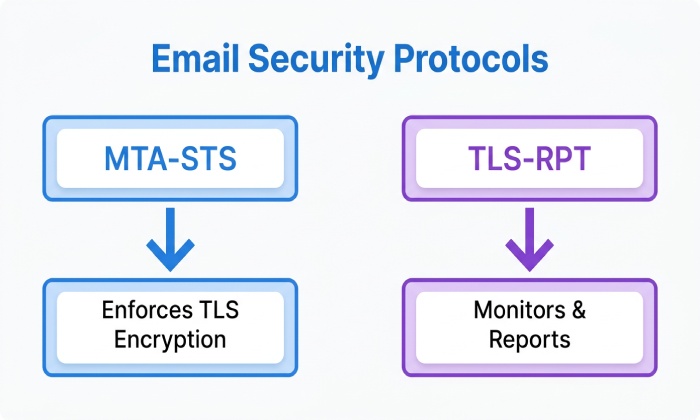
MTA-STS works alongside TLS-RPT, defined in RFC 8460, which provides SMTP TLS reporting about delivery failures, certificate validation problems, and policy enforcement issues. While MTA-STS defines the secure transport policy, TLS-RPT gives domain owners visibility into whether TLS encryption is actually working. Together, MTA-STS and TLS-RPT create an important layer of email security beyond SPF, DKIM, and DMARC.
MTA-STS, DANE, TLSA, and DNSSEC in Context
MTA-STS is often compared with DANE, which uses DNSSEC and TLSA records to authenticate mail server certificates. DANE and TLSA provide strong cryptographic assurance, but DANE depends on DNSSEC adoption, which remains uneven among commercial domains and non-commercial domains. MTA-STS, by contrast, is easier to deploy for organizations using Google Workspace, Microsoft 365, Microsoft Exchange Online, or cloud server infrastructure managed by an ESP.
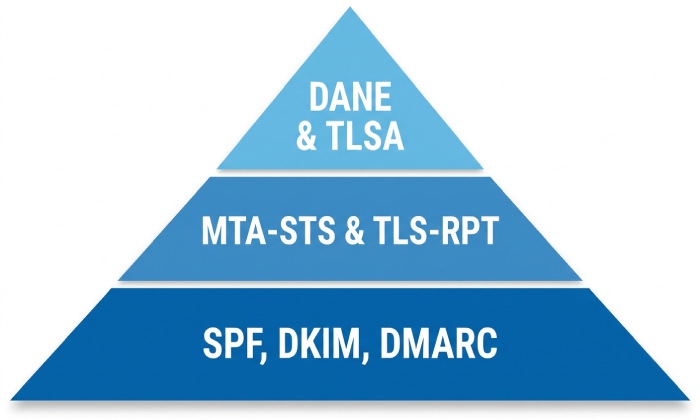
A mature email security program may use SPF, DKIM, DMARC, MTA-STS, TLS-RPT, DANE, and TLSA as part of a defense-in-depth strategy. SPF validates sending infrastructure, DKIM validates message integrity, DMARC aligns email authentication results, MTA-STS enforces TLS encryption, TLS-RPT supports encryption monitoring, and DANE with TLSA can strengthen secure email delivery where DNSSEC is available.
Why Hosted MTA-STS Is Operationally Useful
Self-hosting MTA-STS requires publishing a TXT record, maintaining a policy file at a specific HTTPS endpoint, managing certificate validation, and ensuring policy updates do not create delivery problems. Hosted MTA-STS removes much of this operational burden through managed policy hosting, automated domain monitoring, and reporting dashboards.
For technical teams, a hosted MTA-STS provider is useful because it centralizes email security, authentication monitoring, DMARC reporting, TLS-RPT analysis, and policy compliance. This matters when an organization has multiple subdomain configurations, third-party senders, and a mix of trusted sender platforms. Without domain monitoring and authentication monitoring, misconfigured SPF, DKIM, or MTA-STS records can hurt deliverability, inbox placement, and sender reputation.
Mailhardener Overview: Core Features, Positioning, and Ideal Users
Mailhardener, available at mailhardener.com, positions itself as a focused mail hardening platform for organizations that want stronger email security without building their own monitoring stack. It covers MTA-STS, TLS-RPT, SPF, DKIM, DMARC reporting, BIMI, DANE, TLSA, and related security standards in one dashboard. The company is associated with Braedon in The Hague, Netherlands, with references to Caballero Fabriek and Caballero Fabriek - unit 18 appearing in business context.
Mailhardener is particularly relevant for small business email security, SaaS companies, MSP teams, and technical teams that want precise domain monitoring rather than a generic deliverability suite. It supports authentication monitoring for SPF policy, DKIM policy, and DMARC policy alignment, while also helping with phishing prevention, fraud prevention, impersonation protection, and unauthorized sender detection.
Core Capabilities for Email Authentication and Transport Security
Mailhardeners core value is that it combines email authentication and secure transport visibility. It helps teams monitor SPF, DKIM, DMARC, MTA-STS, TLS-RPT, DANE, and TLSA from a single operational view. DMARC reporting includes aggregate reports through rua reports and can support forensic reporting concepts such as ruf reports where available, although many providers limit forensic reporting due to privacy and availability constraints.
Policy Hosting and Reporting Workflow
For hosted MTA-STS, Mailhardener helps create and maintain the MTA-STS policy file, the required TXT record, and TLS-RPT endpoints. This policy hosting approach is useful because MTA-STS errors are easy to miss until a recipient domain or sending platform reports delivery problems. Mailhardeners dashboard supports policy enforcement review, encryption monitoring, certificate validation checks, and ongoing domain monitoring.
Mailhardener vs. Hardenize: Policy Hosting, Reporting, and Security Monitoring
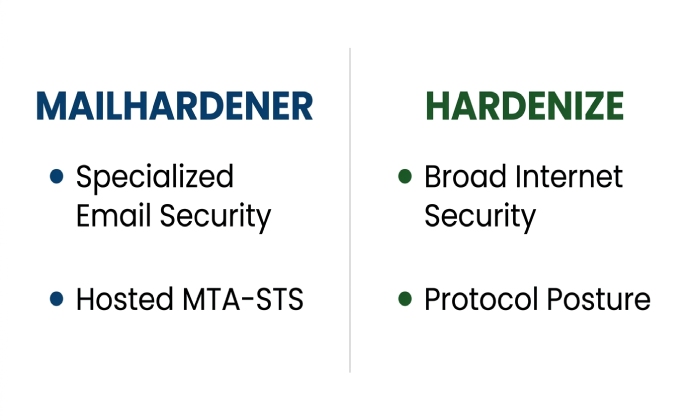
Hardenize is known for broad internet-facing security assessment, including TLS, DNSSEC, certificates, and protocol posture. It is valuable for security standards benchmarking and technical audit work. However, Mailhardener is more specialized around email security, hosted MTA-STS, DMARC reporting, TLS-RPT, SPF, DKIM, DANE, TLSA, and authentication monitoring.
Where Hardenize may appeal to security engineers who want broad domain and infrastructure analysis, Mailhardener is designed for mail hardening workflows. That difference matters. A security team may use Hardenize to test TLS configuration and DNSSEC status, while using Mailhardener for ongoing domain monitoring, MTA-STS policy hosting, TLS encryption reporting, email authentication, phishing prevention, and fraud prevention.
Hosted MTA-STS and TLS-RPT Comparison
Mailhardeners advantage is operational email focus. Its hosted MTA-STS functionality simplifies policy file management, policy updates, and SMTP TLS reporting through TLS-RPT. The platform is built to explain whether MTA-STS policy enforcement is working, whether TLS encryption is failing, and whether secure email delivery is affected.
Hardenize and Mailhardener offer different approaches to domain and email security monitoring. When comparing the platforms, evaluate their documented support for certificate validation, DNSSEC, DANE, TLSA, hosted MTA-STS, TLS reporting, SPF, DKIM, and DMARC reporting. The right choice depends on your organization’s security requirements, monitoring needs, and preferred workflow.
Mailhardener vs. EasyDMARC: Deliverability Tools and Compliance Coverage
EasyDMARC is often compared with Valimail, dmarcian, GlockApps, Mailflow Authority, and Mailhardener because it focuses heavily on DMARC reporting, SPF, DKIM, BIMI, and deliverability workflows. EasyDMARC has strong appeal for organizations prioritizing DMARC policy deployment, inbox placement, sender reputation, and compliance-oriented email authentication.
Mailhardener, by contrast, leans deeper into secure email transport and technical domain monitoring. Its coverage of MTA-STS, TLS-RPT, DANE, TLSA, SPF, DKIM, and DMARC reporting makes it especially relevant for teams that want both email authentication and TLS encryption assurance. EasyDMARC may be attractive for organizations looking for broad compliance coverage and guided DMARC adoption, while Mailhardener may better suit technical teams focused on mail hardening, hosted MTA-STS, secure transport, and encryption monitoring.
Deliverability, Compliance, and Provider Ecosystem Fit
For deliverability teams, EasyDMARCs value lies in simplifying DMARC reporting, aggregate reports, SPF policy management, DKIM policy checks, BIMI readiness, and sender reputation workflows. It may pair well with Postmaster Tools, GlockApps, Blacklists monitoring, and ESP diagnostics.
For infrastructure-focused teams, compare Mailhardener’s documented support for MTA-STS, TLS-RPT, DANE, TLSA, and email authentication. If API access, developer tools, multi-domain management, auditor access, MSP features, or priority support are important, verify which capabilities are available and whether they depend on the selected plan. Before choosing a provider, review its current pricing, trial or evaluation options, and hosted MTA-STS capabilities. Confirm that each shortlisted service supports the specific policy hosting and TLS reporting features your organization needs.
Mailhardener vs. PowerDMARC: Enterprise Features and Managed Services
Mailhardener and PowerDMARC offer email security capabilities designed to help organizations manage email authentication and improve domain protection. Their platforms can be evaluated based on features such as SPF, DKIM, DMARC reporting, MTA-STS support, TLS reporting, and options for managing multiple domains.
Enterprise Control vs. Managed Support
Organizations with in-house IT or security teams may prioritize detailed configuration controls, domain monitoring, and visibility into email authentication and secure mail transport. When evaluating Mailhardener, review its current support for hosted MTA-STS, TLS reporting, SPF, DKIM, DMARC, DANE, and TLSA to determine whether it meets your technical requirements.
Organizations that prefer additional implementation assistance may also consider PowerDMARC’s available managed services and partner offerings. Relevant evaluation criteria include multi-domain management, reporting capabilities, onboarding support, and tools for progressing toward an appropriate DMARC policy.
Both platforms should be assessed against your organization’s technical requirements, team resources, and budget before choosing a solution.
Where Mailhardener Stands Out
Mailhardener offers email security features that organizations can evaluate when implementing secure email transport and email authentication. Its hosted MTA-STS capabilities can help simplify policy hosting and management, including publishing the required DNS TXT record and maintaining the policy file under RFC 8461.
When combined with TLS Reporting (TLS-RPT), defined in RFC 8460, MTA-STS can help administrators review reported TLS delivery failures, certificate validation problems, and policy-related issues. The visibility available depends on the reporting data received and the provider’s supported features.
Mailhardener also documents support for email security technologies such as DANE and TLSA. Organizations using DNSSEC can evaluate these capabilities alongside SPF, DKIM, DMARC, and BIMI as part of a broader email security strategy. Each technology serves a different purpose, so the appropriate combination depends on the organization’s infrastructure, security requirements, and monitoring needs.
General Manager
General Manager of DuoCircle. Product strategy and commercial lead for AutoSPF's 2,000+ customer base.
LinkedIn Profile →