Publishing SPF Alone Isn't Enough: Make Authentication Work

Quick Answer
Publishing an SPF record alone does not guarantee email authentication. Organizations must fix duplicate records, manage DNS lookup limits, authorize legitimate senders, and align SPF and DKIM with DMARC to strengthen email security.
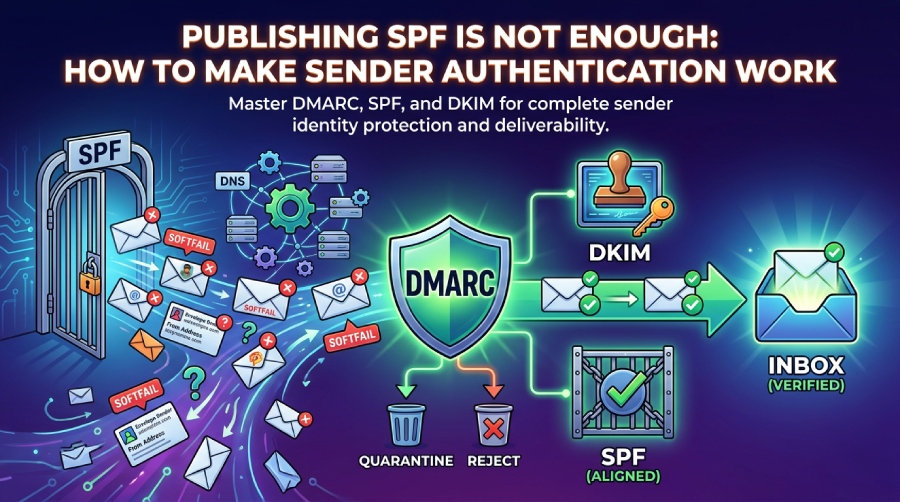
Executive takeaway
Publishing SPF does not prove that sender authentication works. Duplicate records and excessive DNS lookups can prevent usable SPF results. Softfail, however, is a policy choice—not a configuration error. SPF authenticates the envelope sender domain; DMARC connects authentication to the From address readers see. Inventory senders, maintain one evaluable SPF record, and deploy aligned DKIM alongside an appropriate DMARC policy. Simplify dependencies before considering segmentation or maintained flattening. Measure authentication outcomes and enforcement separately from record publication.
Your SPF record exists. Does it actually work?
Publishing an SPF record completes a configuration task; it does not prove that sender authentication works. Receivers must be able to evaluate the record, authenticate intended senders, and connect authentication to the relevant identity.
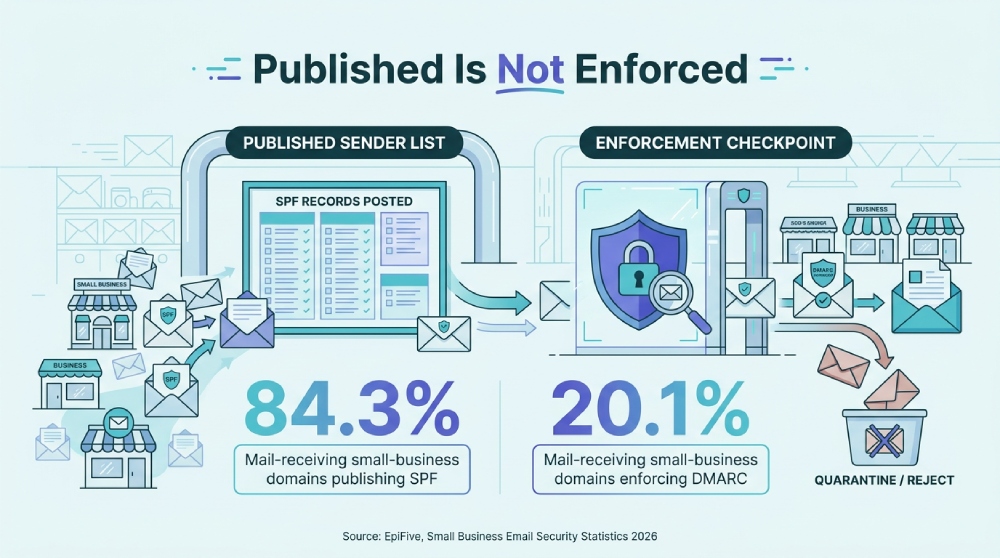
The supplied summary of EpiFive’s 2026 small-business study illustrates why publication alone is insufficient. Among 4,830 mail-receiving domains, 84.3% published SPF, while 20.1% enforced DMARC through quarantine or reject policies.
These percentages measure different controls, not successful and failed versions of the same control. Their difference is not an SPF failure rate. Neither figure establishes how individual messages authenticate, and neither represents every domain on the internet.
SPF, short for Sender Policy Framework, identifies servers authorized to send for a domain. It normally checks the envelope sender domain, which can differ from the From address readers see. AutoSPF’s coverage review describes this distinction and the complementary role of DMARC.
A useful authentication review therefore asks three separate questions:
- Can receivers evaluate the record? It must satisfy syntax requirements and remain within SPF’s evaluation limits.
- Does it authorize the intended senders? Its authorizations should match the services actually sending organizational mail.
- Does authentication protect the visible sender identity? DMARC requires successful authentication aligned with the visible From domain.
Configuration errors and policy choices need different responses. Duplicate SPF records can invalidate evaluation, while nested provider dependencies can exceed the lookup budget. A record ending in ~all, or softfail, is not automatically broken.
The objective is usable authentication, not merely detectable records. Keeping evaluation, authorization, and alignment separate makes both adoption statistics and operational checks more informative.
Source: EpiFive, Small Business Email Security Statistics 2026
Why SPF adoption numbers tell different stories
SPF adoption figures depend on which domains researchers count and what they test. A publication rate measures presence. A validity rate needs a clear definition before it can support stronger conclusions.
The March 2026 Tranco-based scan, summarized by AutoSPF, reportedly found valid SPF on 56.0% of 5.5 million domains. This is a reported result for a popularity-ranked domain cohort, not an estimate for all businesses or email-sending domains.
By contrast, EpiFive’s 2026 study reports 84.3% SPF publication among 4,830 mail-receiving domains. Those domains form a subset of 6,129 small-business domains examined across eleven countries. Its denominator therefore selects businesses with an identifiable email role rather than popularity-ranked websites.
Sampling offers a plausible explanation for some of the difference, but its contribution cannot be quantified here. Measurement definitions also differ. Three distinctions are essential:
- Publication: Does the domain publish an SPF record in DNS, the system storing domain configuration?
- Syntax validity: Does that record follow SPF’s formatting and language rules?
- Successful evaluation: Can a receiver complete the check for a particular message without an evaluation error?
Successful evaluation does not necessarily produce a pass: a completed check can identify an unauthorized sender. Conversely, acceptable syntax does not guarantee that all dependencies can be evaluated within protocol limits.
The Tranco reporting illustrates this ambiguity. Alongside the valid-SPF headline, AutoSPF’s account reports lookup-limit violations affecting 4.8% of SPF-enabled domains. The supplied evidence does not reconcile those classifications. Validity might refer to syntax or another narrower test, but that interpretation remains unconfirmed. The 56.0% figure should therefore not be relabeled as reliably working SPF.
Repeated coverage does not provide independent confirmation. AutoSPF and gaidme’s adoption overview summarize the same underlying DMARCguard scan for the 5.5-million-domain finding. Counting them as separate measurements would exaggerate the evidence base.
Regional comparisons face additional uncertainty. The supplied material attributes high EU adoption to JRC email-security assessments, but does not establish the measurement year and population adequately. Those findings cannot serve as a verified 2026 EU-wide benchmark.
Keep the results separate rather than averaging them. Each percentage needs its population, measurement date, denominator, and test definition. Operationally, the strongest measurement is one that demonstrates authentication for the organization’s actual senders.
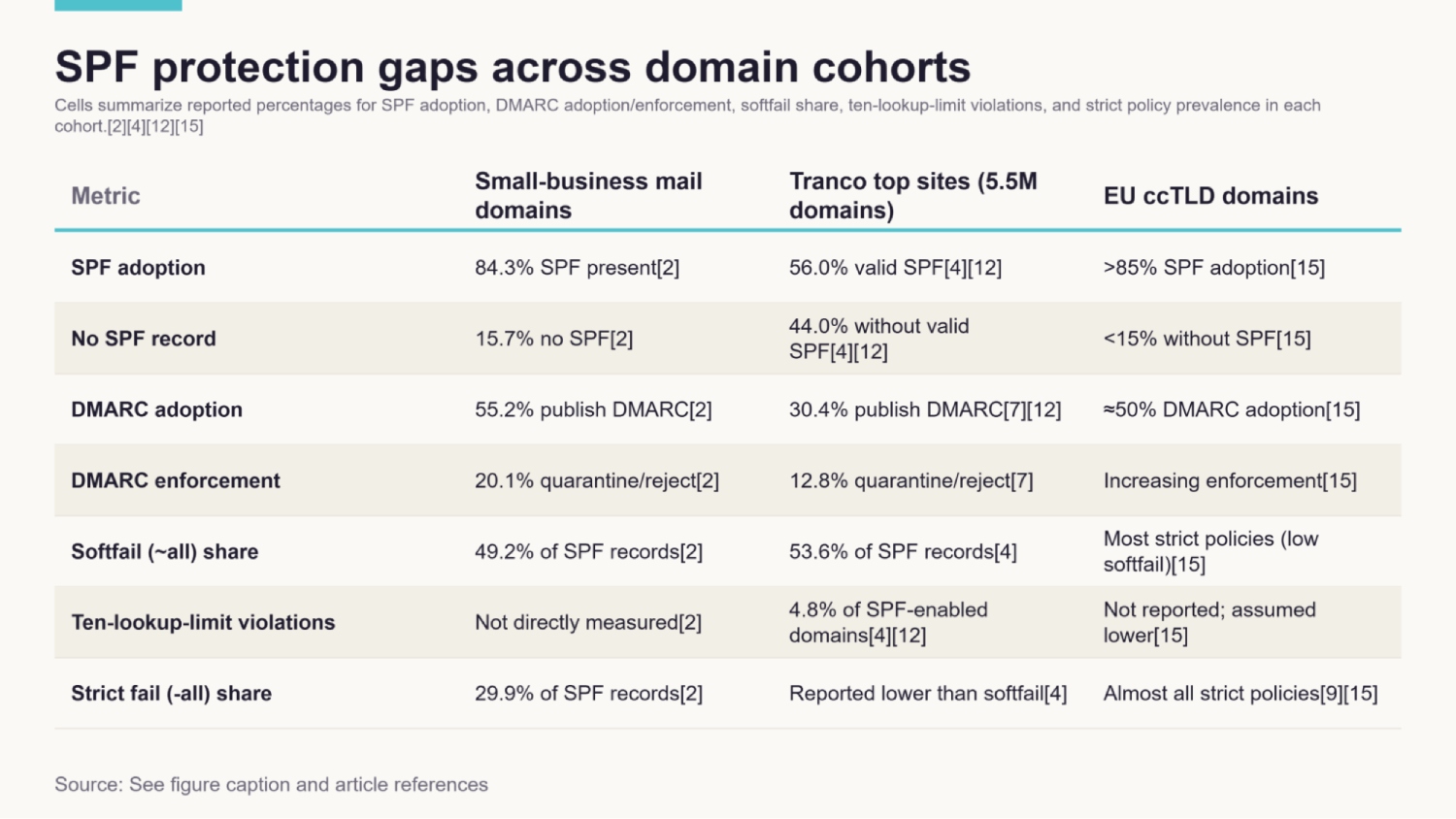
This table compares SPF and DMARC adoption, softfail prevalence, and ten-lookup-limit violations across small-business mail domains, a broad Tranco top-sites cohort, and EU ccTLD domains, highlighting how publication and protection diverge by population. Method: Values are taken directly from EpiFive’s small-business study, DMARCguard’s 5.5M-domain Tranco scan as summarized by AutoSPF and Gaidme, and JRC technical reports on EU email standards.[2][4][12][15] The table groups metrics to show relative strengths and weaknesses without averaging across fundamentally different samples.
What SPF checks—and what it leaves to DMARC
SPF checks whether a connecting mail server may send for the envelope sender’s domain. It does not directly authenticate the From address readers see. AutoSPF’s overview describes this DNS-based authorization model; it is explanatory commentary, not the protocol specification.
The envelope sender is used during mail transport, including for returning delivery failures. Its domain can differ from the visible From domain. An SPF pass alone therefore cannot establish that the displayed sender is authentic.
For a typical message, the receiver retrieves the envelope domain’s SPF TXT record, beginning with v=spf1. It evaluates the connecting server’s IP address against the record’s rules. Mechanisms describe matching tests; qualifiers specify the result when a mechanism matches.
- Mechanisms can identify addresses through
ip4andip6, or reference another domain’s policy through include. - Qualifiers specify pass (
+), fail (-), softfail (~), or neutral (?). An omitted qualifier means pass. - all matches any address. Placed last, it supplies the result for senders not matched earlier.
Receivers evaluate mechanisms in order until a match determines the result or evaluation otherwise ends. The principal outcomes distinguish authorization decisions from evaluation problems:
- Pass: The evaluated domain authorizes the connecting IP.
- Fail: The domain explicitly identifies the IP as unauthorized.
- Softfail: The domain considers the IP probably unauthorized, without making the stronger fail assertion.
- Neutral: The domain makes no authorization assertion.
- None: No applicable SPF policy was found.
- Temporary error: A transient problem prevented evaluation.
- Permanent error (
permerror): A configuration or evaluation-limit problem prevented a usable result.
These results inform receiver decisions; they do not determine delivery by themselves. In particular, -all produces fail for unmatched senders, not an unconditional rejection command.
DMARC connects authentication to the visible From domain. It requires an aligned pass from SPF or DKIM, not necessarily both. The supplied gaidme authentication review describes this combined authentication model.
DKIM provides a separate route through a cryptographic signature associated with a signing domain. For DMARC, the signature must verify and its domain must align with the visible From domain. Strict alignment requires identical domains; relaxed alignment permits domains sharing the same organizational domain.
An aligned DKIM pass can satisfy DMARC when SPF fails or returns an error. If neither method supplies an aligned pass, DMARC fails. A published quarantine or reject policy then guides receiver handling; p=none requests neither action. Authentication results, domain-owner policy, and final delivery decisions remain distinct.
Two SPF records are not better than one
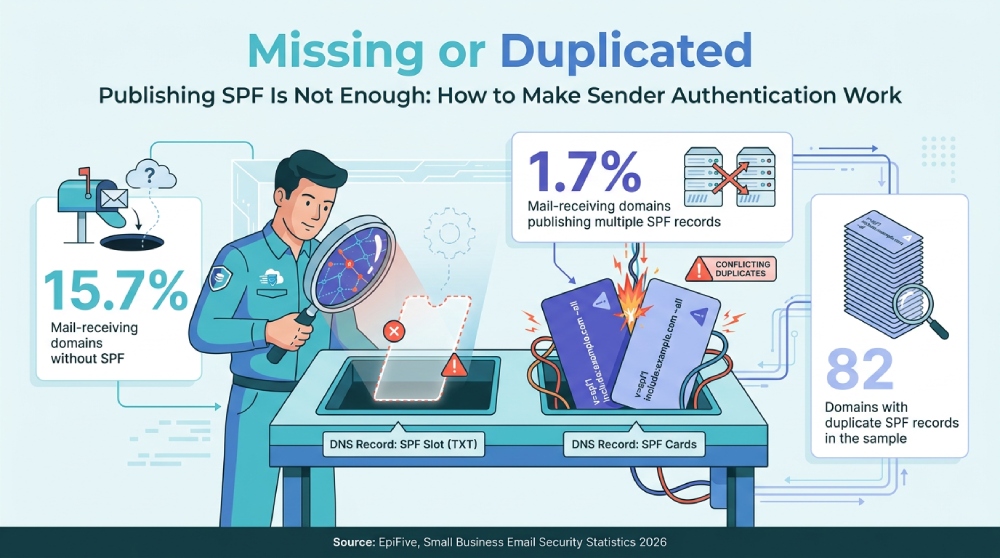
A second SPF record can break authentication rather than strengthen it. The supplied account of EpiFive’s 2026 study identifies 82 domains publishing multiple SPF records. They represented 1.7% of its 4,830 mail-receiving domains—not all small businesses or the internet.
Duplicates can arise when teams implement providers’ setup instructions independently. For example, one administrator adds a productivity suite’s policy, while another adds a marketing platform’s policy. Both begin with v=spf1, leaving competing SPF records at the same domain name.
SPF requires one policy record at each evaluated domain name. Receivers should not choose whichever record they prefer or combine separate policies. This restriction concerns multiple SPF records, not unrelated TXT entries used for service verification or other purposes.
Consolidation requires a configuration review, not concatenation of complete provider instructions:
- Inventory authorized senders. Identify every service and server using the affected domain. Confirm requirements with service owners.
- Review existing authorizations. Retain current services and remove confirmed obsolete entries.
- Build one coherent record. Combine necessary mechanisms under one
v=spf1declaration and choose the policy ending deliberately. - Check nested lookups. Evaluate provider dependencies, not just the includes visible in the replacement record.
- Validate production sending. Confirm that only one SPF record remains and test legitimate mail from each identified service.
Removing duplicates does not guarantee successful evaluation. The gaidme authentication review also identifies lookup-limit violations as a source of permanent errors. Consolidating providers can expose that separate problem rather than resolve it.
Assign responsibility for reconciling provider instructions before DNS changes. The goal is one maintained, evaluable policy—not merely one remaining text entry.
Source: EpiFive, Small Business Email Security Statistics 2026
Softfail is a policy choice, not automatic protection
Softfail is a policy choice, not broken SPF. The March 2026 Tranco scan, summarized by AutoSPF, reportedly found ~all on 53.6% of SPF-enabled domains. That measures published policy, not rejection rates or demonstrated protection against spoofing.
The policy figure should retain that denominator: SPF-enabled domains, not all 5.5 million domains scanned. It shows softfail prevalence but cannot explain administrators’ reasons for choosing it.
The final all mechanism applies when no earlier mechanism matches. Its qualifier expresses the domain’s position on those remaining sources:
~all: softfail. The source is probably unauthorized. This does not require rejection or guarantee spam-folder placement.-all: fail. The source is explicitly unauthorized, but receivers retain their own handling policies.?all: neutral. The domain makes no authorization assertion. Neutral is neither a pass nor an explicit authorization failure.+all: pass. Every source reaching this mechanism receives an SPF pass, positively authorizing otherwise unmatched IP addresses.
Softfail can reflect deliberate caution during deployment. An incomplete inventory may omit billing systems, support platforms, or occasional notification services. Forwarding can also change the server connecting to the final receiver, creating an SPF mismatch. A stricter ending changes the result for that unlisted server; it does not resolve the mismatch.
Caution should nevertheless have a defined purpose and review point. Administrators should investigate missing senders, examine forwarded traffic, and test alternative aligned authentication. The prevalence statistic cannot distinguish deliberate staging from an unattended default.
Neither softfail nor fail supplies the SPF pass required by DMARC. Changing ~all to -all does not establish alignment or enable enforcement for the first time. Aligned DKIM can satisfy DMARC under either ending; without an aligned pass from either method, DMARC fails.
EpiFive’s reported protection criteria accept either ~all or -all alongside enforced DMARC. Its 2026 study also identifies at least one +all configuration. These should not be treated as equivalent policies: +all can supply an SPF pass to an otherwise unauthorized source. If that authenticated domain aligns, the message can also satisfy DMARC through SPF.
Choose the qualifier deliberately, but assess protection through sender coverage, alignment, and receiver handling—not the final character alone.
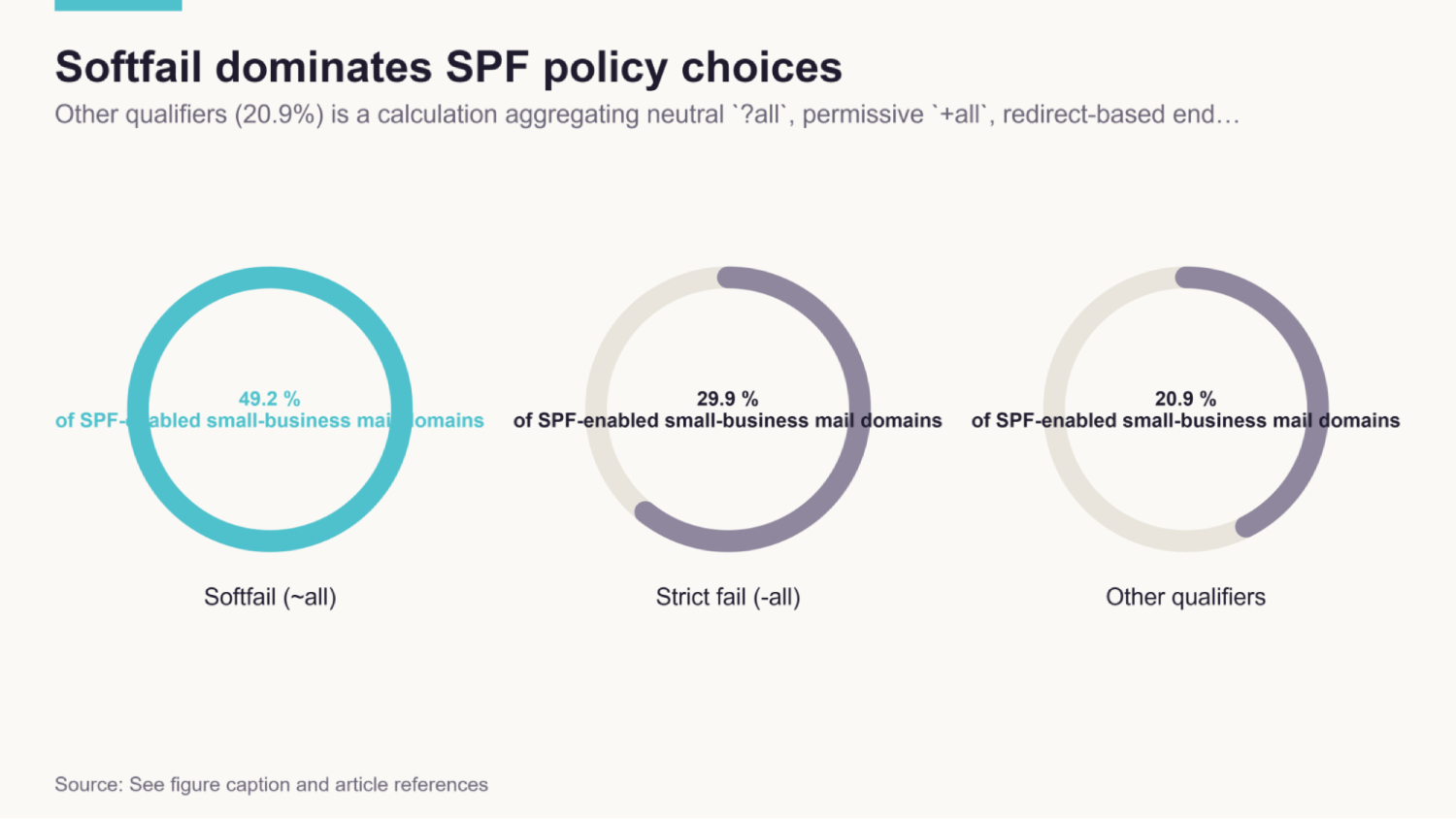
Radial segments show the distribution of SPF endings among small-business mail domains, highlighting how softfail accounts for nearly half of policies while strict fail remains a minority choice. Method: Percentages for softfail and strict fail come directly from EpiFive’s SPF results table.[2] The “other qualifiers” segment is calculated as 100% minus the sum of softfail and fail shares, capturing neutral, permissive, redirect, and anomalous configurations.
The hidden lookup budget behind a simple TXT record
A short SPF record can conceal substantial DNS dependencies.
- An include references another domain’s policy, which may contain further includes.
- The visible TXT record therefore reveals only part of the receiver’s evaluation work.
SPF limits evaluation to ten DNS-lookup-causing terms, including relevant terms in nested records. The supplied AutoSPF configuration overview identifies provider dependencies as a route to exceeding that limit. Counting only top-level includes misses this complexity.
The budget applies to particular mechanisms and the redirect modifier when evaluation reaches them:
- include evaluates another domain’s SPF policy; its nested terms share the budget.
- a checks addresses associated with a hostname.
- mx checks addresses associated with mail servers.
- ptr performs reverse-name checks.
- exists tests whether a specified DNS name has an address record.
- redirect continues evaluation using another domain’s policy when applicable.
By contrast, ip4, ip6, and all do not consume this ten-term budget.
- Record length and lookup cost are therefore different measurements.
- A longer list of explicit addresses can require fewer DNS-dependent terms.
The budget is not a count of network packets.
- A mechanism can require several DNS operations, and caching changes network activity.
- Administrators need to examine evaluated terms and dependencies rather than infer compliance from packet counts.
Evaluation order also matters.
- A sender matching an early mechanism may pass without reaching later dependencies.
- Another sender using the same domain may follow a longer evaluation path and exceed the limit.
- For example, three visible provider includes can require substantially more than three counted terms once their nested policies are evaluated.
Exceeding the budget produces permerror, a permanent evaluation error.
- It is neither proof of malicious sending nor an ordinary SPF fail.
- Legitimate messages can encounter it because the policy cannot be evaluated within the protocol’s constraints.
Gaidme’s summary of DMARCguard’s March 2026 Tranco scan reports 4.8% lookup-limit violations among SPF-enabled domains, affecting 148,655 domains. These are reported figures from the same measurement, not independent findings or a count calculated here from rounded percentages.
That domain-level result is not a message-level failure rate.
- The supplied evidence lacks enough evaluation-path detail to determine how often particular senders encounter errors.
- It also does not establish which organizational changes caused the configurations.
Provider changes nevertheless create a plausible maintenance risk.
- Adding a sending service introduces dependencies, while providers can change nested policies without altering the organization’s own TXT record.
- Review nested terms after service changes and periodically between them.
- Test representative sending addresses, and record which providers consume the budget.
A record that evaluates successfully today is not a permanent guarantee. Treat lookup capacity as an ongoing configuration constraint rather than a publication check.
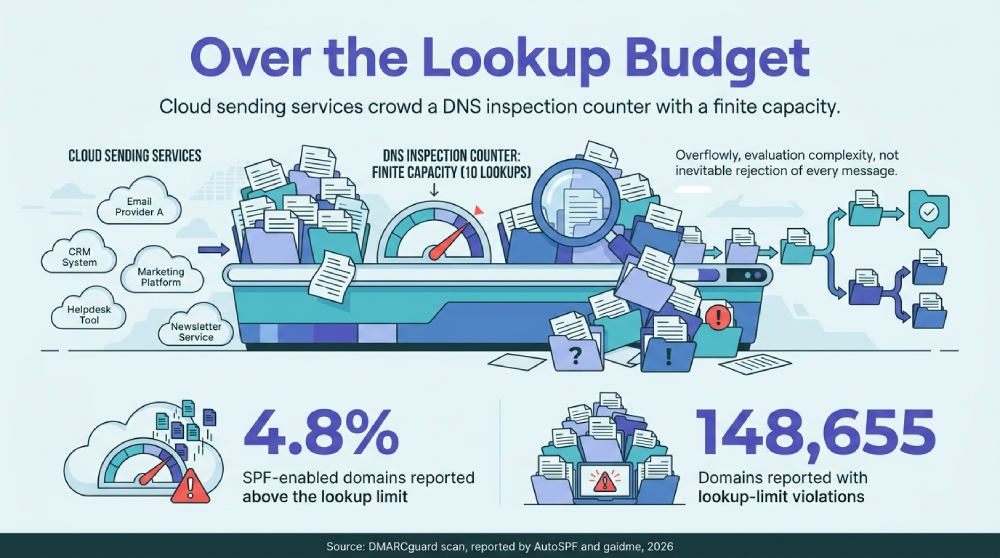
Source: DMARCguard scan, reported by AutoSPF and gaidme, 2026
Connect SPF repairs to DMARC and delivery outcomes
SPF repair should be judged through message authentication, not merely a successful DNS check. The next questions are whether legitimate messages pass DMARC and what policy applies when they fail.
The supplied EpiFive 2026 study reports that 20.1% of 4,830 mail-receiving domains used DMARC quarantine or reject policies. Another 44.8% lacked DMARC altogether. These describe domain configurations in that cohort, not the proportion of messages protected.
Missing DMARC and monitoring-only DMARC are different operational states. A domain without DMARC publishes no DMARC handling policy. A domain using p=none can support observation through configured reporting, but requests neither quarantine nor rejection. The supplied DMARC adoption review distinguishes monitoring from enforcement.
Monitoring can help identify legitimate services and investigate failures before policy changes. It does not guarantee message acceptance: receivers can still filter under their own rules.
The important deployment question is which mechanism supplies each sender’s aligned pass. A message with SPF permerror can still pass DMARC through valid, aligned DKIM. A DKIM pass without alignment is insufficient. If SPF is the only aligned path and it breaks, legitimate mail can fail DMARC under an enforced policy.
Thus, broken SPF does not switch DMARC enforcement off. It can instead expose legitimate messages to the published failure policy. Repair should restore reliable authentication while preserving other working paths.
Delivery consequences require separate evidence. The gaidme authentication analysis associates configuration errors with authentication failures and delivery concerns. However, the supplied material establishes no measured inbox-placement improvement from repairing SPF. No percentage uplift is justified.
Use a before-and-after operational check:
- Establish a baseline. Sample legitimate mail from each service and record SPF, DKIM, and DMARC outcomes.
- Check alignment. Identify which mechanism supplies the DMARC pass rather than stopping at a standalone authentication pass.
- Repeat after changes. Confirm that repaired SPF evaluates successfully and previously working senders still pass DMARC.
- Investigate delivery separately. Review rejection notices and filtering complaints without assuming authentication explains every outcome.
Use these observations to guide movement from monitoring to quarantine or rejection. The decision should rest on demonstrated sender coverage, not simply a repaired record.
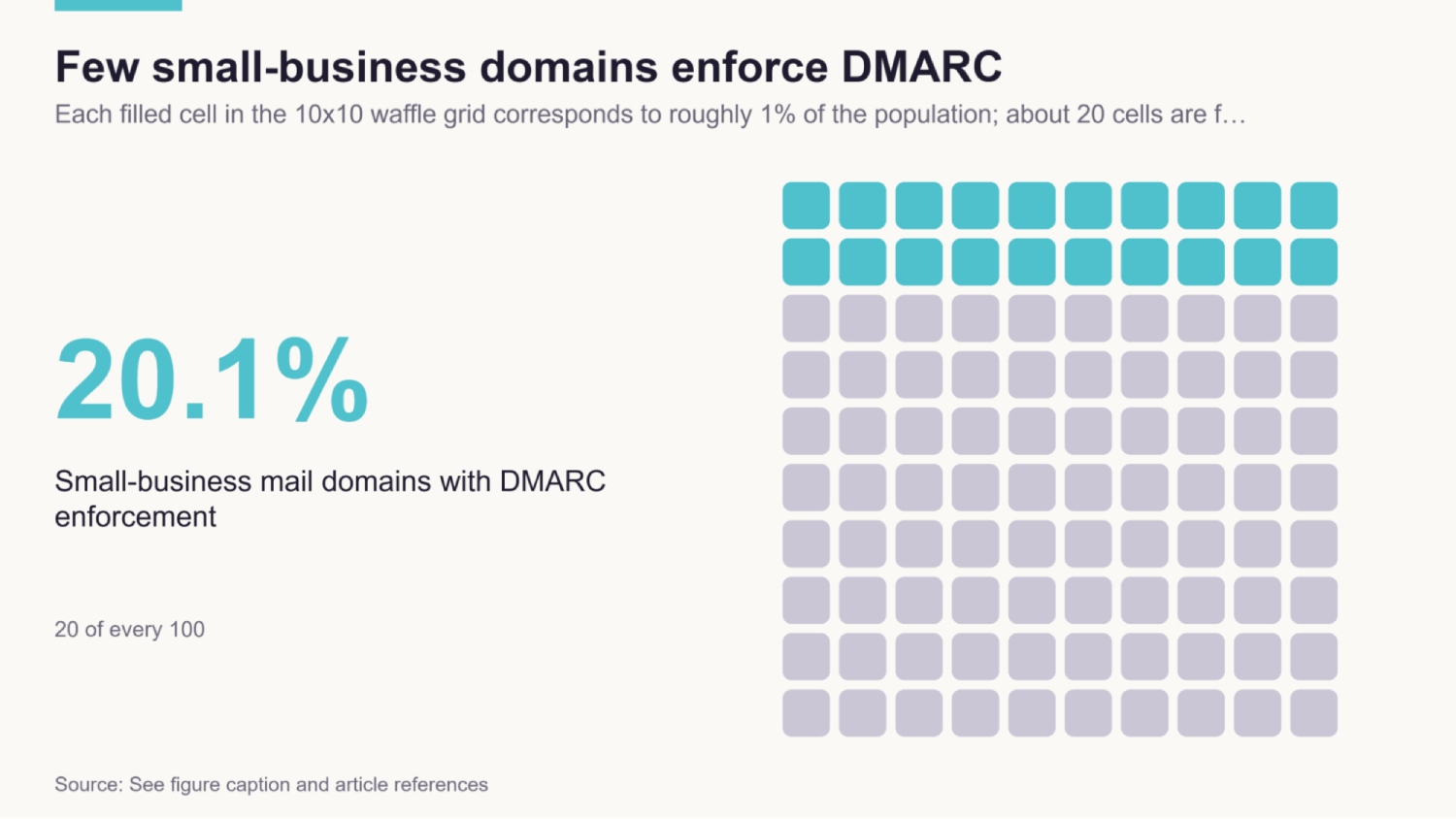
A waffle chart shows that only about one-fifth of small-business mail-receiving domains enforce DMARC, visualizing the enforcement gap that leaves SPF misconfigurations unmitigated. Method: The 20.1% enforcement figure is taken directly from EpiFive’s summary of DMARC policies among 4,830 mail-receiving small-business domains.[2] The waffle grid represents this share as filled squares out of a 10x10 matrix for visual emphasis.
Simplify first, segment next, flatten when needed
Repair the actual failure before choosing a tool. Duplicate records, excessive lookups, and missing alignment require different remedies. Flattening addresses lookup pressure; it cannot replace sender discovery or establish DMARC protection.
Start with an inventory of every sending service, including rarely used applications. Record its business owner, purpose, envelope sender domain, and observed authentication results. Use this inventory to consolidate required authorizations into one SPF record at each evaluated domain name.
Prune includes for retired services, but confirm retirement with the owner first. Infrequent billing or payroll messages can be easy to overlook. Then recalculate lookup consumption, including nested provider dependencies.
If active senders still create excessive complexity, consider dedicated subdomains for distinct mail streams. Marketing and transactional services can use separate policies rather than sharing one crowded record. Segmentation gives each evaluated domain its own lookup budget, but providers must actually use the intended envelope sender domain.
Changing the visible From address alone does not move SPF evaluation to a new subdomain. Test actual messages and preserve DMARC alignment under the applicable settings. Keep aligned DKIM signing in scope as an additional authentication path.
Flattening becomes an option when legitimate dependencies still exceed the budget after practical simplification and segmentation. It replaces suitable lookup-dependent authorizations with resolved address lists expressed through ip4 and ip6. The supplied configuration-management discussion presents flattening as a management approach, not a measured guarantee of improved delivery.
The trade-off is less evaluation complexity but greater maintenance responsibility. Provider includes can reflect infrastructure changes; flattened snapshots must be refreshed. Stale lists can omit legitimate new addresses or retain obsolete authorizations.
Automation can help maintain those lists, but accountability remains necessary. Establish who investigates refresh failures, reviews unexpected address changes, and restores a working configuration. Validate that the replacement preserves the intended authorization behavior rather than assuming any flattened list is equivalent.
The flattening figure should distinguish lookup remediation from unrelated authentication repairs. Its topic is reduced evaluation dependencies, not proof of complete protection:
- Excessive lookups: simplify first, then assess segmentation or maintained flattening.
- Duplicate records: consolidate legitimate authorizations and remove competing SPF records.
- Missing DMARC or incorrect alignment: repair those controls separately.
Roll out changes in stages with a saved configuration and rollback plan. Test representative messages from every active provider, checking SPF results, envelope domains, and DMARC alignment. Assign an owner for provider changes, address refreshes, and periodic sender reviews, whether management is internal or outsourced.
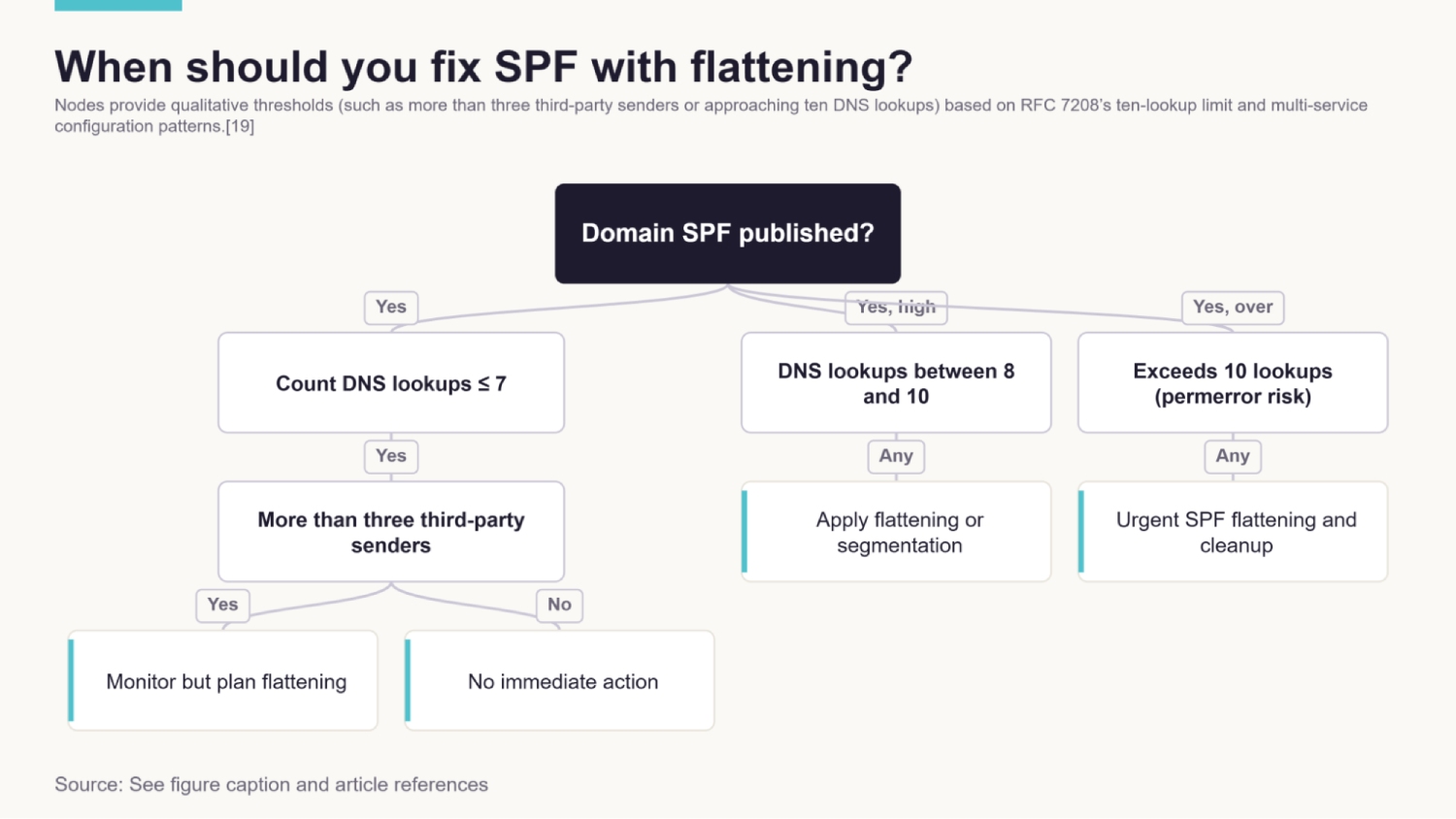
A practical decision guide that helps administrators decide whether their domain’s SPF record likely needs flattening or segmentation based on the number of authorized services and DNS lookups consumed. Method: This decision tree is inferred from best-practice guidance on SPF’s ten-DNS-lookup limit, recommendations to prune unused includes, and the observation that multi-service environments commonly exceed the limit unless flattening or segmentation is applied.[18][19] It is not drawn from a single measured dataset but from protocol rules and configuration advice.
Buy better visibility—and measure working protection
Buy visibility into authentication outcomes, not another count of published records. The evidence distinguishes publication, evaluation, alignment, and enforcement. A useful tool should make those distinctions visible rather than collapse them into one status indicator.
Use a domain-level scorecard with an accountable owner and dated evidence:
- One usable SPF record. Check syntax, duplicate records, and authorization of intended senders. Record evaluation errors separately from policy choices such as softfail.
- Managed dependencies. Expose nested terms, flag lookup-limit risks, and track provider changes.
- Known senders. Maintain an approved service inventory and investigate unfamiliar sources rather than automatically authorizing them.
- Aligned authentication. Measure legitimate-mail outcomes by sending service, so an aggregate pass rate cannot hide a failing application.
- DMARC enforcement. Track quarantine and reject policies separately from monitoring, alongside legitimate-mail failures.
Evaluate prospective tools against these tasks using your own domains and representative messages. Ask vendors to demonstrate dependency tracing, sender identification, alignment reporting, change alerts, and exportable evidence. These are evaluation criteria, not proven guarantees of delivery or spoofing prevention.
For flattening services, examine address-refresh behavior and failed-update handling. Ask when dependency removal or stream segmentation would be preferable. Automation should clarify maintenance responsibilities rather than conceal them behind a successful status check.
Commercial forecasts provide context, not evidence of control effectiveness. Compared with the paper’s 2026 operational focus, Dataintelo’s market report supplies a historical 2024 estimate of $1.52 billion and a 2033 forecast of approximately $7.18 billion. Neither measures observed 2026 spending, and market expansion does not demonstrate better authentication outcomes.
For ongoing reviews, track usable-record coverage, unresolved errors, unknown senders, aligned legitimate-mail rates, and enforcement coverage. Pair those measures with remediation deadlines and checks after sender or DNS changes.
The finish line is not a published TXT record or a purchased platform. It is a maintained authentication system whose legitimate senders continue to work—and whose failures someone owns.
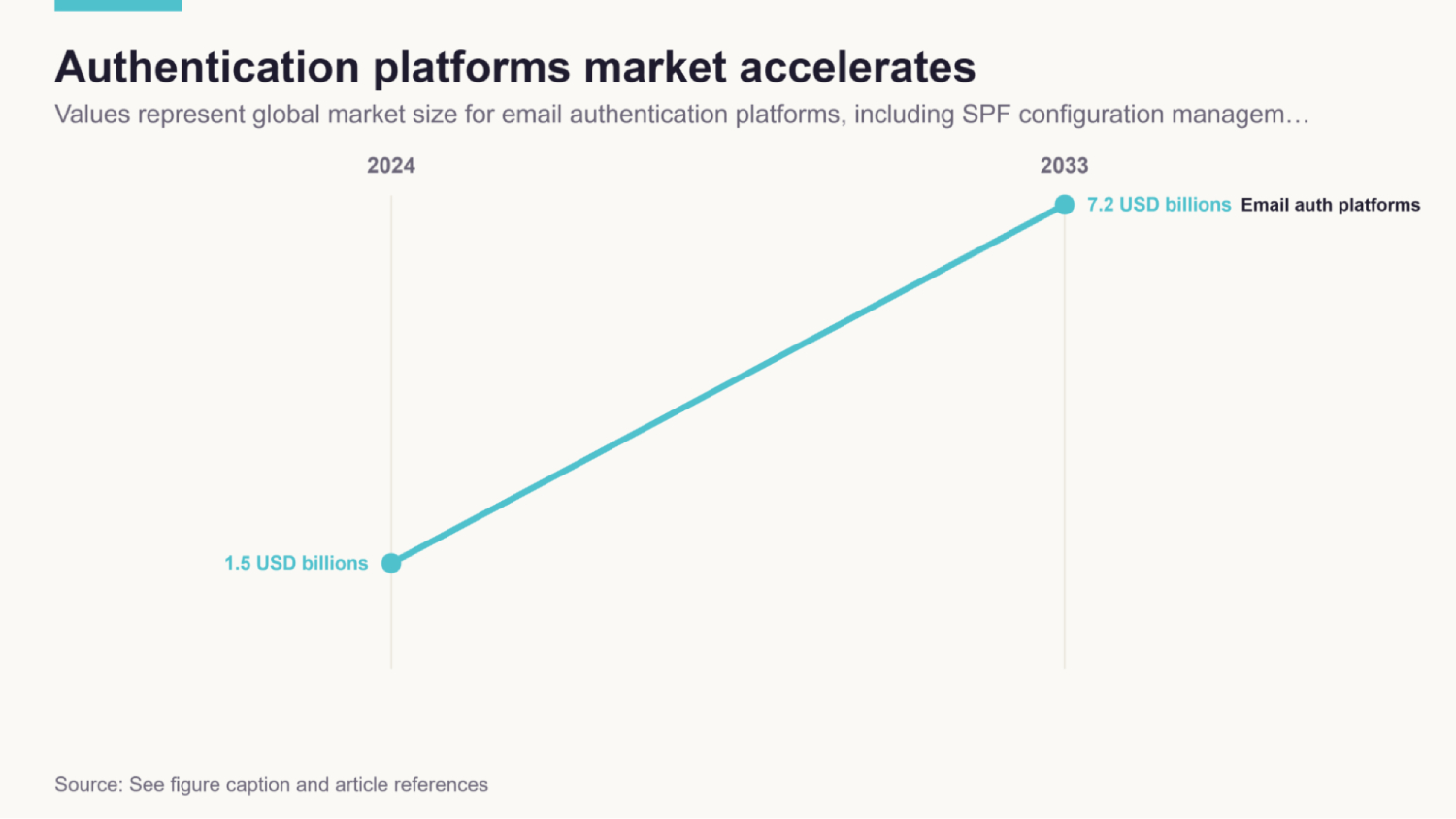
A slope visualization of the email authentication platform market size from 2024 to 2033 illustrates rapid growth in spending on tools that manage SPF, DKIM, and DMARC configurations. Method: Market size data for 2024 and the 2033 forecast are drawn from Dataintelo’s email authentication platform report, which reports a 2024 baseline of USD 1.52 billion and a 2033 forecast of USD 7.18 billion with an 18.7% CAGR.[16] Values are used directly without interpolation.
Limitations
- The studies cover different domain populations and use inconsistent definitions of validity. Their percentages cannot establish a global adoption rate or a message-level failure rate.
- Verification is limited to the supplied evidence summaries and source metadata. Original study methods and source passages were not supplied for independent inspection.
- Several articles repeat the same underlying scan, rather than providing independent confirmation. Regional measurement dates and some classification definitions remain unresolved.
- The supplied report overstates several protocol effects. Softfail does not disable DMARC, SPF failure does not guarantee rejection, and aligned DKIM can satisfy DMARC despite SPF errors.
- The remediation recommendations are operational guidance, not interventions with demonstrated causal effects on delivery or fraud. Market forecasts do not establish security effectiveness.
References
- Small Business Email Security Statistics 2026 (Study)
- SPF Is Nearly Universal—Until You Change the Sample
- SPF Is Widespread: Email Protection by Domain Coverage
- Email Authentication: 2024 SPF, DKIM, DMARC Adoption Rates
- The State of DMARC Adoption in 2026:938000 Domains …
- Email communication security standards - an analysis of uptake in …
- Email Authentication Platform Market Research Report 2033
- SPF Configuration Management Market Share Trends and Demand …
General Manager
General Manager of DuoCircle. Product strategy and commercial lead for AutoSPF's 2,000+ customer base.
LinkedIn Profile →